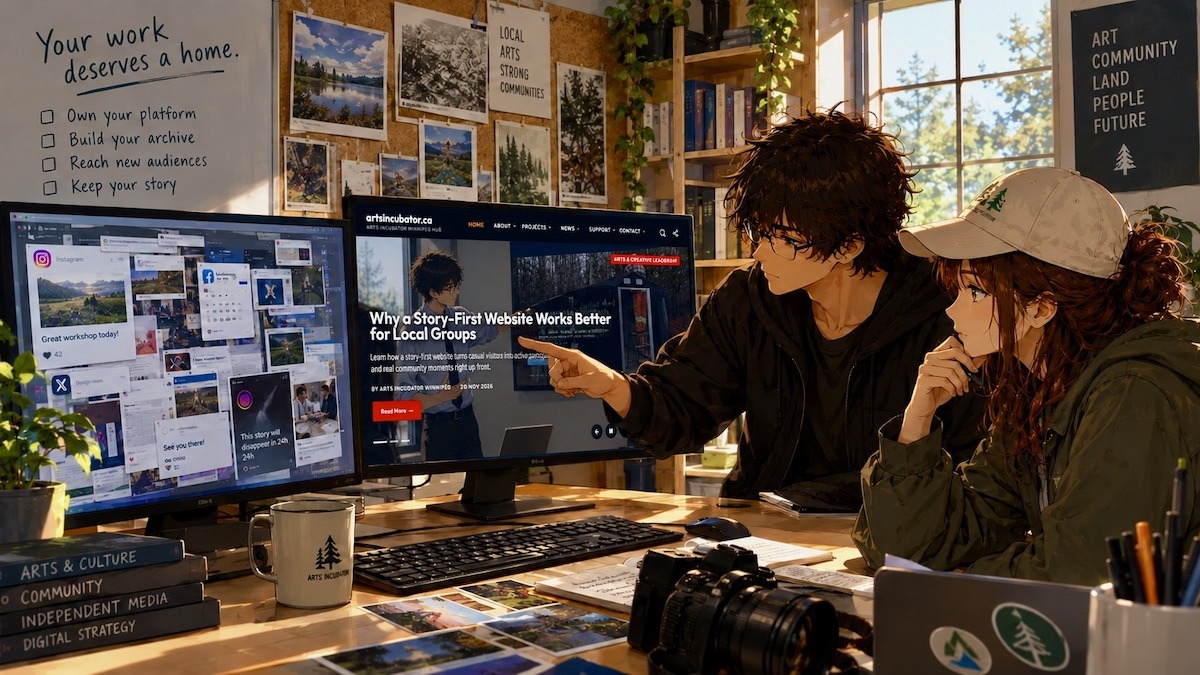
Why a permanent digital home is absolutely essential for any organization.
Most small arts organizations don’t struggle for lack of artistic quality. They deliver strong workshops, meaningful exhibitions, and transformative residencies. The breakdown happens afterward. Without a reliable system to document the work, a vital program is reduced to a buried Instagram post, a rushed flyer, or an outdated webpage that hasn’t been updated in ages.
We’ve seen web sites for organizations where their last post was made five years ago.
When a program leaves no permanent record, the organization loses its leverage. The common reflex is to post more frequently on social media, but volume doesn’t solve an infrastructure problem. Without an owned, centralized home for your work, every new project starts from zero.
The risk of rented attention
For over a decade, arts administrators were advised to build audiences on social media. Many small teams still spend hours every week feeding third-party platforms where algorithms change without notice and outbound links are routinely suppressed.
Relying on rented reach has always been precarious, and the discovery landscape is shifting again. Search engines and AI tools increasingly summarize information directly for users rather than sending traffic to external links. These systems rely on structured, plain text sitting on functional, indexable websites. An exhibition that existed solely on an expired social media story is effectively invisible to search engines, researchers, and future audiences.
For organizations operating in Northern Manitoba, rural Alberta, Northwestern Ontario, or smaller communities across the country, the stakes are even higher. Without major local media coverage or a dedicated communications staff, a searchable, current website is often the primary bridge between regional artists and the broader public.
The strategic value of an owned platform
A functional digital platform consists of four assets the organization controls outright: a fast website, an active events calendar, a public archive, and an independent mailing list. Anyone arriving via a search engine or a shared link should be able to understand within a minute who you are, what you produce, and how to engage next.
Beyond public visibility, this infrastructure serves three critical operational functions:
- Stronger funding applications: Grant reporting and funder updates are faster to assemble and far more credible when program histories, artist bios, and documentation are already organized and verifiable online.
- Institutional continuity: Small arts groups experience frequent board and staff turnover. A structured public archive ensures that organizational memory survives leadership transitions.
- Audience insulation: Social networks change ownership, lose users, or restrict organic reach. An independent domain and a direct mailing list protect your relationship with your audience regardless of platform volatility.
Stopping the subscription drain
Many nonprofits are locked into expensive, fragile web setups: proprietary page-builder licences, tiered plugin subscriptions, and recurring contractor fees whenever a routine update breaks the site. Individually, these expenses look manageable. Compounded over five years, they divert thousands of dollars away from artist fees and programming—while leaving the organization with zero equity. If the subscription stops, the archive disappears.
Breaking this cycle requires deliberate technical choices. Audit recurring software expenses, adopt open-source tools where they meet your needs, and store content in standard, exportable formats. Most importantly, ensure at least one person on your team understands how the site is structured so routine updates don’t require an external invoice.
A practical approach to AI
In building and maintaining our own platforms, we treat AI mostly as a back-end utility rather than a creative replacement. Sure, we like to use generated images, but that’s part of the fun and learning. Where all of this really comes in is that we use it to draft and troubleshoot code. And every line is reviewed, tested, and verified by a human before deployment. None of our public-facing pages generate automated answers for visitors.
AI can’t replace curatorial judgment or community trust, nor should it try. You’ve got to work on it too. Its practical value lies in lowering the technical barrier to building custom, lightweight web infrastructure—allowing a small team to maintain tools they previously had to rent. Realizing that benefit, however, requires developing enough internal literacy to evaluate technical output critically.
Digital literacy as leadership
Arts administrators, communications people or volunteers don’t need to become software developers, but leadership does require asking sharp operational questions:
- Do we own our data, and can we export our archive cleanly if a vendor changes its terms?
- Can a staff member or volunteer update this site next month without specialized training?
- Is the site built on stable standards that will still function in five years?
- Does the layout meet basic accessibility standards for visitors using screen readers?
These are no longer minor IT details; they determine how your organization is found, funded, and remembered. If you’re looking to strengthen your digital foundation this year, start with four steps:
- Centralize your documentation: Make your website the primary archive for your programs, using social media strictly to drive traffic back to your domain.
- Audit your software spend: Tally every annual subscription tied to your web presence and evaluate open-source alternatives.
- Assign internal ownership: Designate one person on your team to understand how your website, domain, and mailing list connect.
- Publish in plain text: Document exhibitions, workshops, and artist rosters on standard, indexable webpages rather than burying text inside downloadable PDFs or social media graphics.
And the most important thing? Have fun with your platforms. We do!