Why Did the Moose Cross the Trans-Canada? Building a Retro Northern Arcade Game for the Fun of It
Anyone who has spent time driving along Trans-Canada highway knows the feeling. You’re winding past towering jack pines, sheer granite rock faces of the Canadian Shield, and stretches of prairie and open water. Your hands tighten slightly on the steering wheel because out here, wildlife crossing the road isn’t just a yellow diamond caution sign on the shoulder—it’s an everyday reality.
As part of our Fall and Winter programming, we decided to take that shared Northern Ontario experience and turn it into something playful. We set aside spreadsheets and serious agendas for a bit and asked ourselves a simple question: What would the classic 1981 arcade game Frogger look like if it grew up around Lake Superior and the forest?
The answer is Moose Crossing.
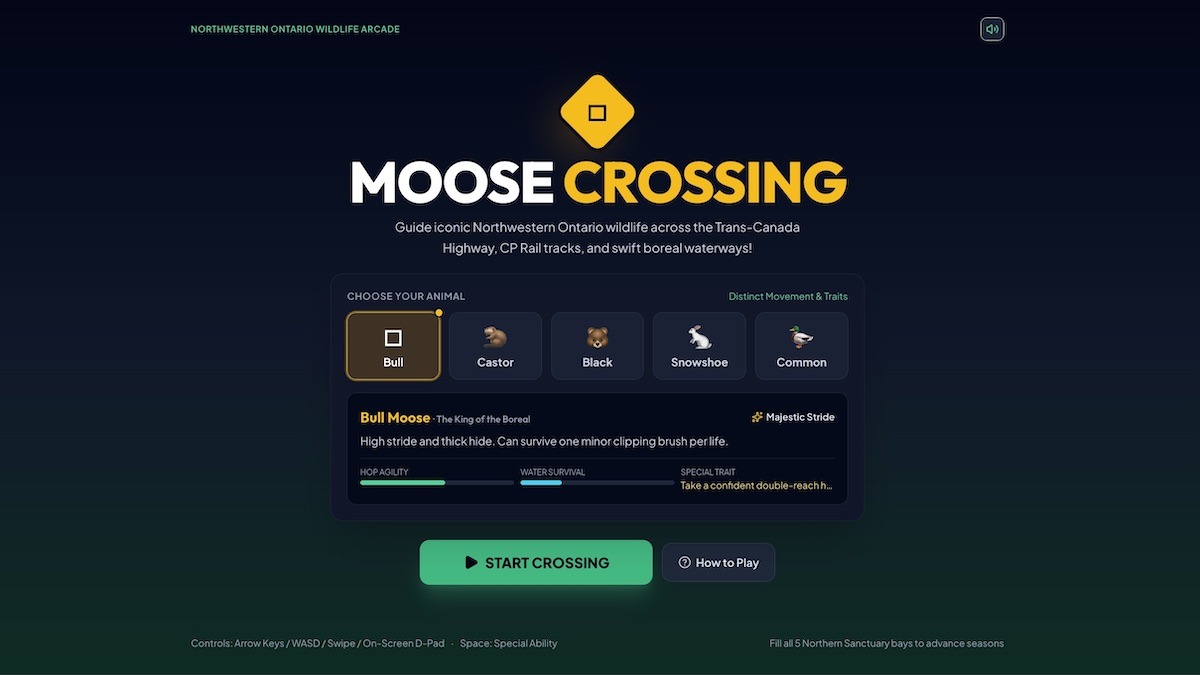
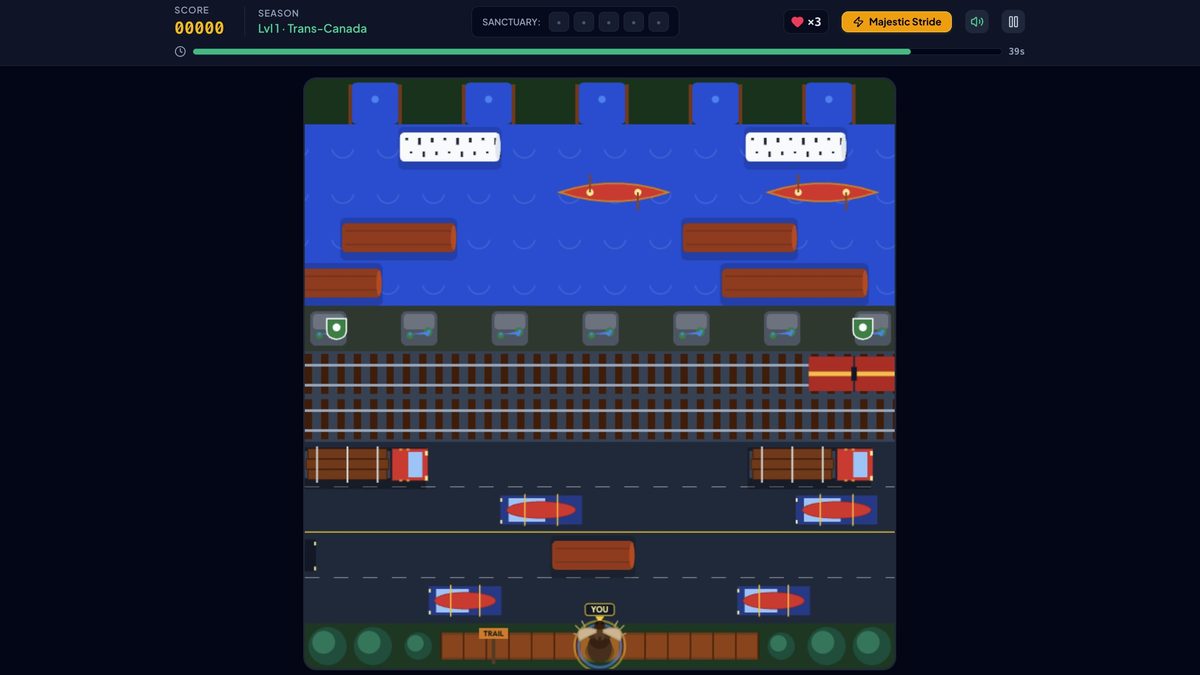
Instead of guiding an anonymous little green frog across a generic city boulevard, players take control of iconic Canadian wildlife trying to navigate the gauntlet of the North. Down at the bottom of the screen, you start in a quiet trailhead clearing. Ahead lies the Trans-Canada Highway, bustling with heavy logging trucks hauling freshly cut timber, RCMP cruisers, and pickup trucks carrying canoes lashed to their roof racks. Just past the road, you encounter the clattering rails of the Canadian Pacific and Canadian National freight trains. And if you make it across the tracks and over the rocky median outcrop, you still have to cross a rushing northern waterway filled with drifting birch logs and paddlers before reaching the safety of five sanctuary bays at the top of the shoreline.
Early on in the process, we realized that an 800-pound bull moose doesn’t move like a snowshoe hare, and a beaver shouldn’t panic the moment it falls into a river. So we began experimenting with different movement characteristics for each animal. The moose has a wide, deliberate stride and a bit of natural toughness to brush off glancing bumps. The beaver moves slower on dry pavement, but handles the river currents with ease and can dive below the surface. The snowshoe hare hops with lightning-quick reflexes, the black bear lumbers forward with sudden bursts of speed, and the common loon can flutter-glide over short water gaps while letting out that unmistakable, haunting northern call.
Is Moose Crossing a polished, triple-A gaming masterpiece? Far from it. It has its quirky moments, the pixel hitboxes will occasionally test your patience, and those freight trains definitely keep you on your toes. But building something polished was never the point.
The real joy of this project came from using game design as a creative sandbox. Games are unique because they blend so many disciplines at once: visual storytelling, sound synthesis, responsive user interfaces, logic puzzles, and simple psychology. Deciding how fast a cedar log should drift, synthesizing the sound of a train crossing bell using pure web audio oscillators, or figuring out how to make an arcade canvas scale naturally across a smartphone screen and a living-room laptop taught us more about interactive design than reading any manual ever could.
Too often, when we sit in front of modern digital tools, we treat them strictly as instruments of productivity. We build forms, organize files, and answer messages. Working on Moose Crossing reminded us of the magic of using these tools simply to tinker, laugh, and make something silly with friends and colleagues.
If you get a chance to take a turn at the controls, take your time, watch out for the timber trucks, and keep an ear out for the loons. And remember: out here in the forest, patience is everything. Should we keep building it, and enhance it? Let us know what you think by contacting us or drop us an e-mail at info@artsincubator.ca!