
PrairiesCan’s RAII calls for youth exposure to AI careers. The most valuable AI skill isn’t typing prompts — it’s understanding, testing and owning what gets built.
For most of the internet’s history, there was a clean line between the people who used software and the people who built it. On one side: everyone. On the other side: a specialist class with years of training, expensive tooling and job titles nobody’s grandmother could explain.
That line is dissolving. We’re increasingly reducing our dependence on things like subscription models, could-based hosting and other costs. And we’ve thought a lot about what replaces it. The answer, we think, is more interesting than “everyone can now code.” The answer is that a new kind of technical professional is emerging: someone who can direct AI tools with precision, audit what those tools produce, and take real ownership of working systems. Someone who builds, not just prompts.
We want more people — especially young people, especially in the Prairies — to become that someone.
What this work actually looks like
Let’s be honest about what AI-assisted development is, because there’s a lot of noise around it. It is not typing “make me a website” into a chatbot and publishing whatever comes back. That approach produces fragile, generic results, and any organization that bets its digital presence on it will regret it within a year.
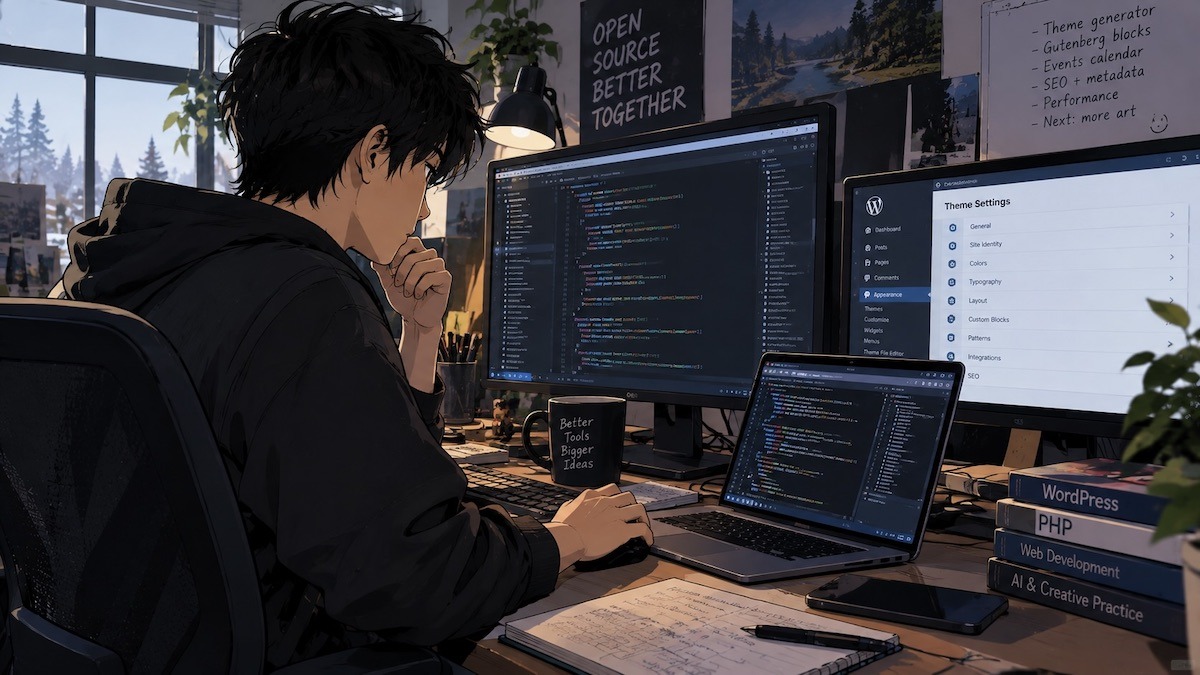
Real AI-assisted development looks more like this. You hold a clear picture of the whole system in your head — in our case, helped by the fact that the architecture lives in one organized, well-structured source. You describe a change precisely. The AI drafts the implementation across every layer the change touches: the template, the frontend styling, the editor styles, the interactive scripts. Then a human takes over. You read the generated code line by line. You check the escaping, the styling logic, the accessibility. You rebuild the theme, load the site in a local staging environment, and test against real content — real galleries, real multi-category posts, real event schedules. You catch what the AI got subtly wrong, because it always gets something subtly wrong, and you fix it yourself.
That’s the skill. Not the prompt — the audit. Not the generation — the judgment.
Our team includes artists, not career software engineers. Yet the people doing this work now read PHP fluently enough to modify it directly, trace a layout bug through several stylesheets, and know why a calendar archive needs its main heading restored for both accessibility and search engines. That knowledge didn’t come from a bootcamp. It came from working on a real system with real stakes, with AI compressing the research and boilerplate so the learning could focus on understanding.
Why this matters for the creative workforce
Findings from Statistics Canada, reveal that only 12 percent of Canadian businesses used artificial intelligence to produce goods or services between mid-2024 and mid-2025. Government analysts expect that number to creep up to 14.5 percent by mid-2026, a figure that international analysts say leaves the country well behind global economic peers.
Artists and cultural workers live inside digital systems whether they understand them or not. They publish on platforms that can change the rules overnight. They exhibit work in tools they don’t control. They promote events through algorithms that decide, on their behalf, who sees what.
Understanding how the systems work changes the power balance. A musician who can read code can evaluate a distribution platform’s terms differently. A festival organizer who understands structured data can make their event listings visible to search engines in ways that used to require a marketing agency. A small publisher who owns their publishing system can redesign their archive in an afternoon instead of waiting six weeks for a developer ticket.
This is what we mean when we talk about digital sovereignty — and it’s why we believe hybrid technical literacy is becoming as fundamental to creative careers as any traditional skill. The division between “creative people” and “technical people” was always partly an accident of tooling. The tooling just changed.
The youth opportunity — and why it needs new entry points
Now zoom out to the regional economy. Programs like PrairiesCan’s Regional Artificial Intelligence Initiative exist because Canada’s AI future shouldn’t be concentrated in a handful of coastal tech hubs. RAII’s ecosystem enablement stream is explicit about this: it includes support for incubators and not-for-profits to help young Canadians gain exposure to AI-related career opportunities. Inclusiveness — including youth aged 15 to 34 — is a stated priority area, and NFP-led projects can receive non-repayable funding covering up to 90% of eligible costs.
We think “exposure” deserves to be more than a campus tour or a webinar about prompt writing. Young people in Winnipeg, Edmonton, Regina, Saskatoon and the communities between them deserve entry points into AI work that are practical, local and grounded in projects with visible outcomes. That’s exactly what a working development environment provides.
Picture a mentorship built around our actual system. A participant gets a real task: an event sidebar widget’s date badge is misaligned on mobile. They open the source, find the events styling, study how the AI proposes a fix, evaluate it, test it in a local development environment, and ship it. Along the way they’ve touched responsive layout, WordPress widget architecture, visual QA methodology and code review. One task, several skills, real code, real deployment.
Multiply that across a structured curriculum — staging and deployment, accessibility, web performance, structured data, code review — and you have something genuinely valuable: young Prairie talent who understand AI as a production tool, not a magic trick.
And the demand side is real. Every small business, nonprofit and community organization adopting AI needs people who can bridge the gap between tools and outcomes. The region needs these hybrid technologists far more than it needs another cohort trained to click through no-code dashboards.
What we’re building toward
We’ve started mapping what a formal program could look like: workshops on programmatic sovereignty versus subscription dependency, technical clinics where partner organizations bring real problems, mentorship streams pairing young participants with working systems, and internships with outcomes funders can measure — sites launched, performance benchmarks hit, skills demonstrated. We also want to hear what others think.
None of this requires inventing anything. The curriculum is the workflow we already use. The case studies come from a system we’re running every day. The infrastructure is ours. What’s needed is structure, partnership and support — which is precisely what RAII’s ecosystem enablement stream is supposed to support.
The old path into technology ran through computer science degrees and big-city agencies. The new path can run through community organizations that have real systems, real code and a willingness to teach. We’re proud to be becoming one of them — and we’d rather share this than keep it to ourselves.
Because the question “who gets to build software?” has a new answer now. The honest version is: anyone willing to learn how to look the machine in the eye. We’d like to help a few hundred young people in the Prairies do exactly that.
Curious to learn more? Contact us. We’d like to hear what you think!
Do It Yourself!
Making WordPress work our way
We’ve been making changes to artsincubator.ca as our collection of stories, exhibitions and projects continues to grow. Along the way, we’ve been working on more than the website’s appearance, developing new tools, systems and ways to publish, manage and share our work.
Here’s a closer look at what we’re building and some of the ideas behind it.