Hidden regulatory powers and union standing gaps in Bill C-39 draw fierce opposition warning.
OTTAWA — Federal officials confirmed that cabinet could unilaterally expand forced, employer-triggered union mergers to any federally regulated industry across Canada without bringing legislation back to Parliament.
The little-noticed regulatory backdoor, alongside an omission that leaves targeted unions without guaranteed formal party status before the federal labour board, emerged during clause-by-clause scrutiny at the Legislative Committee on Bill C-39 on Monday, November 23, 2026 in Ottawa.
Why this matters now: unlike routine technical amendments to the Canada Labour Code, geographic certification rewrites how bargaining units are formed across federally regulated sectors—including ports, rail, aviation, telecommunications, and banking—and lets cabinet expand the mechanism by regulation rather than a new act of Parliament. For unions, employers, and workers, the change shifts power away from individual workplace votes toward centralized bargaining structures and executive discretion.
Bill C-39, known as the Building Canada Strong Act, is a sweeping federal omnibus bill introduced by Prime Minister Mark Carney’s government on September 21, 2026, containing over 300 clauses across more than a dozen federal statutes designed to fast-track major infrastructure projects, modernize trade corridors, and overhaul federal labour laws. While the government presents the bill as essential for economic security and attracting global investment, it has sparked nationwide protests and fierce opposition from labour unions, Indigenous nations, environmental advocates, and scientists.
Beyond West Coast Ports
Under clauses 306 and 307, two or more employers or the labour minister can apply to the Canada Industrial Relations Board (CIRB) to geographically certify multiple unions into a single bargaining unit. Under federal labour law, geographic certification groups multiple workplaces or bargaining agents in a region or sector under a broader bargaining framework rather than keeping bargaining strictly unit-by-unit, which supporters argue reduces fragmented disputes at major trade hubs.
Liberal MPs argued the measure addresses recurring West Coast port disruptions, with Liberal MP Madame Desrochers citing a strike impact of $10 billion in 13 days on farmers and workers.
Liberal MP Emma Harrison asked Employment and Social Development Canada director general Douglas Wolfe to explain the origin of the policy. “Can you tell me who recommended this and why?” she asked.
“This recommendation came out of the West coast industrial inquiry Commission that the government appointed a commission some time ago and the Commission made a number of recommendations and this was one of them,” Wolfe replied.
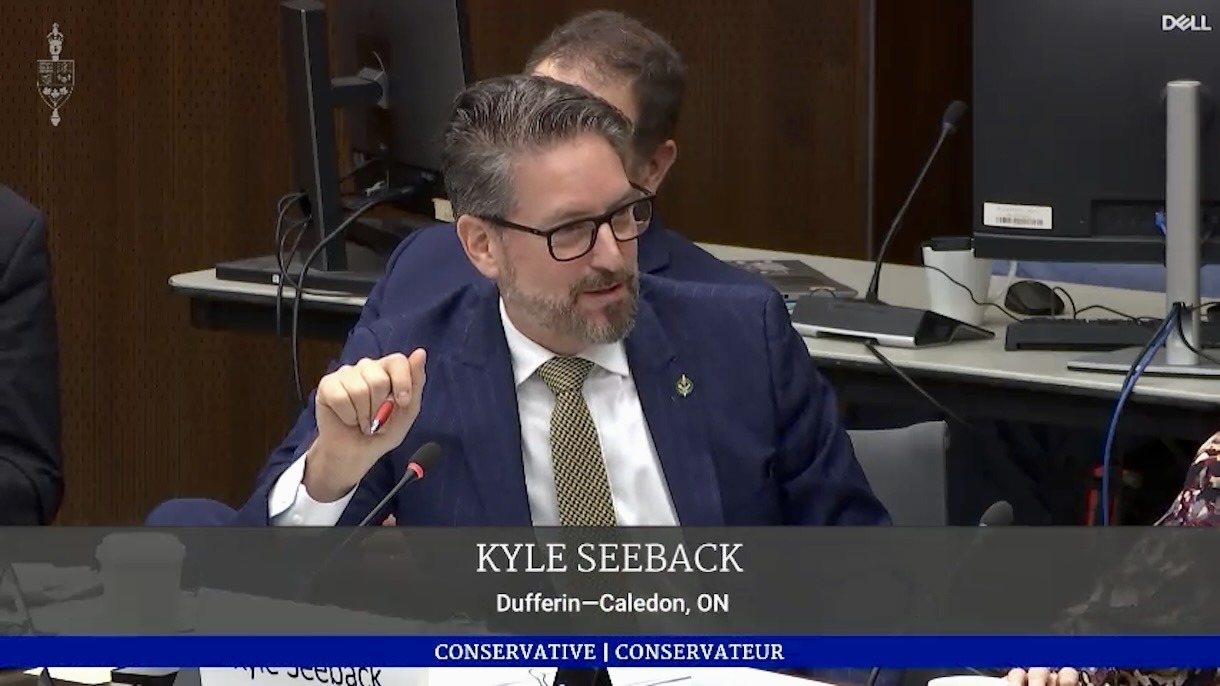
However, Conservative MP Kyle Seeback pressed Wolfe on critical discrepancies between the inquiry report by Vince Ready and Amanda Rogers and the actual text of Bill C-39. “So did the report suggest that the governor and council should be able to expand geographic certification to any industry in any part of the country, Mr. Wolfe?” Seeback asked.
“No, the report did not specifically provide that,” Wolfe answered.
Seeback also noted that while the commission explicitly recommended excluding Westshore Terminals and Trigon Pacific Terminals from a British Columbia-wide certification, Bill C-39 leaves them exposed. “But not excluded in the legislation?” Seeback asked.
“No, they are not,” Wolfe confirmed.
Governor-in-council regulations are cabinet-made rules issued on the formal advice of the Privy Council after a bill grants regulation-making authority, allowing governments to adjust scope or implement details without a full legislative vote. Although Wolfe stressed the government currently intends to limit the rule to longshoring, Seeback highlighted clause 307-1.1(b), which covers any other industry in any geographic area. “Which is not subject to a vote or a committee study. It’s done by governor in council. If the minister decides that they are going to expand geographic certification into any other industry in any other area of the country in fact that is just through regulation. It does not go through the House of Commons as part of legislation and it does not come to committee to be studied or debated. Is that correct?” Seeback asked.
“It would be done through regulations,” Wolfe replied.
Standing Trap and No Worker Vote
Conservative MP Tamara Kronis uncovered a second procedural gap in clause 307, contrasting it with Section 35 of the Canada Labour Code, which expressly gives affected unions a statutory right to make representations. When an employer or minister files an application without a union’s involvement, Kronis warned, affected unions are not guaranteed full formal status.
In tribunal practice, a formal party—often called a full or “capital-P” party—has guaranteed procedural rights such as receiving filings, calling evidence, and appealing decisions, whereas an intervener or “small-p” participant may only be allowed limited submissions at the board’s discretion. “If that entity does not name the union as some kind of respondent or some kind of capital P party in the application, is there anything in these rules that requires the union or that allows the union to be guaranteed the affected unions to be guaranteed to be a capital P party? We have no dispute here that they will be a small P party,” Kronis asked.
“So, to be clear, there’s nothing in the legislation that would require what you’re suggesting. That said, the board has a long history of creating processes that are fair and I think parties would see them as fair. And would provide for the opportunity for all interested parties to be able to have an opportunity to express their views,” Wolfe replied.
Opposition members repeatedly failed to insert worker safeguards. Conservative MP Dan Albas asked whether newly certified workers targeted by an employer application could ballot on keeping their union. “But do they get a vote?” Albas asked.
“No, you know that that’s not part of the process,” Wolfe answered.
Liberal MP Tim Louis defended leaving procedures to the CIRB rather than codifying rules in statute. “My concern with this conservative amendment is that then parliament, if this amendment passed, parliament would begin prescribing how independent expert tribunal must consider those proceedings. I believe we should establish the law and then allow CIRB to apply it using the expertise and independent process,” Louis said.
Six Conservative amendments requiring consultative votes, transition supports, and protections for smaller employers were defeated 6-5, as was an NDP amendment requiring worker consent. NDP MP Heather McPherson argued that “The government does not get to decide who represents a worker and nor do employers. It’s up to workers to determine,” while Bloc Québécois MP Gabriel Ste-Marie warned that “As I said, this is a direct attack on the freedom of association.”
Clauses 306 and 307 both passed by narrow 6-5 votes.