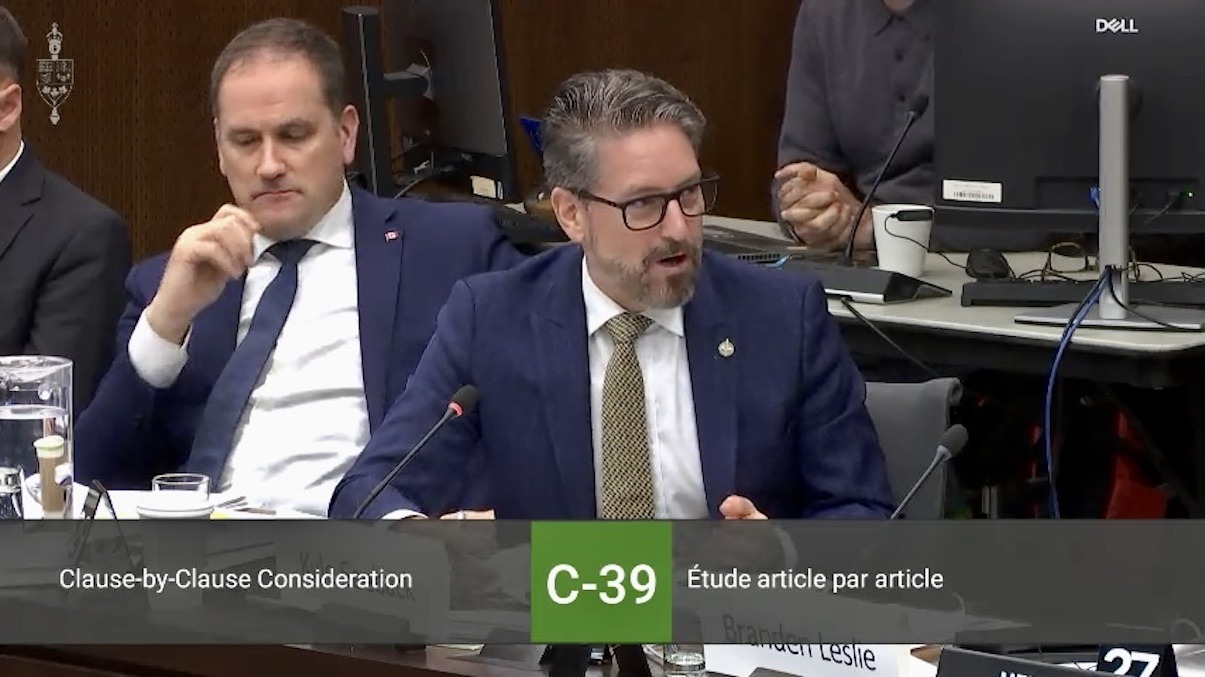
Contract-flipping limits, dismissed leak allegations, and shifting party alliances mark marathon Bill C-39 wrap-up.
OTTAWA — As the clock ticked past 100 hours of clause-by-clause scrutiny, a federal committee voted to protect airport workers from contractor turnover while leaving other federally regulated sectors uncovered, before ending in a sharp clash over a dismissed leak complaint.
Those overlooked disputes closed out eight days of marathon deliberations at the Legislative Committee on Bill C-39 on Monday, November 23 in Ottawa, culminating in a 10-1 vote to report the amended omnibus legislation back to the House of Commons.
Bill C-39, known as the Building Canada Strong Act, is a sweeping federal omnibus bill introduced by Prime Minister Mark Carney’s government on September 21, 2026, containing over 300 clauses across more than a dozen federal statutes designed to fast-track major infrastructure projects, modernize trade corridors, and overhaul federal labour laws. While the government presents the bill as essential for economic security and attracting global investment, it has sparked nationwide protests and fierce opposition from labour unions, Indigenous nations, environmental advocates, and scientists.
In Canadian parliamentary practice, omnibus bills bundle changes across multiple acts into a single piece of legislation. Supporters argue they allow cohesive policy packages to move efficiently, while critics contend they compress scrutiny over unrelated provisions across diverse portfolios such as infrastructure, trade, and labour.
Airport-Only Shield
Clause 310 introduces successor rights to stop “contract flipping”—where incoming service contractors reset workers’ seniority, wages, and vacation entitlements—specifically in aviation and airport services. NDP MP Heather McPherson moved amendments to extend the same guarantee to all federally regulated workplaces, warning privatization puts other workers at risk.
In Canadian labour law, successor rights ensure that when a business, operation, or service contract transfers from one employer to another, existing collective bargaining agreements, seniority, and worker protections carry over rather than resetting. Contract flipping often occurs in outsourced sectors such as airport security, baggage handling, cleaning, and food service when low-bid contractors replace incumbents.
“A change of contractor should not become a way to erase negotiated rights,” McPherson said, asking ESDC director general Douglas Wolfe: “Why would that not be appropriate to expand to all workers within federally regulated workplaces?”
“There is no fundamental problem with doing that, we just don’t see a problem within other industries,” Wolfe replied.
Liberal MP Emma Harrison asked Wolfe directly whether the department had identified contract-flipping abuses beyond airports. “To Mr. Wolfe, do you know of any other industries outside of airports where this is a problem?” she asked.
“We are not aware of other issues in other sectors at the moment that said, there is a regulatory power and regulation making power to be able to expand this to other industries if we learn that there could be a problem in the future,” Wolfe answered.
Conservative MP Kyle Seeback expressed sympathy for airport workers facing lost seniority but sided with Liberals to defeat the NDP expansion, citing a lack of committee study. “In principle this is a good change. With respect to the NDP amendment, I don’t know what the effect it would have if it is expanded to every federally regulated sector,” Seeback said. Only the Bloc Québécois backed the NDP motions.
Leak Ruling Sparks Friction
Once the final clause carried, the committee chair ruled on a days-old question of privilege raised by Conservative MP Branden Leslie, who alleged that confidential committee amendments had been leaked, prompting outsiders to call MPs’ offices about specific motions.
Under parliamentary procedure, a question of privilege allows an MP to argue that a development—such as a leak of confidential documents or interference with members’ duties—impedes MPs’ ability to carry out their parliamentary work. If a chair finds a prima facie case, meaning sufficient initial grounds to warrant examination, the matter can be brought before the House of Commons for further consideration; if not, the chair’s ruling stands unless overturned by a committee vote.
The chair rejected the complaint because no sources were named. “I cannot possibly find that there is even a prima facie case of a breach of privilege when the allegation is that an unnamed person was another unnamed person who was told by another unnamed person,” the chair ruled.
“We live and work in the city of Ottawa, probably about 80% of the information we hear on a day-to-day basis is gossip, hearsay, and unprovable, which is how I would categorize the information,” the chair added.
Conservative MP Dan Albas challenged the ruling, warning it failed to protect MPs’ rights and recalling a past budget leak that cost a parliamentary secretary their job. “This is a terrible second decision, I don’t believe it protects my rights, it certainly doesn’t protect Mr. Leslie’s rights, and when people phone offices with specific amendments asking, what are you doing in this particular amendment, that is one shade off of intimidation,” Albas said.
Leslie insisted the leak had occurred—”I have talked to people in and around this room who are well aware that that document was circulated, sent out, it got into many hands”—and urged the chair to warn ministerial staff against distributing confidential committee packages, though the chair’s ruling was sustained 6-4.
Shifting Political Alliances
The marathon wrap-up also exposed an unusual partisan realignment on labour policy. Bloc Québécois MP Gabriel Ste-Marie praised Conservative efforts to restrict Section 107 and protect worker votes, remarking: “I do not remember seeing the conservatives being more on the side of workers than the Liberals.”
Under federal labour law, Section 107 of the Canada Labour Code grants the minister of labour broad authority to refer disputes to the Canada Industrial Relations Board or take steps to promote industrial peace—a provision that has drawn sharp debate in recent federal labour disputes over how quickly the government can intervene in strikes or lockouts without a vote by workers.
Accusing the government of sliding toward an American-style labour stance, Ste-Marie added: “I have never seen a Liberal government as anti unionist as this current government.” Conservative MP Philip Lawrence framed the divide around parliamentary checks, noting “Conservatives put forward an amendment 57 parliamentary supremacy, the Liberals will always refer to the executive where we will stand up to the common people.”
Still, Conservatives ultimately joined Liberals in voting 10-1 to pass the amended bill—with Seeback casting what he called “A reluctant yes” and Ste-Marie casting the lone vote against.
The 10-1 vote to report the amended bill back to the House of Commons sends the legislation to the report stage, where members of Parliament can propose further amendments and debate the committee’s changes before a final vote on third reading. If passed by the House, the bill moves to the Senate for consideration and royal assent before becoming law.