Trade retaliation fears, drafting loopholes, and missing data dominate debate over expanded back-to-work powers.
OTTAWA — European labour groups have formally warned Canadian trade officials that Bill C-39’s expansion of ministerial back-to-work powers could breach the Canada-European Union trade agreement, compounding warnings from opposition MPs over a legal drafting flaw and missing government data.
The warning surfaced during intense scrutiny of conciliation timelines and Section 107 powers at the Legislative Committee on Bill C-39 on Monday, November 23, 2026 in Ottawa, as the panel closed out eight days and more than 100 hours of clause-by-clause review before voting 10–1 to report the amended bill back to the House of Commons.
Bill C-39, known as the Building Canada Strong Act, is a sprawling omnibus bill introduced on September 21, 2026, by Prime Minister Mark Carney’s government. Spanning more than 300 clauses across over a dozen federal statutes, it pairs fast-tracked infrastructure projects and trade-corridor measures with sweeping overhauls to federal labour laws.
In Canadian parliamentary practice, omnibus bills bundle changes across multiple acts into a single piece of legislation. Supporters say that structure lets cohesive economic and trade policies move efficiently—especially amid tariff friction with the United States—while critics argue it compresses scrutiny across unrelated portfolios and weakens worker protections, environmental safeguards, and consultation obligations.
While the government presents Bill C-39 as essential for economic security and attracting global investment, it has drawn nationwide protests and fierce opposition from labour unions, Indigenous nations, environmental advocates, and scientists.
European Trade Pact Warning
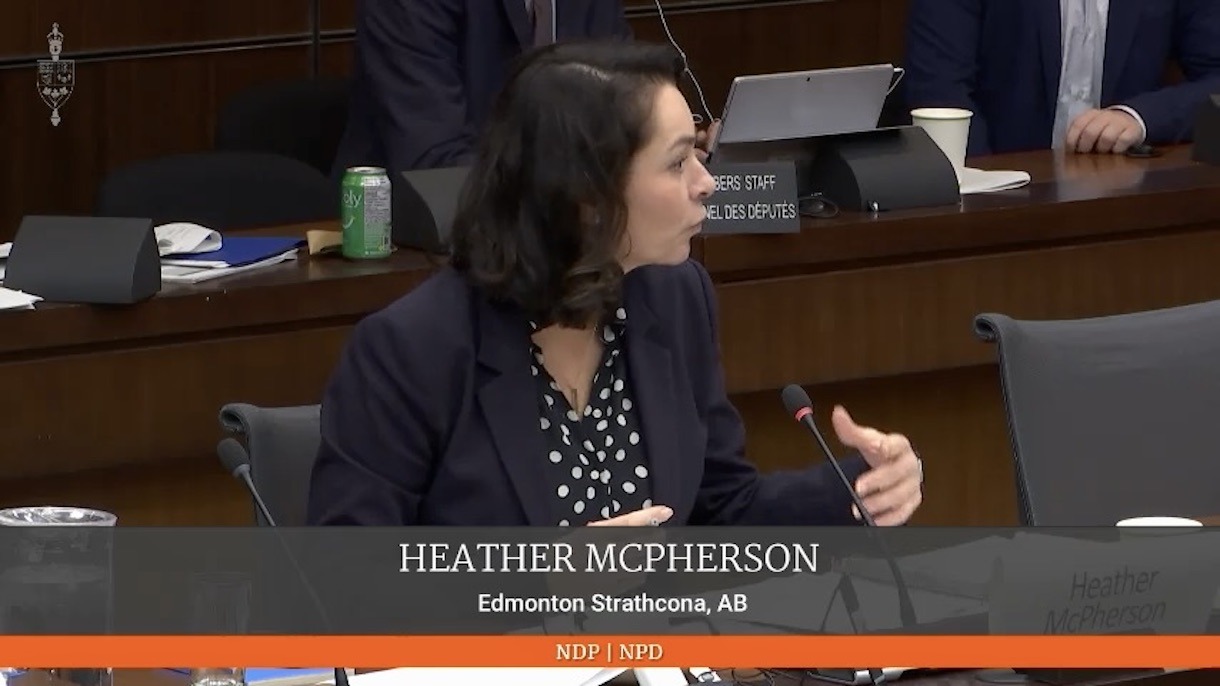
During debate on clauses 332 and 334—which codify ministerial authority under Section 107 of the Canada Labour Code to end strikes and impose binding arbitration—NDP MP Heather McPherson cited a November 20 letter sent to International Trade Minister Maninder Sidhu and the European Commissioner for Trade and Economic Security.
Under federal labour law, Section 107 allows the labour minister to refer disputes to the Canada Industrial Relations Board or take steps to promote industrial peace. Critics contend that expanding or codifying those powers lets Ottawa halt strikes or lockouts and push disputes toward binding arbitration without a union member vote, while supporters argue governments need fast tools to protect essential trade and public services.
“In fact I have the letter in front of me right here, that the European Public Service union wrote and warned Canadian legislators that threatening the right to strike, which is in C-39. That is very, very clear, could violate the Canada-EU trade agreement,” McPherson told the committee.
Trade agreements such as the Canada-European Union Comprehensive Economic and Trade Agreement include labour commitments tied to internationally recognized worker rights. Even when trade disputes do not trigger automatic tariffs, lawmakers and unions use potential treaty friction alongside ongoing U.S. tariff pressures to argue that domestic labour rules carry external economic risks.
Bloc Québécois MP Gabriel Ste-Marie warned the trade fallout could hit Canadian exporters hard amid ongoing United States tariff tensions. “We might get stuck paying a second tariff because the European Union would not want to carry out trade with delinquents, people who are delinquent to international labour law. So all of Canada would be penalized. And consequentially Quebec would be as well,” Ste-Marie said.
Liberal MP Tim Louis defended Section 107 as a last resort comparable to international norms. “It exists, has existed in Canada for decades and there are similar dispute resolution tools maintained by governments around the world,” Louis said, citing Australia and Norway.
The Drafting Loophole and Secret Advice
Conservative MP Tamara Kronis flagged an overlooked syntactic issue in clause 334, warning that a comma and the word “or” separate the minister’s broad power to take any measure in subsection 1 from the new “guardrails” in subsection 2.
“The issue is that the bill adds safeguards for three specific orders. It extends an agreement or imposes binding resolution, but those conditions apply only in the circumstances set out in section 2,” Kronis argued, warning the wording invites Charter litigation and retroactively ratifies 2024 and 2025 interventions.
ESDC director general Douglas Wolfe rejected that reading. “So really I don’t see a problem or any difficulty with the way that this is drafted at the moment. So I do not have the same read as others have presented today,” Wolfe replied.
Opposition MPs also extracted admissions that “national interest” remains undefined in Bill C-39 and that the minister’s assessments stay behind closed doors. Conservative MP Kyle Seeback asked Wolfe: “There is no obligation for the minister to publish the section 107 referral, is there?”
“There is not,” Wolfe confirmed.
McPherson pressed Wolfe on whether citizens can ever verify if a minister ignored non-partisan departmental advice. “I just want to confirm that Canadians will have no way of knowing what was in the report, whether the Minister followed the recommendations within the report, whether Canadian workers were even consulted for the report,” she asked.
“The minister has full discretion to be able to do as the minister sees fit. I mean, that’s what ministers often do. They are there because they’re making decisions,” Wolfe answered.
Liberals rejected opposition proposals giving Parliament power to revoke Section 107 orders or creating an independent public interest panel, but passed two compromises: CPC-57.1, requiring a House committee study within three sitting days and a four-hour Commons debate, and an amended CPC-59 requiring a factual summary for the labour board—though Liberals stripped out a requirement to make the rationale public.
“What we are saying is, Minister shouldn’t be able to operate in a black box, without explaining why they have met the test, making sure the public is aware,” Seeback said.
Missing Data on 90-Day Conciliation
Earlier, on clause 318, which extends mandatory conciliation from 60 to 90 days, Conservative MP Branden Leslie questioned whether data justified freezing strike rights for an extra month, after Ste-Marie asked Wolfe: “During the conciliation period and the cooling off period, the union cannot strike, is that the case?”
Under federal collective bargaining rules, conciliation and cooling-off periods delay lawful strikes or lockouts while parties try to reach a settlement. Extending mandatory conciliation from 60 to 90 days lengthens the window in which work stoppages are barred, making the absence of historical extension data a central point of contention for opposition MPs questioning whether the change is evidence-based.
“Yes,” Wolfe replied.
“But my question for officials is what frequency were voluntary extensions undertaken at the 60-day period? If you had a percentage of frequency to go over the 60 day days, what percentage would that be?” Leslie asked.
“I’m afraid we don’t have information on that,” Wolfe answered, adding later: “So to my awareness, the federal mediation conciliation service doesn’t keep that data.”
Tempestuous exchanges also flared over committee pacing when Liberal MP John Paul Danko accused opposition members of “90 hours of opposition coalition conservative and NDP opposition and obstruction of this important legislation” amid a U.S. trade war—before returning to tell colleagues, “I’d just like to offer my apologies to the members opposite for my earlier comments.”