The Subscription Economy Is Draining Community Organizations. There’s Another Way.
Think about everything a community leaves behind in digital form. The photo archive from last year’s exhibition. The festival schedule that took three volunteers a month to assemble. The oral history project, the community newspaper’s back catalogue, the workshop registrations, the newsletter that keeps two hundred neighbours informed. This material is community memory — and in most towns and neighbourhoods, it’s stored on infrastructure the community doesn’t own, running on software it rents month to month, one missed renewal away from disruption.
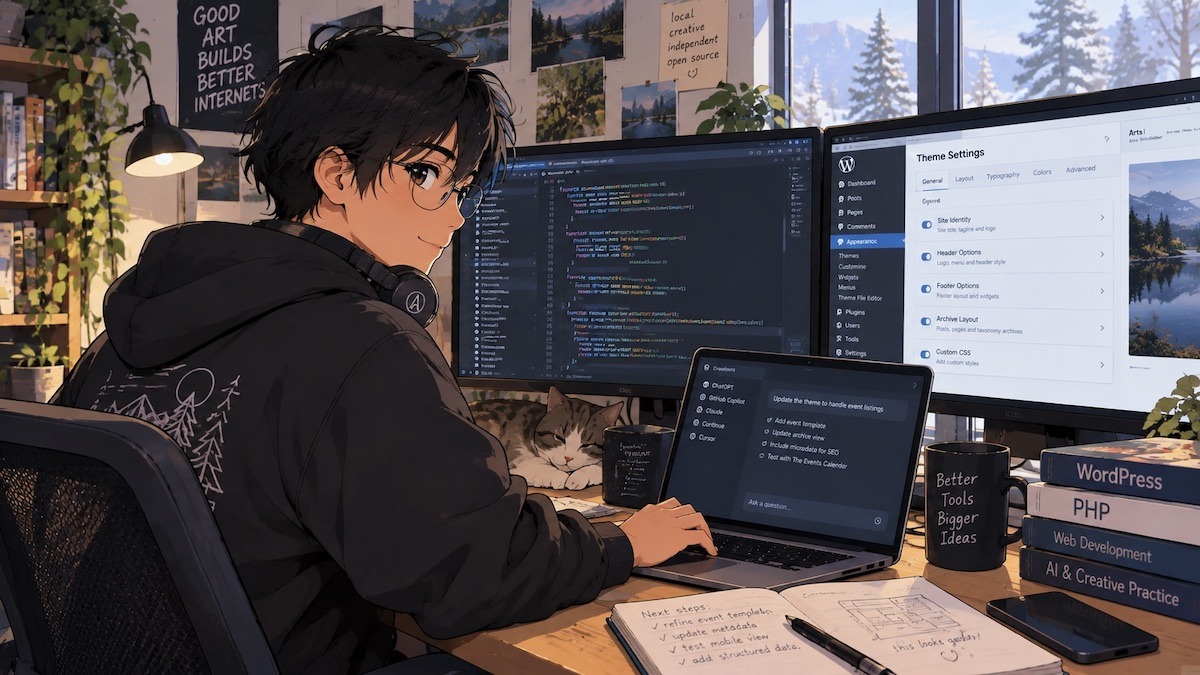
We spend a lot of time thinking about that arrangement, because we work hard to stop participating in it. Our website runs on a publishing system we designed and built ourselves. It costs us nothing in licensing fees, and every line of it is ours to read, change and teach.
We’d like to argue that more community organizations should be in this position — and that programs like PrairiesCan’s Regional Artificial Intelligence Initiative are a good start to make it more achievable.
The quiet economics of dependency
Nobody sets out to build a fragile community or digital operation. It happens by default, one reasonable decision at a time.
A small organization needs a website, so it hires an agency — a legitimate investment, often grant-funded. The agency, working efficiently, builds the site on a commercial page builder and a stack of premium plugins, because that’s the fastest route to delivery. Then the site launches, and the bills begin: the builder license, the SEO plugin renewal, the events calendar add-on, the gallery tool, the hosting tier that was priced for someone else’s traffic.
A modest community hub can reasonably spend $1,000 to $5,000 a year — and that’s before anything breaks.
And things break. A plugin update conflicts with the theme. A widget starts rendering wrong. Search engines update their performance standards and the site quietly drops in rankings. Each fix means either a paid support ticket or a volunteer’s lost weekend, and for organizations where the web person is also the programs person, the fix often just… doesn’t happen. The calendar falls out of date. The archive becomes hard to navigate. The organization slowly loses touch with its own digital presence.
Over three or four years, the typical trajectory ends the way it was always going to: another consultant recommends another rebuild, and the cycle starts over with a fresh invoice.
This is the subscription-and-consultant economy, and it extracts real money from the community sector every year. Not because anyone involved is acting in bad faith — mostly because the accessible options were built to be rented, and the ownership options seemed out of reach. Seemed. Past tense, and we’ll defend that tense.
What building it ourselves changed
Our system — we wrote about its origins in an earlier article — inverts nearly every part of that arrangement. We’re building our own tools: modular stylesheets that minify themselves into one efficient bundle, 21 reusable editorial patterns for the layouts we actually publish, an accessible gallery lightbox built on native browser features instead of a paid plugin, a complete search and structured-data architecture, and a full integration with plugins like The Events Calendar that makes it look and behave like part of the site. All of it deterministic, all of it inspectable, all of it running on ordinary PHP with zero external dependencies at runtime.
The economics are changing accordingly. No page builder subscription. No SEO plugin renewal. No paid events add-on. No lightbox license. When we want something changed, we change it — work that an assessment estimated at 160 to 240 hours of senior developer time was completed in a fraction of that, because AI-assisted development handled a lot of the research and boilerplate while our team made the decisions and tweaked the rest by hand. We’ll be honest. We’re a small program and we can’t afford those kinds of consulting bills. Not in today’s economy.
But here’s the part that matters most for this argument: the capability stays with us. The knowledge of how the system works, the confidence to modify it, the skills to teach it — those don’t expire, don’t get repriced, and can’t be moved behind a higher tier. That’s the difference between renting capacity and owning it, and for mission-driven organizations, it’s the whole ballgame.
Why this is a community issue, not just a tech issue
Community organizations do communicative work that nothing else in society does as well. They hold local knowledge that no institution is archiving on their behalf. They coordinate the events that build social fabric. When their digital infrastructure is fragile or rented, that work degrades — and the loss is collective, even if nobody invoices for it.
Digital sovereignty, in this context, isn’t an ideological position. It’s actually very practical. It’s the difference between a community archive that the community can reorganize, migrate and preserve — and one locked inside a proprietary platform’s format. It’s an events calendar that adapts to a festival’s actual workflow rather than the other way around. It’s a local story that loads fast, carries proper structured data and can surface in Google Discover alongside coverage from outlets a hundred times its size, because the technical playing field genuinely has levelled.
Just as importantly, the system was architected for sharing from the start. Brand identity, colour palettes and organizational details are separated cleanly from the core engine, so a tailored version for a partner organization becomes a configuration exercise rather than a rebuild. When we say “built to be shared,” we’re describing the actual structure of the code — not an aspiration.
Where programs like the RAII fit
Which brings us, naturally, to funding. Community organizations can’t fund this transition one subscription saving at a time — the math works annually, but the build-out needs upfront capacity. That’s precisely the gap public programs exist to close, and PrairiesCan’s Regional Artificial Intelligence Initiative is a step in the right direction.
The initiative’s ecosystem enablement stream supports incubators, accelerators and not-for-profits to connect SMEs and community organizations with technical, advisory, demonstration and market supports — and, notably, to give young Canadians exposure to AI-related career opportunities. Contributions for eligible NFPs are non-repayable and can cover up to 90% of eligible costs, with project sizes between $250,000 and $5 million over as long as three years. Digital industries is a priority area. So is inclusiveness, which explicitly includes youth.
Fit that framework around what we’re describing and the outline draws itself: a Prairie network of community organizations with shared technical infrastructure, operator training and youth mentorship built in; demonstration environments where partners can see the system running before adopting it; onboarding support so a gallery in one town and a heritage society in another aren’t each solving the same problems from scratch.
The larger point
Regional resilience gets discussed mostly in economic terms — diversification, value-added processing, supply chains. All legitimate. But resilience also lives in smaller, less measurable places: whether the community newspaper’s archive survives a platform change, whether the festival’s volunteers can update the schedule at midnight without calling a developer, whether a young person in a small Prairie town can learn serious technical skills without leaving for Toronto or San Francisco first.
Strong communities need strong digital infrastructure. For most of the internet’s history, that infrastructure was something you bought, rented or did without. We now know, from running our own system every day, that a third option exists: build it, own it, and teach your neighbours to do the same.
The tools have changed. The economics are changing even faster. The only question left is who’s going to take advantage of it — and we intend for the answer to include as much of the Prairie community sector as we can reach.
We’re curious to know what you think. Contact us and share your thoughts. We’d really like to hear what you think.