An experiment in using AI-assisted programming to automate routine work, save time, and help small creative organisations do more with limited resources.
Most conversations about AI focus on what it can make: stories, images, articles, videos, and code. But there is another use that gets less attention. AI can help us build software that takes care of the repetitive work we would otherwise have to do ourselves.
This fall have been testing this through our Winter City Stories project, which we did last fall and winter. Although the project centres on storytelling, the real experiment is about something broader: how much routine work can we automate, and what does that free us up to do?
The premise was simple: It was fun to pick up and dust off the data from last year’s project. We saved loads of simple tests, short stories, unfinished pieces and decided to see what we could do with them.
Building a system, not just producing content
Publishing a collection of stories involves much more than writing. Someone has to organise the material, create webpages, maintain navigation, add author biographies, manage categories, prepare text for speech synthesis, and keep everything connected as the collection grows.
These tasks are necessary, but they take time away from other work. Instead of handling each one manually, we used AI to help develop a program that does them automatically. The generator retrieves approved stories from a database, processes the content, builds webpages, creates category and genre directories, adds search-engine metadata, and produces an index of project URLs.
It also generates individual pages for research analyses, treatments, and scripts, with shared stylesheets to keep the site consistent and reduce duplicated code.
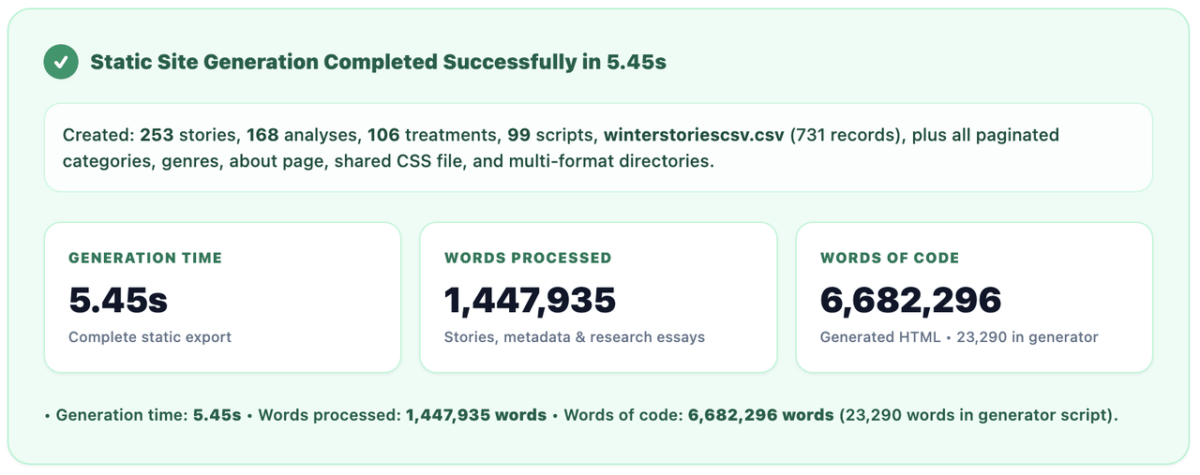
In a recent run, the generator completed the static export in 5.45 seconds. The output included 253 stories, 168 analyses, 106 treatments, 99 scripts, and a CSV containing 731 project page URLs. The system reported processing nearly 1.45 million words of stories, metadata, and research material.
The AI helped write the software. The software did the repetitive work. People still review the material and the results, checking that the content is appropriate, the presentation is right, and the published output meets the project’s standards.

The value is in what happens next
Building the generator took effort. But that effort produced something reusable. When the collection changes, we can run the process again rather than rebuild hundreds of pages by hand. The same software handles the routine steps, applying consistent structures and formatting across the collection.
Human review remains part of the workflow. Automation makes production faster, but people still need to check the output, catch errors, and make editorial decisions. The aim is to reduce the amount of repetitive work involved, not to remove human judgement from the process.
As the project grows, the amount of manual publishing work does not have to grow at the same rate.
This is where AI-assisted programming becomes particularly useful for small organisations. We may not have a dedicated development team or the resources to hire people for every technical task. Being able to build tools around our own workflows gives us another way to get the work done.
Instead of using AI to produce one output at a time, we can use it to create a system that produces many outputs whenever we need them, with people reviewing the results.
More time for the work that matters
For an arts organisation, publishing is only one part of the job. There are stories to write, music to make, workshops to run, ceramics to produce, exhibitions to organise, and community projects to develop.
Administrative and technical work can easily absorb time that might otherwise go towards these activities. Automating some of that work does not replace the creative process. It reduces the effort required to support it, while leaving people responsible for the decisions that shape the work and how it reaches an audience.
The same principle applies beyond storytelling. We can use similar approaches to organise research, maintain project archives, document exhibitions, publish community histories, and manage information across different initiatives. Each project presents opportunities to identify repetitive tasks, build tools to handle them, and review the results before they are put to use.

An experiment in effort reduction
We are interested in more than how quickly a computer can generate a website. We want to understand how much human effort can be saved by building the right tools.
That means looking at the time spent developing the software, the work it removes from the publishing process, and the effort needed to review and maintain the results. The 5.45-second generation run is one measurement. The more significant question is how much recurring work we no longer need to do manually.
This is an ongoing experiment in practical automation. We are finding ways to use AI-assisted programming to build capabilities that can be reused across our work, rather than treating every task as a separate problem. The underlying approach can be applied wherever people spend too much time repeating predictable tasks.
The point is not simply to make more things with AI. It is to build systems that make the work behind those things easier, while keeping people involved in reviewing the results and making the decisions that matter.