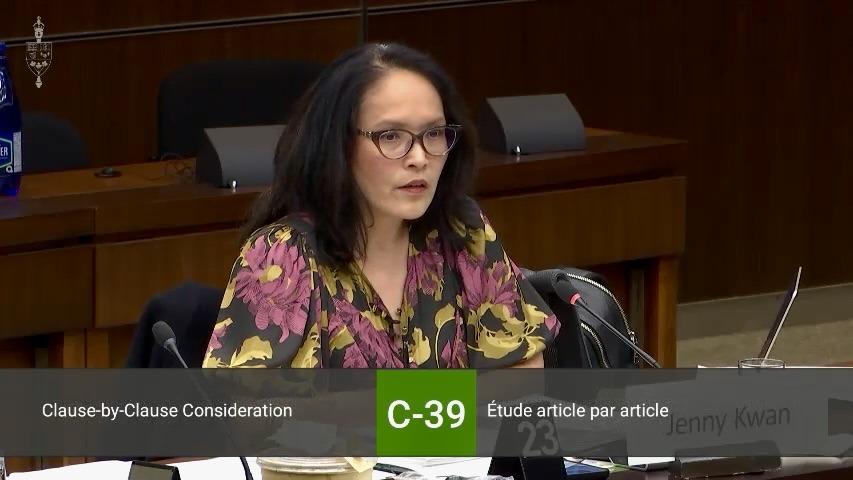
NDP and Liberal MPs collide over whether omitting explicit consent clauses invites new constitutional court battles.
OTTAWA — A dozen consecutive amendments backed by First Nations leaders to anchor Indigenous consent and constitutional safeguards into federal permitting laws went down to defeat, drawing blistering warnings that Bill C-39 is setting up costly legal battles.
The confrontation unfolded before the Legislative Committee on Bill C-39 on Saturday, November 21, 2026, in Ottawa, where NDP MP Jenny Kwan squared off repeatedly against Liberal, Conservative, and Bloc Québécois members over clauses spanning energy pipelines, international power lines, navigable waters, ocean dumping, and endangered wildlife.
Bill C-39—the Building Canada Strong Act—is a sweeping federal omnibus bill introduced by Prime Minister Mark Carney’s Liberal government on September 21, 2026, containing over 300 clauses across more than a dozen federal statutes designed to fast-track major infrastructure projects, modernize trade corridors, and overhaul federal labour laws.
While the government presents the bill as essential for economic security and attracting global investment, it has sparked nationwide protests and fierce opposition from communities, labour unions, Indigenous nations, environmental advocates, and scientists.
The tension mirrors earlier battles over federal regulatory overhauls—such as the 2019 Impact Assessment Act (Bill C-69) and subsequent Supreme Court challenges—highlighting how successive governments have struggled to balance investor demands for predictable timelines with constitutional obligations to Indigenous rights holders.
Twelve defeats and the ‘uni party’ charge
One after another, Kwan moved amendments shared by the B.C. Assembly of First Nations—numbered NDP 69 through NDP 80—seeking to require free, prior, and informed consent or explicit Section 35 constitutional checks before regulators exempt pipelines, set 90-day power-line timelines, exempt waterways, or vary environmental permits.
Each time, Liberal, Conservative, and Bloc Québécois MPs voted them down or abstained.
“What we are witnessing, of course, is the Liberals and Conservatives have actually become a uni party, all walking in unison, cooperating, and moving things forward to advance fossil fuel projects as quickly as they possibly can,” Kwan told the committee during debate on Clause 159.
Kwan challenged federal officials on why the committee had spent earlier hours codifying 60-day application completeness timelines—compromises negotiated between Conservative proposals and Liberal subamendments—while refusing to spell out Indigenous rights in the same statutes.
“Why is it that we cannot have language in the act itself with these kinds of protections? What’s the justification other than it’s repetitive? But we saw repetition earlier with timeline changes that the government and the Conservatives were happy to accommodate each other on, that when it comes to Indigenous rights then it’s just an outright rejection?” she asked.
Joanne Weiss Reid, Director of Operations and Regulatory Development at the Department of Transport, responded that constitutional obligations already override every decision made under the Canadian Navigable Waters Act.
“I would just say that in terms of the consideration of adverse impacts on constitutionally protected rights, it is paramount. It is the primary focus of how we inform our decisions,” Weiss Reid testified.
Kwan pressed back immediately: “With the exception that every now and again I know the government takes that position and then matters end up in court where there’s a disagreement on whether or not that constitutional rights of Indigenous peoples have been respected. That’s been part of the Canadian history. No?”
“Yes,” Weiss Reid acknowledged.
Redundancy versus legal certainty
Liberal and Conservative MPs argued that scattering extra consultation clauses across individual sections of existing acts would create legal confusion rather than stronger protection.
Conservative MP Kyle Seeback put that question directly to Natalie Turmel, Senior Counsel with the Department of Justice Canada, asking: “Including a specific duty that already exists into a particular clause into a piece of legislation, that doesn’t add any additional clarity because that duty is constitutionally set. Am I correct in that?”
“Yes, you are,” Turmel replied, pointing out that Section 2.3 of the Canadian Navigable Waters Act already mandates that decision-makers consider adverse impacts on Section 35 rights before making any decision under the act.
During debate on Clause 160—which empowers the transport minister to exempt waterways from prohibitions on depositing materials or dewatering for projects such as mines—Conservative MP Dan Albas asked officials to clarify what happens when an exemption is granted. Officials testified that proponents and the department remain legally required to engage affected First Nations, assess impacts, and document accommodations before any ministerial order is issued.
The clash intensified over Clause 161.1 and NDP 76, which sought to require Indigenous consultation before Cabinet makes regulations excluding minor “works” from the act’s approval regime. Conservative MP Philip Lawrence asked officials directly to weigh Kwan’s warning of heightened legal risk against Liberal MP Mike Kelloway’s argument that the amendment was redundant.
Transport Canada officials testified that Section 35 consultation duties remain binding whenever regulations are drafted or amended to exclude works, noting that the regulatory process itself triggers mandatory consultation with potentially affected Indigenous groups.
Later, during debate on ocean disposal permits under the Canadian Environmental Protection Act, 1999, Kelloway asked Environment and Climate Change Canada officials whether NDP 79—requiring consultation before setting or altering permit conditions—would slow approvals unnecessarily: “Does this amendment create unnecessary duplication and process burden with potential impacts on time of decision-making across a broad range of activities?”
Environment and Climate Change Canada Director General Stephanie Lane testified that adding a new statutory duty could trigger mandatory consultations even when minor permit adjustments do not affect Indigenous rights.
“The one concern here may be that there may be conditions that are varied or added that don’t necessarily affect Indigenous rights, and this would require kind of an obligation under the statute to consult on all of them,” Lane said.
Kwan countered that leaving consultation to administrative discretion rather than explicit statutory text leaves First Nations forced to litigate after approvals are already granted, arguing that Parliament should spell out the duty clearly rather than rely on courts to enforce it after the fact.
She had struck a similar note earlier in the sitting as NDP amendment 71—which sought to remove 90-day approval limits for international power lines where Indigenous rights holders need more time—was voted down.
“Anything to speed up the project proposed by the Conservatives is welcomed, but anything that says respect the rights of Indigenous peoples is not,” she said.
Liberal MP Parm Bains defended the government’s approach, saying: “This issue has come up before, and we believe keeping flexibility to address issues and concerns are important to ensure sound decision-making, so I will leave it at that.”