New research explores human-centered, smart succession frameworks at Athabasca University.
This weekend, researchers, faculty, and graduate students are gathering in Athabasca, Alberta—and connecting virtually from across the country—for Athabasca University’s 2026 Graduate Student Research Conference. Centered on the theme Together in Research, the conference offers a vibrant space to explore how collaborative inquiry drives real-world continuity, organizational resilience, and systemic change.
We are thrilled to see Elyssa Stump, presenting her research on succession planning in complex systems on Sunday.
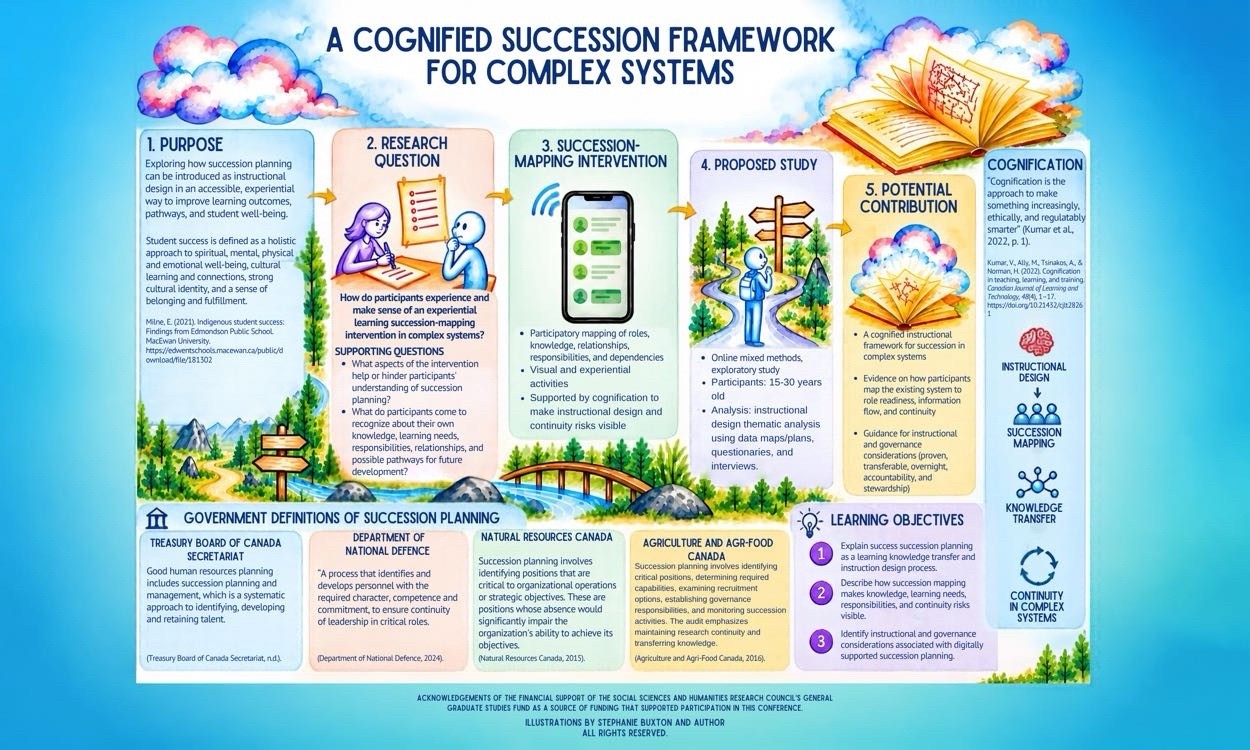
Complex environments require knowledge, responsibility, and decision-making to move across people, roles, organizations, and systems. When these transitions are poorly designed, continuity can be lost. Elyssa’s research reconceptualizes succession planning as an instructional-design problem centred on knowledge transfer, role readiness, continuity, and accountable action through cognification.
The study will examine how participants experience and make sense of an experiential learning intervention designed to make succession planning personally relevant and accessible. Participants will complete a participatory succession-mapping exercise, beginning with a goal or future pathway and identifying the knowledge, relationships, roles, learning needs, responsibilities, information flows, and potential points of complexity involved in reaching it.
Cognification provides a framework for examining how human knowledge and activity can be made explicit, structured, supported, transferred, or augmented through digitally enabled systems while preserving human oversight and accountability. The intervention connects organizational succession, internal development toward greater responsibility, and individual progression toward future opportunities.
Pre- and post-intervention questionnaires, participant-created maps and plans, and interviews will examine what participants understand and recognize through the activity. Alberta and federal legislation, regulations, and policies, alongside AI literacy and governance principles, will guide analysis of privacy, transparency, accountability, data stewardship, and human oversight. Findings will inform a preliminary cognified instructional framework for experiential succession planning.
In bringing instructional design and cognification together, this research moves beyond static handoffs toward visual, interactive mapping that makes hidden dependencies, knowledge flows, and learning needs visible, supporting more informed and accountable succession planning.
We look forward to seeing this program develop over the coming months and encourage anyone interested in learning more or collaborating to reach out and connect!
Special thanks go out to Athabasca University, the Athabasca Graduate Students’ Association and the Faculty of Graduate Studies for organizing and hosting such an engaging event. We also thank the Social Sciences and Humanities Research Council General Graduate Studies Fund for supporting participation in this conference.
The environment is welcoming and the presentations are generating a lot of valuable questions and insights. We know the great work being presented this year will resonate for years to come. Thanks for making everyone feel so welcome!