Environmental lawyers clash with industry and conservation groups over pipeline exemptions and nature-positive offset proposals.
OTTAWA — Environmental groups split sharply on Parliament Hill whether Canada’s deeply controversial Bill C-39 can be salvaged with conservation offsets or whether its pre-approval and pipeline clauses invite irreversible ecological harm.
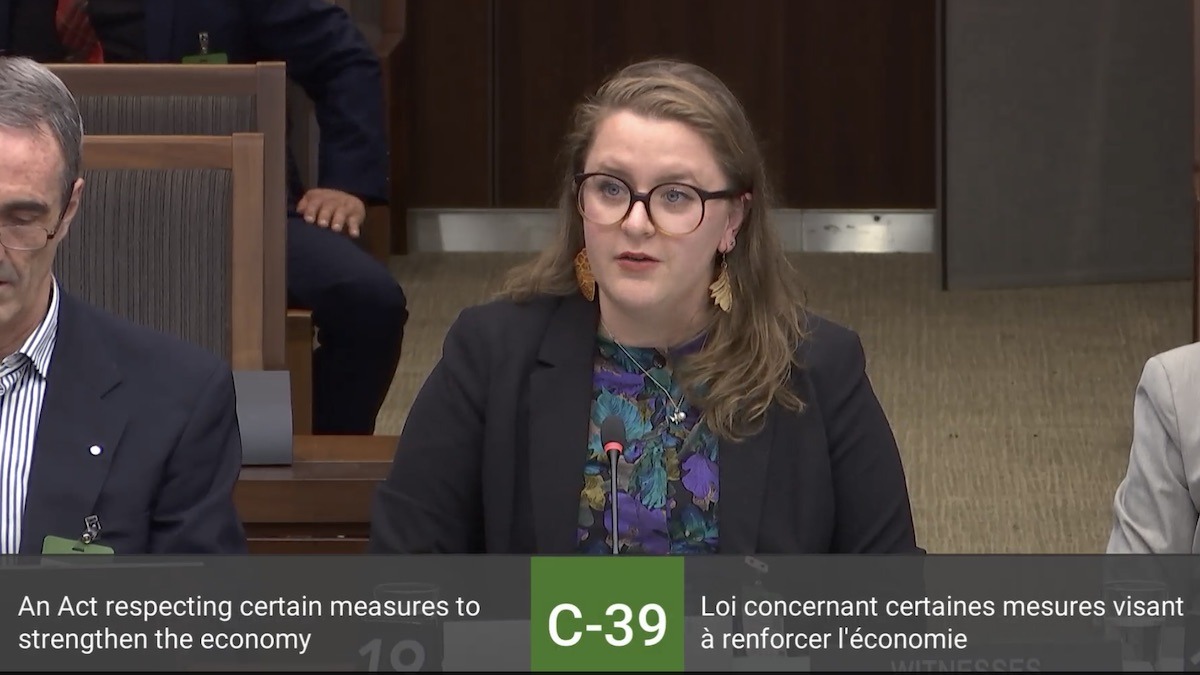
During hearings of the House of Commons Legislative Committee on Bill C-39 in Ottawa on Monday, October 26, 2026, Ecojustice specialist Isabel McMurray urged MPs to scrap the bill outright, even as clean-economy experts and the Nature Conservancy of Canada pitched amendments to mandate net-positive outcomes for nature.
McMurray faced pointed questioning from Conservative MP Branden Leslie over Liberal accusations that critics of the legislation—dubbed the “Bulldoze Nature Bill” by Ecojustice—have waged a misleading campaign.
“Do you think that the government is dismissing legitimate environmental concerns, or as Liberal MPs are claiming, are you and your organization in fact deliberately offering a wild disinformation campaign?” Leslie asked.
“All jokes aside, this work that my colleagues and I are doing is not mis- or disinformation. We are interpreting the legislation as it stands to explain what its impacts would be on the environment and on projects. We are looking at what the legislation says and not just what the legislative intent is,” McMurray replied.
Pipeline Exemptions and Extinction Risks
When Leslie asked what specific environmental consequences she feared over the next decade if Bill C-39 passed unchanged, McMurray singled out expanded powers for the Canada Energy Regulator and early construction approvals.
“If Parliament were to pass Bill C-39 unchanged, what specific environmental consequences are you most concerned about over the next five or 10 years?” Leslie asked.
“Section 214 is being amended so that the Canada Energy Regulator can pre-approve a pipeline of any length—or, more specifically, it can exempt a pipeline of any length from the need to obtain a certificate,” McMurray said, warning that a pipeline could be approved without any rigorous environmental assessment.
Leslie followed up on clauses allowing early construction before final impact reviews and expanding ministerial power to alter project conditions.
“In your view, aren’t those conditions and approval requirements part of what is, in fact, aimed at protecting our environment?” Leslie asked.
“Absolutely. The ability to start construction before the full impacts of the project are understood, before consultation is completed and before indigenous communities may have disclosed impacts on their rights…. We’d get ahead of ourselves,” McMurray answered.
Bloc Québécois MP Gabriel Ste-Marie pressed McMurray on whether cabinet-designated “regions of national interest” could jeopardize endangered wildlife.
“Do you think the national interest regions that will be established by Bill C-39 will endanger species such as the beluga whale, killer whale, copper redhorse and the 300 or so other endangered species listed in schedule 1 of the Species at Risk Act? My question is about regions of national interest,” Ste-Marie asked.
“If a regional assessment leads to a region of national interest on the St. Lawrence River, there could be negative consequences for the copper redhorse, which is endemic to Quebec. That could lead to the extinction of the species in the world, so yes, to answer your question,” McMurray replied.
Can ‘Nature-Positive’ Rules Marry Speed With Rigour?
Other witnesses argued Ottawa can accelerate major energy and mining approvals without gutting ecological standards—if Parliament writes binding conservation targets directly into the bill.
“Can you provide an example or the top-tier items that would need to be in there to suffice and to focus on the investment piece and the environment piece?” Liberal MP Mike Kelloway asked University of Ottawa professor Stewart Elgie, co-chair of the Prime Minister’s task force on nature financing.
“What you need are stringency, predictability and speed. If you have those three ingredients, you can actually get to a win-win outcome,” Elgie replied, recommending mandatory habitat offsets and conservation banking modelled on the U.S., the U.K. and Australia.
Liberal MP Danielle Martin asked Nature Conservancy of Canada vice-president Lisa McLaughlin how regional planning zones could protect sensitive habitats.
“When you look ahead at something far into the future, is that an opportunity, for example, to make sure that we route projects away from high-value habitats where species might be at risk, etc.? Can you talk about that?” Martin asked.
“Those regional planning zones provide that opportunity if, as Stewart mentioned, we bring the conservation angle into it,” McLaughlin said, pointing to habitat-banking partnerships.
Energy and mining leaders welcomed the bill’s one-year clock for federal decisions, though Conservative MP Philip Lawrence questioned whether regulators face any real consequences for missing deadlines.
“Specifically, I’m talking about the accountability under this act. Could you tell me what consequences the government or any regulator would face if, in fact, they don’t meet the 300-day standard?” Lawrence asked.
“I think it’s difficult to hold them accountable, and I think there are some loopholes. I like the legislation because it would create an expectation of one project, one review, one year. It’s a strong political signal to the bureaucracy,” Macdonald-Laurier Institute director Heather Exner-Pirot replied.