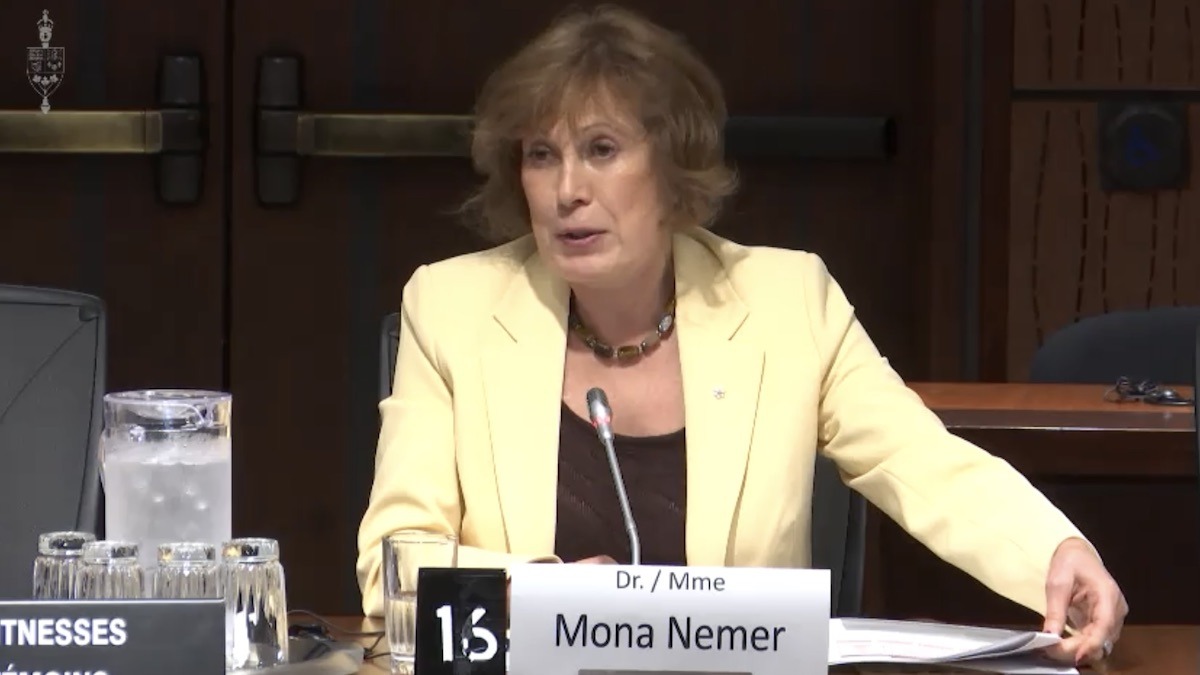
Canada’s chief science adviser was never shown the full national security strategy
OTTAWA — Opposition MPs pressed Canada’s chief science adviser over why the word science does not appear once in the federal government’s new national security strategy, while questioning budget cuts and her exclusion from major legislative drafting.
Dr. Mona Nemer appeared in person before the House of Commons Standing Committee on Science and Research on Thursday, October 29, 2026, in Ottawa, hours after the Prime Minister released Canada’s first national security strategy in more than two decades.
Conservative MP Tony Baldinelli noted the document runs just 13 pages, accompanied by a four-page press release, and questioned Nemer on the omission.
Questions Over the National Security Strategy
“The word “science” does not appear in that strategy document, not once. Does that concern you?” asked Baldinelli.
“It really doesn’t concern me, and I’ll tell you why. This is because it is understood that in every one of these boxes, science and technology—because we can put them both together—is assumed there. When we talk about pharmaceuticals, biotech, food security, critical minerals and energy—you name it—it’s assumed that it’s there,” replied Nemer.
She added that ensuring domestic ownership remains essential during implementation. “If we want to be sovereign, it has to be our technologies and our IP that is produced in Canada,” she said.
When Baldinelli asked, “Given your role as chief science adviser for Canada, did the Government of Canada consult your office for input and feedback on this strategy document?” Nemer said she had been consulted on specific areas such as pharmaceuticals and food security.
Conservative MP Connie Cody followed up by asking who Nemer had spoken with and requesting copies of any written recommendations. “You told the committee you consulted with the government on its national security strategy. Specifically, who did you consult with?” asked Cody.
Nemer clarified that her talks over the past two years with the ministers of innovation and health, the Prime Minister’s Office and senior officials centred on health security and biosecurity rather than a formal national security document.
“At the time when we were talking about health security, biosecurity, etc., we were not talking about a national security approach. I don’t want this to be mistaken with the national security. However, the element that was being discussed is now part of the national security agenda,” said Nemer.
When Cody asked about a line in the Prime Minister’s message promising to collect actionable intelligence—”Could you explain that to me?”—Nemer declined to speculate: “I’m sorry, but I haven’t had a chance to read the entire thing, so I’m not sure that I can explain this to you. I don’t want to say things out of context.”
Budget Cuts, Legislation and Graduate Pay
Bloc Québécois MP Maxime Blanchette-Joncas broadened the scrutiny to federal decision-making, asking: “Is science still at the heart of major decisions made by the current Canadian government?”
“It is difficult to answer that question in purely abstract terms because scientific evidence is clearly only one part of a broader decision-making process that also involves legal, socio-economic and, of course, ideological considerations,” replied Nemer.
Blanchette-Joncas also challenged the 2% reduction applied to science budgets, including Nemer’s own office. “When the government reduces the budget and resources of the office of the chief science adviser, do you believe that sends a message to the public about the importance, or lack thereof, it places on science?” he asked.
Nemer confirmed her office faced the same 2% reduction, though she argued science fared better than most departments. “However, it is important to note that while most sectors faced budget reductions of about 15%, the science and research sector saw its funding reduced by only 2%. So that is some consolation. It is the only sector, apart from defence, where the cuts were significantly smaller than in other sectors,” she said.
On Bill C-39—which allows the government to bypass or amend the Impact Assessment Act for priority projects—and Bills C-30 and C-31 on pesticide rules, Blanchette-Joncas asked whether Nemer was consulted.
“I am not consulted when legislation is being drafted, that’s for sure,” Nemer said regarding the Impact Assessment Act changes, while urging officials not to treat science as an obstacle. “Science doesn’t say yes or no. Science is always there to help us.”
She gave a similar reply on the pesticide bills, noting departmental advisers handle those files. On scientific integrity policies across 25 federal departments—21 of which had not implemented assessment plans as of 2025—Nemer acknowledged slow follow-through. “There has not been much progress. The good news is that all 25 organizations do have a science policy and a plan, but we have to ask ourselves whether it’s working. How is all of this being monitored? That’s still a topic of ongoing discussion,” she said.
Liberal MP Marilyn Gladu asked for an update on stagnant stipends for graduate researchers and the risk of talent leaving for the United States.
“The government has actually been quite generous with the fellowships that are given directly. However, those who are paid from the grants need an increase now to match the others. Otherwise, it’s unfair,” replied Nemer, warning that raising grant-based pay squeezes lab budgets: “This is where we have pressure right now, because if we increase this, there isn’t money to pay for the supplies for them to do the work with.”