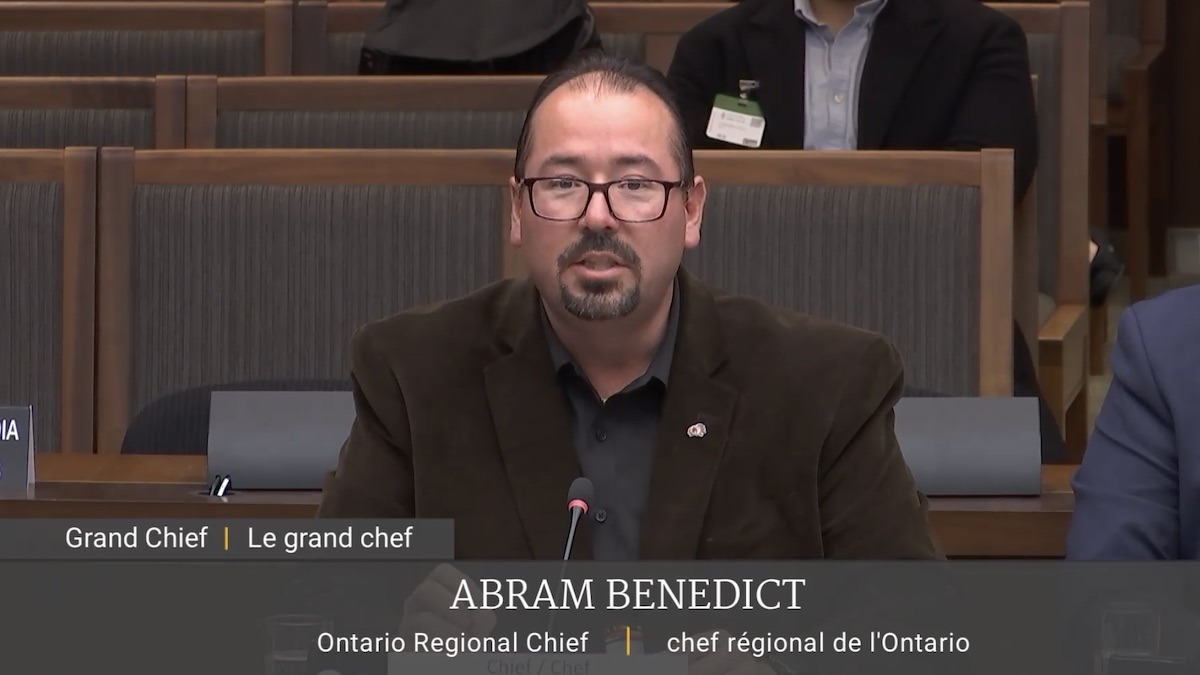
Indigenous leaders say Ottawa failed to consult before tabling Bill C-39 and reject rigid timelines.
OTTAWA — First Nations leaders closed out Monday’s marathon committee hearings with a blunt warning to federal lawmakers: they were not consulted before Bill C-39 was drafted, and forcing major resource projects through on a rigid one-year clock will send Ottawa straight to court.
Testifying before the House of Commons Legislative Committee on Bill C-39 in Ottawa on Monday, October 26, 2026, Chiefs of Ontario Regional Chief Abram Benedict, Liard First Nation Chief Harlan Schilling and First Nations Summit political executive Robert Phillips gave identical answers when Conservative MP Philip Lawrence polled them on pre-bill consultation.
“Were you or your organization meaningfully consulted before the drafting and introduction of Bill C-39?” Lawrence asked Benedict.
“No. The discussion paper that was released to all Canadians via a post on the website was similar. It was at the same time. We may have heard at different points that this was coming, but we weren’t consulted,” Benedict answered.
“It’s the same question for you, Mr. Phillips,” Lawrence continued.
“Quite simply, again, it’s no,” Phillips said.
“Chief Schilling, it’s the same question for you. Were you meaningfully consulted before the introduction of Bill C-39?” Lawrence asked.
“No, it was not before—not in my previous office in British Columbia with Daylu Dena Council. I can’t speak to whether the Liard First Nation’s administration was consulted before my time there,” Schilling replied.
UNDRIP Gaps and Winter Realities
Benedict told the committee that Bill C-39 strips away the principle of free, prior and informed consent (FPIC) and urged MPs to pause the legislation and send it to specialized committees.
“Bill C-39 as it stands right now makes absolutely no mention of compliance with UNDRIP or FPIC, in direct contravention of Canada’s commitment, which they have continued to publicly state,” Benedict said in his opening statement.
Bloc Québécois MP Gabriel Ste-Marie pressed both Benedict and Schilling on the bill’s one-year assessment limit.
“What is your critique of Bill C-39 with respect to the one-year deadline for assessments of major projects? What risks does this pose to the Crown’s duty?” Ste-Marie asked.
“The one-year time frame for large projects that has been talked about to protect and build the nation’s economy is not enough for most of our communities that will be affected by large projects,” Benedict replied.
Schilling argued the timeline ignores northern geography and short field seasons.
“One thing that I noted in my presentation is that this bill does not correctly reflect the north. We do have very short timelines. For six months, it’s winter. To do a proper assessment of how this is going to affect everything…. We’re not the same as the south. You cannot get a true image of how it’s going to affect something when it’s under 10 feet of snow,” Schilling said, warning earlier that “A project forced through over our nation’s objections is headed to court, and that would be the slowest path of all.”
Conservative MP Dan Albas asked whether the leaders backed amendments curbing a minister’s unilateral power to alter project conditions after community consultations conclude.
“Chief Schilling and Mr. Phillips, if you could say whether you’re in concurrence or not, I would like to have you on the record regarding an amendment that would limit the authority that the minister would have,” Albas asked.
“I would absolutely agree with that. Again, it’s about coming together. It really is. Again, the fact that one person could veto…. Again, we’re going in and saying this is what we’ve agreed on and then to have a minister able to change that…it’s 2026. We have rights. It’s known,” Schilling replied, with Phillips adding, “I concur.”
Partnerships and Nuclear Concerns
Liberal MPs highlighted provisions aimed at streamlining federal engagement and backing Indigenous-led development.
Liberal MP Parm Bains noted Bill C-39’s proposed Crown consultation hub, asking Schilling: “How could that coordination prevent complicated consultation processes and support more effective engagement?”
“Building and partnerships are key to success in the north. As we have done with the Dene K’éh Kusān, we have reached out to all of our neighbouring first nations, because, again, we can’t succeed unless we do it together,” Schilling answered.
When Bains asked Phillips about regional energy corridors, Phillips pointed to British Columbia wind projects featuring “51% equity with first nations,” while telling Liberal MP Danielle Martin that Indigenous-led environmental restoration “is an economy on its own.”
Bloc Québécois MP Sébastien Lemire closed the evening by asking Benedict whether Bill C-39’s expanded powers for the Canadian Nuclear Safety Commission risked eroding judicial protections following a recent Federal Court of Appeal ruling on the Chalk River nuclear site.
“Do you think the introduction of this bill, particularly the part on first nations consultations and the power of the Canadian Nuclear Safety Commission, may have had an impact on the judges and created precedents that will completely exclude first nations from using their fundamental right to claim protection of their lands?” Lemire asked.
“There still should be some judicial independence in this country that we can stand behind, because we have seen very clearly what happens when it is not very close to us, including in my community, which is a border community,” Benedict replied, calling for treaty and UNDRIP principles to be written explicitly into law.