OTTAWA — A warning about historically low public confidence in Canadian universities turned into a sharp partisan clash over diversity hiring rules in nuclear engineering and artificial intelligence during parliamentary testimony.
Dr. Les Jacobs, vice-president of research and innovation at Ontario Tech University, told the House of Commons Standing Committee on Science and Research on Thursday, October 29, 2026, in Ottawa that eroding public trust poses a fundamental threat to Canadian research.
“Although I could raise a number of different issues today—and I note that there’s the in-camera session after this on AI—I want to highlight specifically the decline in trust and confidence in universities among the Canadian public,” said Jacobs in his opening remarks.
Clash Over Restricted Research Chairs
Conservative MP Vincent Ho challenged Jacobs on whether universities themselves are driving that distrust through equity, diversity and inclusion policies.
“In your opening statement, you mentioned that public trust in universities has been eroding in recent years. I want to examine whether universities’ own policies might be contributing to that problem. Ontario Tech University’s website names you on the steering committee responsible for implementing its DEI agenda. Is that correct?” asked Ho.
“Yes, basically,” replied Jacobs.
Ho cited Ontario Tech postings from August 2025 for a Canada Research Chair in advanced nuclear engineering and January 2026 for a chair in artificial intelligence and education, both restricted to women and gender equity-seeking groups.
“Can you understand why Canadians might lose confidence in publicly funded institutions when they see opportunities closed to otherwise qualified applicants because of their identity?” asked Ho.
“I understand exactly the concerns. Part of my general advice is to dig deeper about what the underlying rationales are for those practices. The short answer is to use a holistic approach,” replied Jacobs.
Ho also pressed Jacobs on mandatory DEI statements in job applications, asking: “Could an applicant openly oppose identity-restricted hiring and still receive full consideration?”
“Yes,” replied Jacobs.
“What safeguards prevent the DEI statement from becoming a test of agreement with the university’s preferred policies?” asked Ho.
“I think it is basic procedural fairness in the process,” said Jacobs.
When Jacobs said the statements are not scored on a points grid, Ho shot back: “If the DEI statement doesn’t affect the scoring criteria, then why ask it?”
“There’s a holistic assessment, which is that, typically, academic hirings are not point-score based. They’re actually holistic hirings,” replied Jacobs.
Liberals Defend Diversity and Warn of Online Abuse
Liberal MP Taleeb Noormohamed followed immediately to defend Ontario Tech’s hiring practices, asking Jacobs whether the three equity-considered hires made since 2019 had weakened academic standards.
“In those cases, the quality of the hires that you made, do you think the people you hired were somehow lesser in terms of their capacity to do the research, to do the work, to add value or to contribute to academia as a result of the fact that you had those criteria placed on them?” asked Noormohamed.
“Certainly in all cases they were at least as good and, I would say, in one or two instances, better,” replied Jacobs.
“My friends opposite seem to think it’s funny that these criteria are applied. Perhaps you might explain to them what value it actually adds to have that diversity, particularly in the case that Mr. Ho pointed out, of women in academia and in that particular research area,” said Noormohamed.
Jacobs pointed directly to workforce demands in the nuclear sector. “For example, in nuclear engineering, one of the fundamental things that we hear from our industry partners—we work closely with all of the major nuclear engineering sectors, as we’re the only nuclear engineering program in the country—is that they are very concerned about having more women who are nuclear engineers,” he said.
Expanding representation also counters alienation, Jacobs argued. “There are large numbers of people in the Canadian public who actually feel excluded from universities and feel excluded from the professoriate, and these measures are ways in which you build up their trust and confidence in the universities,” he said.
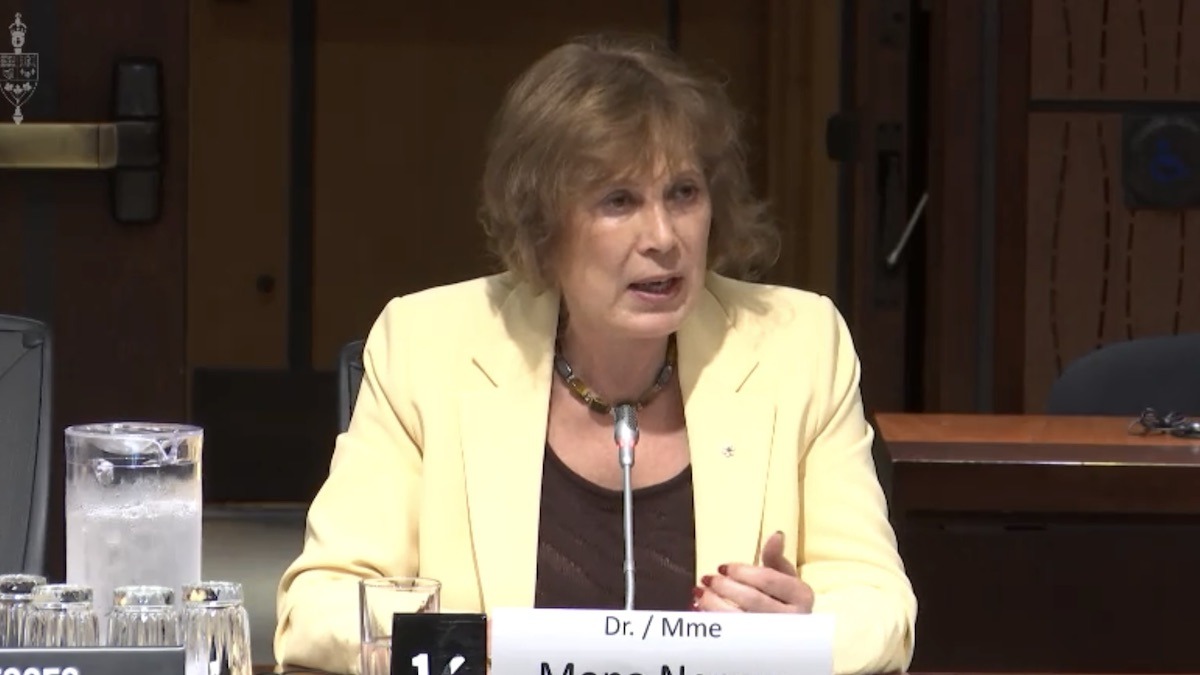
Earlier in the meeting, Noormohamed asked Chief Science Advisor Mona Nemer and Jacobs about the toll of anti-science rhetoric and online attacks on researchers.
“When we start to think about what it does when we denigrate science, when we denigrate scientists and when, particularly, politicians start to take on science with no fact and no evidence, using simply the power of social media to attack scientists, what does it do to the research environment in any country?” asked Noormohamed.
“I think it’s actually dangerous. I don’t think that word is too big when anti-science spreads. Data shows that people who doubt science actually doubt institutions in general. Then there’s a problem not just for science but also for democracy and social cohesion,” replied Nemer.
Jacobs noted that Ontario Tech hate-speech scholar Barbara Perry faces heavy social media backlash after media interviews. To rebuild public trust, Jacobs urged Ottawa to invest beyond the roughly 7,000 combined undergraduate research placements funded annually by NSERC and Mitacs.
“Declining public trust and confidence in our universities among Canadians brings, in my view, a new level of urgency. Scale undergraduate student involvement in university research to address that crisis,” he said.