
Radical Checkers: Hands-on prototyping remains the most fun way to explore logic, design, and gamification.
Most Saturday mornings begin with coffee, stray sketches on scrap paper, and a simple challenge: what can a small crew build in ninety minutes when you treat code like clay? Our fall and winter creative sessions aren’t about enterprise roadmaps or stuffy corporate seminars. They’re playgrounds for digital literacy, where artists, tinkerers, and storytellers gather to turn mid-week napkin doodles into live interactive prototypes. This past weekend, we decided to dust off one of the oldest strategy games on earth, strip away the clutter, and give it an engine built purely for speed and tactile satisfaction.
The result is Radical Checkers—a snappy, web-first tribute to American draughts that swaps slow turns for crisp diagonal combat. Checkers has always had a deceptively peaceful reputation, but anyone who has played under official tournament rules knows it’s an unforgiving tactical duel. We wanted our digital board to capture that bite. That meant building standard tournament mechanics from scratch: diagonal forward maneuvers for men, full multi-directional freedom for crowned kings, and the all-important mandatory capture rule. If a jump is open, you take it. No hesitation, no backing down.
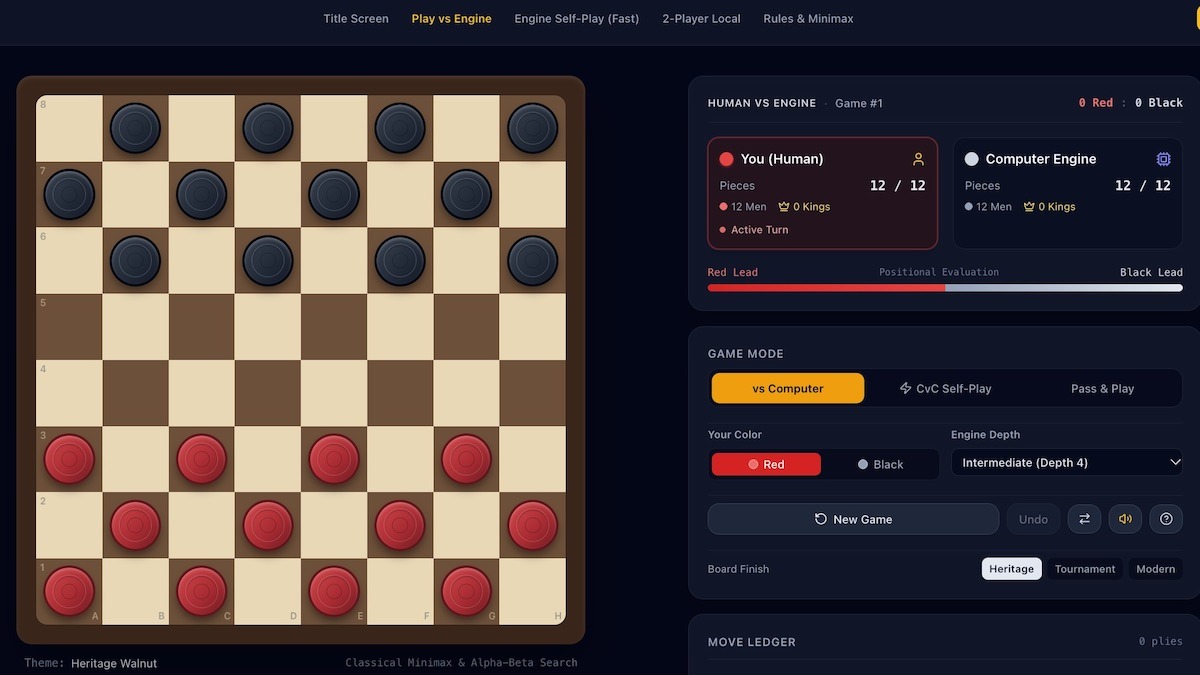
Where the prototype really comes alive is under the hood. Instead of bogging the browser down, we wired the board to a classical minimax tree search equipped with alpha-beta pruning. It calculates board positions and material advantages in mere fractions of a millisecond. That lightweight architecture allowed us to build our favorite feature of the weekend: Computer vs. Computer self-play. In Hyper Mode, the board turns into a whirlwind, executing over forty moves per second in front of your eyes as two algorithmic personalities trade pieces and crown kings in a blur. For anyone learning how game loops and heuristic logic work, watching two machines battle across sixty-four squares in under three seconds is pure magic.
Because we approach every coding experiment through an arts-first lens, the sensory details mattered just as much as the logic. We crafted three board finishes—from a warm, dark Heritage Walnut with concentric wooden lathe ridges to an authentic Tournament Green felt. Every slide, jump, and kinging sequence is backed by custom audio synthesized directly in the browser using the Web Audio API, so every capture lands with an unmistakable wooden clack. We also added an algebraic move ledger, a live positional evaluation bar, and a batch simulator that lets you run fifty full matches in the blink of an eye.
Rapid prototyping isn’t about building finished commercial products in an afternoon; it’s about discovering how much creative expression lives inside simple code, and making technology approachable for everyone in our community. We had a blast piecing this together, and now we’d love for you to take it for a spin. Jump on the board, test your wits against the computer, or crank the speed slider all the way up and watch the engines duke it out.
Play a few rounds and drop us a line at info@artsincubator.ca. Did you spot any wild double jumps? Should we add custom opening books, time clocks, or tournament brackets next? Tell us what you think and let us know if this is a prototype we should keep expanding!