How Melgund Township is Turning Milkweed into Political Power
In the quiet corners of Northwestern Ontario, a common plant is sparking a creative and political revolution. Art Borups Corners is officially launching Milkweed to Market in May 2026—a project that proves community art isn’t just about making things look pretty; it’s about making local voices heard in the highest levels of federal government.
By blending artisanal craft with climate entrepreneurship, Melgund Township is transforming from a dot on the map into a powerhouse of environmental advocacy.
Art as an Act of Resistance
The project centers on the Milkweed to Market cycle: a seasonal journey where residents plant native milkweed, harvest the fibers, and process them into high-quality, artisanal paper. This isn’t just a craft workshop; it’s also about climate entrepreneurship.
Local artists and community members aren’t just learning a hobby; they are building a “green economy” from the ground up. By turning a local plant into a marketable product, the community is demonstrating that ecological health and economic value go hand-in-hand. This “Living Lab” approach uses the arts to demystify complex environmental issues, making them tangible and, more importantly, profitable for the local community.
Cracking the Federal Code
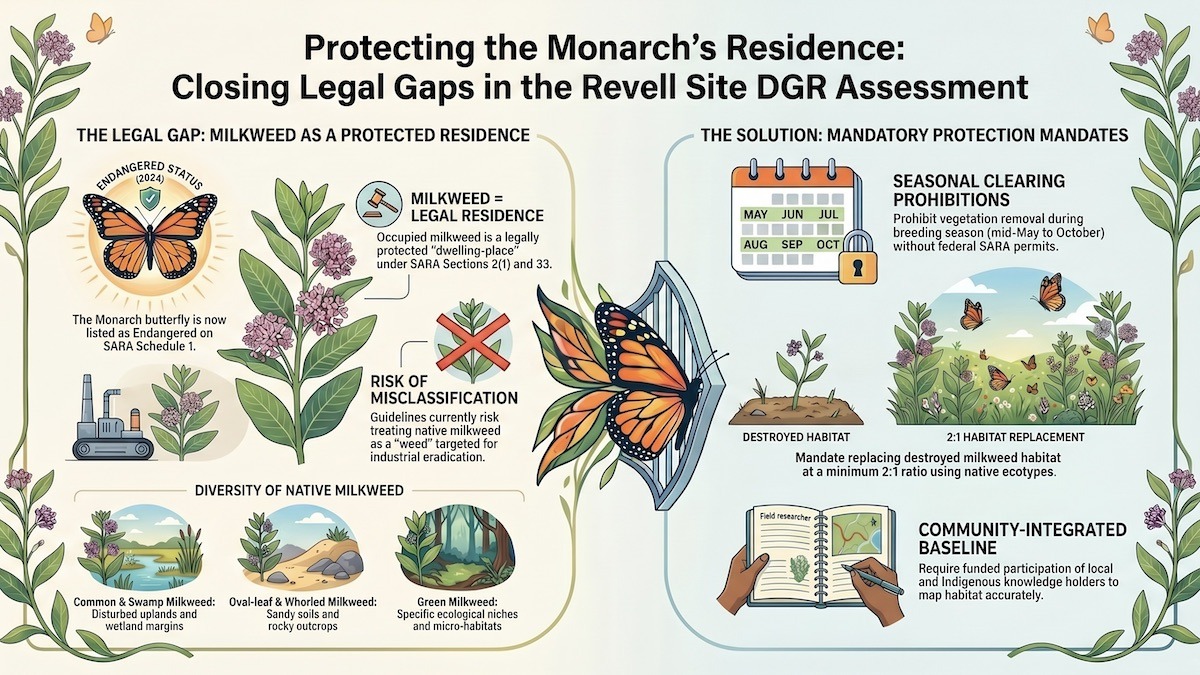
While the papermaking happens in the studio, the real impact is felt in the boardroom. Art Borups Corners recently leveraged this project to write formal submissions to the Impact Assessment Agency of Canada (IAAC) regarding the proposed Deep Geological Repository (DGR) for Canada’s Used Nuclear Fuel Project at the Revell Site.
The community made a sophisticated argument: because the Monarch butterfly is endangered, and because the Monarch requires milkweed to survive, those milkweed patches are legally protected “residences.” By documenting these plants through their art and gardening programs, residents are producing the exact scientific baseline data that federal assessments and proponents often overlook.
The “Living Classroom” Strategy
This project flips the script on traditional environmentalism. Instead of sitting through dry lectures, community members engage in:
- Creative Placemaking: Turning the Dyment Recreation Hall into a hub for sustainable innovation.
- Land-Based Literacy: Gaining the “field experience” needed to challenge industrial experts during federal hearings.
- Entrepreneurial Skills: Showing that a sustainable future includes local jobs and artisanal exports.
By the time the first sheets of milkweed paper are dried, the participants have become more than just artists—they’ve become “citizen experts” capable of navigating the complex world of the Species at Risk Act (SARA).
Why This Matters Now
As the DGR process moves forward, the data collected by Melgund residents will be vital. Major projects often have gaps in their research on small insects and “common” plants. Milkweed to Market fills those gaps.
Every photograph taken, every plant mapped, and every piece of art created serves as evidence. It’s a way for a small township to stand toe-to-toe with federal agencies, armed with the beauty of their local landscape and the hard data to back it up.
Join the Movement
Starting May 1, 2026, the Dyment Recreation Hall and Complex will host the first round of plantings and workshops. Seeded with support from the IAAC Participant Funding Program and the Arts Incubator Winnipeg, this is a chance to turn local ecology into global action.
In Melgund, they aren’t just watching the butterflies; they are mapping the future. Whether you’re an artist, a gardener, or a local advocate, it’s time to see what happens when a community decides that their “weeds” are actually their greatest assets.