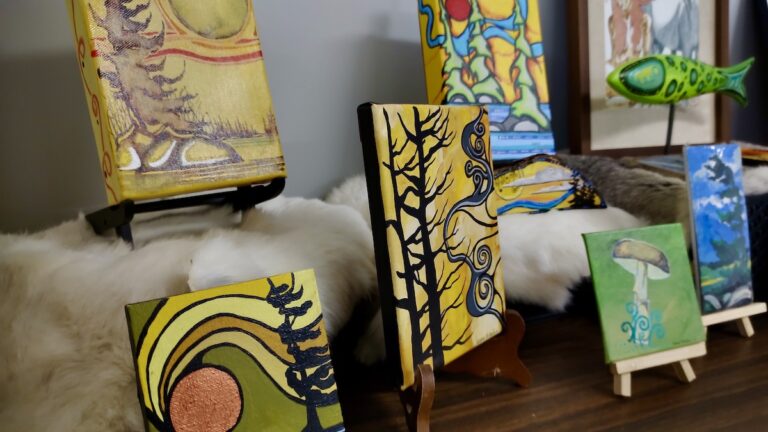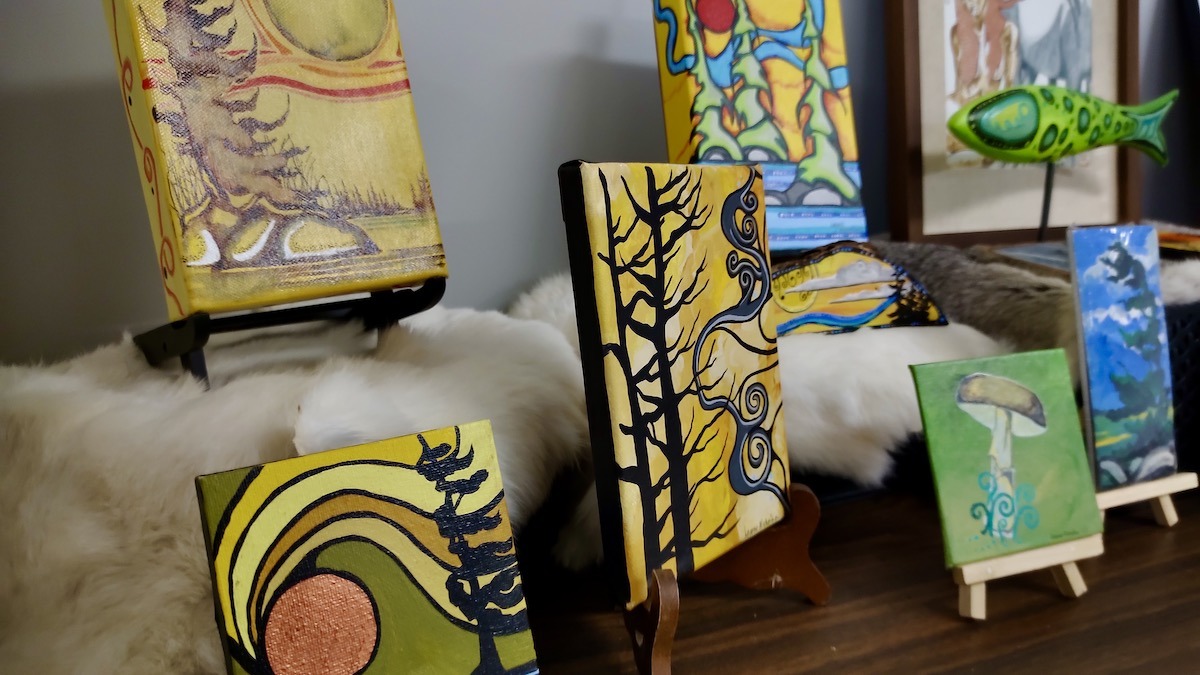
These beautiful paintings were created by Northwestern Ontario artist Leanne Nicholson.
Painting and Visual Arts in Community Recreation Programming
It’s a privilege to highlight the work of Leanne Nicholson. Her vibrant visual style—defined by bold linework, organic forms, and influences that echo the Woodland School of Art—captures something essential about Northwestern Ontario. Her work doesn’t sit at a distance from the landscape; it feels in conversation with it.
From sweeping blue compositions that evoke bone and memory, to forest scenes charged with movement and intensity, Nicholson’s paintings are not simply observations of place. They carry rhythm, presence, and a deep sense of connection to land, history, and lived experience. There is a grounding quality to her work that resonates strongly within community-based arts programming, where storytelling and identity are often at the centre of creative practice.
Within recreation programming, visual arts like painting and drawing play a much larger role than simple leisure activity. They are structured spaces for expression, reflection, and skill development—accessible to beginners while still meaningful for experienced artists refining their practice.
At the heart of this is the idea of participation. When people engage in painting or sketching through community programs, they are not only learning technique. They are also developing confidence in their own visual language. Over time, brushwork, colour choices, and composition become ways of communicating ideas that might not be easily expressed in words.
One of the most significant benefits of visual arts in recreation settings is the mental space it creates. Painting encourages focus without pressure, allowing participants to enter a kind of flow state where attention narrows and external stress fades into the background. This isn’t just about relaxation—it’s about cognitive reset, creative problem-solving, and emotional grounding through process-based work.
There is also a broader community impact that comes from supporting visual arts in this way. Local artists who develop their practice through accessible programming often become part of a wider creative ecosystem. Skills gained in these spaces can lead to exhibition opportunities, freelance work, teaching roles, and contributions to regional creative economies. In this sense, recreation programming becomes an entry point into long-term creative pathways.
In Northwestern Ontario and similar regions, visual arts also carry cultural weight. Painting and illustration often serve as tools for storytelling, preserving place-based knowledge, and reflecting Indigenous perspectives and relationships to land. This transforms visual arts programming into something more than individual expression—it becomes part of a shared cultural record that evolves over time.
Arts incubators and community-based studios play a critical role in this process. They provide the space, materials, and support needed for artists at different stages of development to work alongside one another. This mix of emerging and established voices creates an environment where learning is continuous and informal mentorship happens naturally.
Leanne Nicholson’s work reflects that environment well. It carries both personal voice and collective influence, shaped by place and strengthened through practice. Her paintings are not isolated works—they are part of an ongoing dialogue between artist, land, and community.
When recreation programs make space for visual arts like this, they are doing more than offering an activity. They are building infrastructure for creativity, cultural expression, and well-being. They are creating conditions where people can explore who they are through image, colour, and form.
And in that sense, painting is not separate from recreation—it is one of its most powerful expressions.
About the Author