
The Next Great Prairie Innovation Hub Might Not Look Like a Tech Company
Spend ten minutes at any innovation conference and you’ll hear the same cast of characters: the startup founders, the university labs, the accelerators with the exposed brick and the kombucha on tap. We’re not knocking any of it, because those places really do matter. But we’ve come to believe there’s a missing character in that story, and it looks a lot like us.
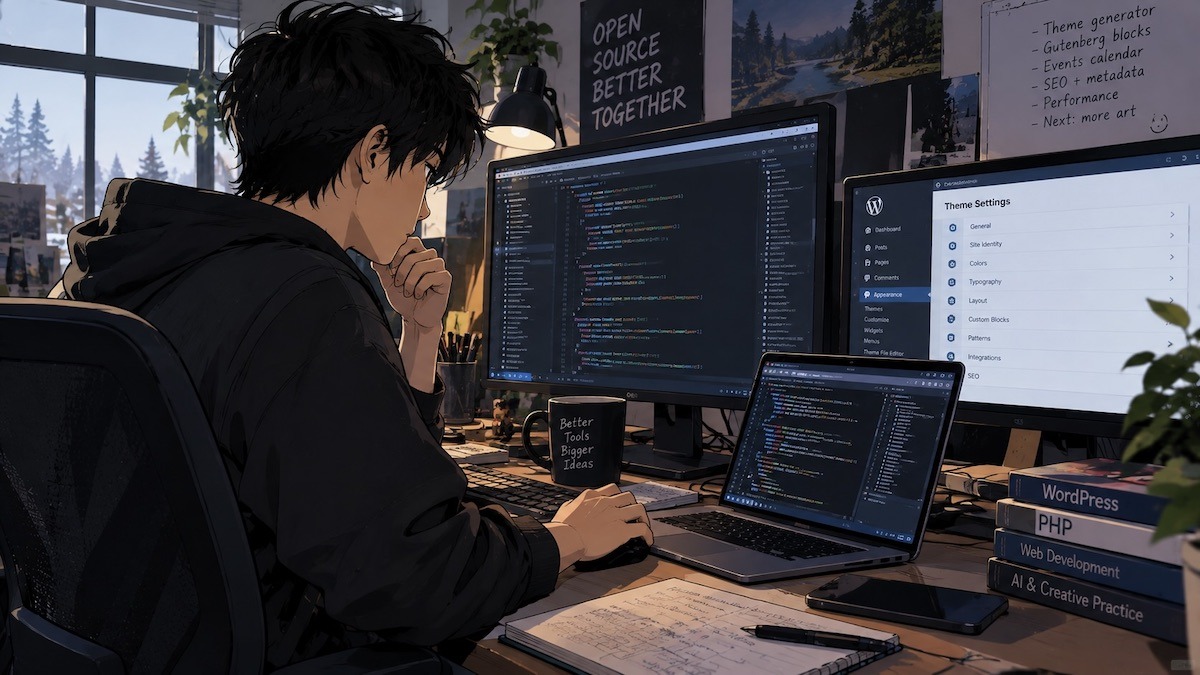
Our program is, at first glance, an arts organization. We work with artists, run programs, publish stories, host events. But over the past while, we’ve also been building software: developing own systems, learning to develop with AI-assisted engineering and running live in real-world operation every day.
We told the first part of this story earlier in our article Making WordPress work our way. This is the part where things get interesting, at least for us!
From a website to a system
Here’s the shift that changed how we think about our own work. Early on, we stopped treating our website as a finished object. You know, something you build once and maintain grudgingly … and started treating it as infrastructure: something designed, versioned and improved the way you’d treat any production system.
That mindset turned every problem into an engineering problem worth solving properly. Gallery captions colliding on exhibition pages. Calendar widgets that didn’t match the rest of the site. Category filters wrapping badly on multi-category posts. A calendar archive missing its main page heading — bad for accessibility, bad for search engines. Instead of patching each symptom, we fixed the system that produced it, and we fixed it at the source: one organized generator that compiles the entire theme and all its code, so a change made once applies everywhere it needs to.
But along the way, we realized we weren’t maintaining a website anymore. We were maintaining a platform — one with its own design tokens, editorial patterns, search architecture and plugin integrations, all coordinated from a single source of truth.
An independent technical readiness assessment, using the Government of Canada’s Technology Readiness Level scale, places our deployed platform at TRL 8 — actual technology qualified through testing and demonstration under real operational conditions. The underlying generator and toolkit sit at TRL 7–8, with the core theme engine assessed at TRL 9. We say “assessed” deliberately, because credibility with funders starts with not overselling. What those numbers tell a reviewer is that this isn’t an idea seeking validation. We already have working infrastructure with an honest, documented path to full maturity.
Why this matters beyond our walls
Step back and look at the Prairie economy for a moment. Small cultural organizations, rural nonprofits, independent publishers, festival societies, community media. These groups are economic actors. They employ people, attract visitors, preserve local knowledge and keep money circulating in their communities. Yet when regional technology strategy gets discussed, they’re rarely in the room. They’re handed generic software designed for someone else’s workflow, priced on someone else’s cost structure, and supported (or not) from someone else’s time zone.
The math underneath that arrangement deserves more scrutiny than it usually gets. A modest community organization can easily spend $1,000 to $5,000 a year on software subscriptions alone — page builders, SEO plugins, event calendar add-ons, managed hosting tiers — before paying a single consultant to fix what breaks. Multiply that across hundreds of Prairie nonprofits and small businesses, and you’re looking at a significant annual transfer of community money to out-of-province vendors, for tools the organizations don’t own and often can’t modify.
Our model is trying really hard to help break that pattern. Our tools run on standard PHP, CSS and vanilla JavaScript, on infrastructure we control. There are no runtime AI dependencies, no API bills, no per-site licenses. When we want a change, we edit the source and regenerate — work that once carried 160 to 240 hours (conservatively) of senior developer time now happens in focused sprints. The money we don’t spend on subscriptions stays here in Winnipeg, funding artists and programming instead of software renewals.
The regional opportunity
This is where programs like PrairiesCan’s Regional Artificial Intelligence Initiative come in — and where we think there’s a genuinely good fit worth talking about.
RAII’s ecosystem enablement stream is built for exactly this kind of work: it supports incubators, accelerators and not-for-profit organizations to connect SMEs and community groups with technical, advisory, demonstration and sector-specific support. For eligible NFPs, contributions are non-repayable, covering up to 90% of eligible project costs, with projects ranging from $250,000 to $5 million over up to three years. The program names digital industries and inclusiveness — youth aged 15 to 34 among them — as priority areas.
Read that stream description next to what we’ve actually built, and the alignment is hard to miss. We’re an incubator with working, inspectable technology. We understand the sectors RAII wants to reach — in our case, galleries, festivals, community groups, small creative businesses — because we work inside those sectors. And from the beginning, the system was designed for repeatability: brand identity, colours and organizational details sit apart from the core engine, so standing up a tailored version for a partner organization becomes a configuration exercise rather than a rebuild. That’s not a slide-deck promise; it’s how the architecture is actually organized.
The next phase for us isn’t about building more features. It’s about proving transferability at scale — partner mapping across Manitoba and the Prairies, structured demonstrations, technical clinics, and a youth and community-facing program that turns this development workflow into real, hands-on exposure to AI-assisted engineering. That’s the kind of project ecosystem enablement was designed to fund, and we’d rather build it with the region than go it alone.
What we’ve learned
A few things, stated plainly for other organizations watching this space:
Innovation doesn’t require permission from the tech industry. The tools to build serious software are more accessible than they’ve ever been, and AI-assisted development has collapsed the cost of iteration for organizations willing to learn the fundamentals.
Systems beat sites. A website is something you have. A system is something you understand, improve and eventually share. Funders and partners should ask that question of any technology project — including ours.
The goal was never the software. The system is a means to an end: cultural organizations keeping (and growing) their digital capacity, their networks and their audiences on their own terms, with skills that stay in the community.
Regional innovation doesn’t have to look like a tech company. Sometimes it looks like an arts incubator that refused to rent its infrastructure forever — and decided to build something it could share.
We’d love to hear what you think. Contact us.
Do It Yourself!
Making WordPress work our way
We’ve been making changes to artsincubator.ca as our collection of stories, exhibitions and projects continues to grow. Along the way, we’ve been working on more than the website’s appearance, developing new tools, systems and ways to publish, manage and share our work.
Here’s a closer look at what we’re building and some of the ideas behind it.