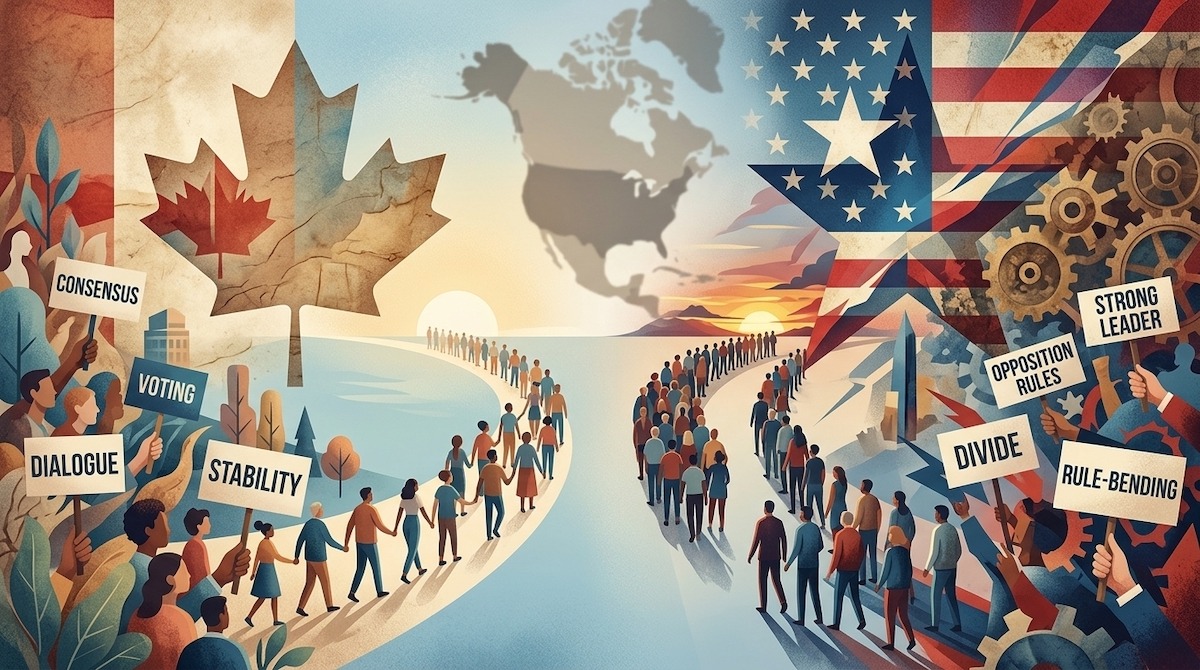
New cross-border research highlights contrasting trends in support for rule-bending executives in Ottawa and Washington.
A new comparative study reveals growing stark contrasts in how Canadians and Americans view executive power, showing that while citizens in both nations are evenly split on leaders who “bend the rules,” Americans are far more politically polarized over autocratic overreach.
The report, published by the Environics Institute for Survey Research in partnership with Vanderbilt University’s LAPOP Lab, highlights three major issues surrounding public support for strong-arm leadership in North America.
The report’s primary finding examines public tolerance for strong national leaders willing to bypass established rules to get things done. In both countries, public sentiment is evenly divided, with 32 per cent of Canadians and 37 per cent of Americans endorsing rule-bending leadership.
However, the two nations are moving in opposite directions. In Canada, support for rule-bending prime ministers fell from 38 per cent during the height of the COVID-19 pandemic in 2021 to 32 per cent in 2025. Conversely, American support surged from 21 per cent to 37 per cent over the same period, propelled by a sharp increase among young American men—whose support jumped from 30 per cent to 59 per cent—and rising Republican backing following Donald Trump’s return to the presidency.
The second major issue centers on whether national leaders should hold the authority to limit the votes and voices of opposition parties in government.
While majorities in both nations reject restricting political opposition, American views are heavily dictated by which party occupies the White House. Half of Americans oppose limiting opposition parties in Congress, but 70 per cent of Democrats express strong disagreement compared to just 23 per cent of Republicans. In Canada, where 38 per cent disagree with limiting opposition voices and 51 per cent hold a neutral view, opposition to executive overreach remains consistent regardless of partisan preference.
The third issue focuses on direct authoritarian measures, including whether leaders should ignore legislative bodies, censor critical news organizations, or override judicial decisions.
Clear majorities in both Canada and the United States reject these measures, with roughly six in ten citizens in both countries opposing efforts to ignore Parliament or Congress, censor news media, or disregard court rulings.
Yet the report highlights a critical divide in how political alignment shapes these views. While Canadian voters across all major parties overwhelmingly reject autocratic powers, American voters remain fractured. One-third of U.S. Republicans support government censorship of critical media outlets, compared to only 15 per cent of Democrats.
“Canadian public opinion about strong national leaders is less about which particular party forms the government as about one’s general political ideology,” wrote report author Keith Neuman, senior associate at the Environics Institute.
The findings are based on representative online surveys conducted with 3,550 Canadians in summer 2025 and 1,600 Americans in October 2025 as part of the 2025-26 AmericasBarometer study.