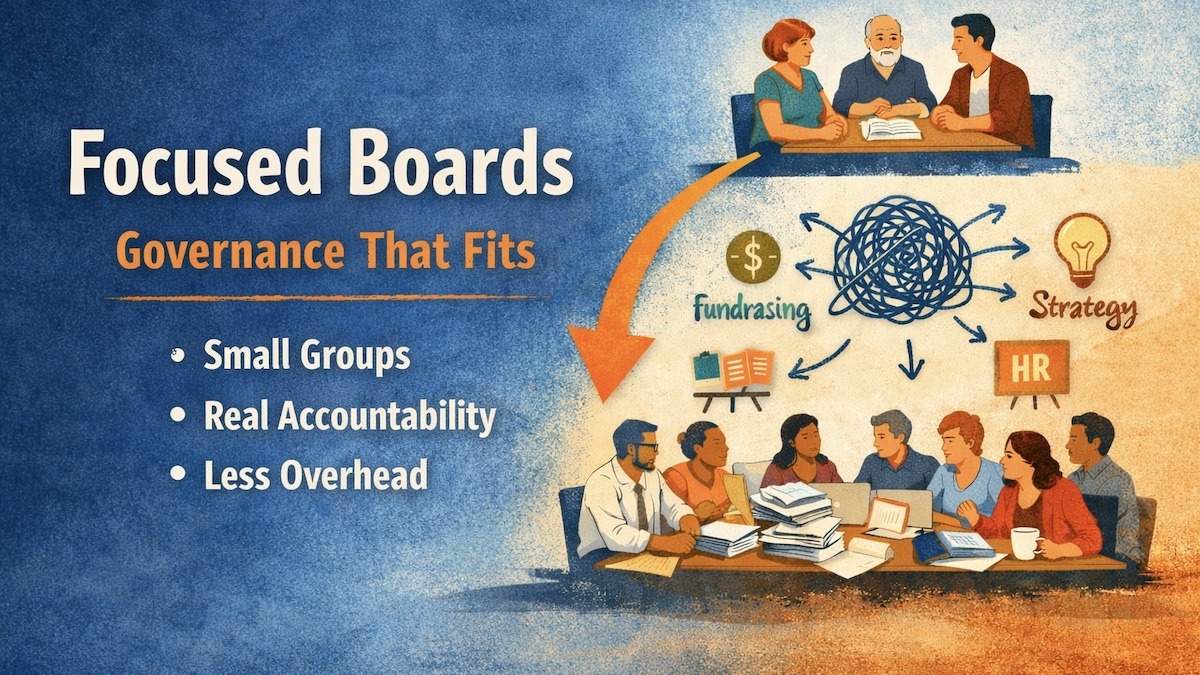
Why many small groups function better with fewer board members and clearer boundaries
Most organizations don’t actually start because someone sat down and designed a governance system. They start because something is happening—a project begins, a relationship forms, a gap in the community becomes impossible to ignore. The structure usually comes later, and when it does, it often feels like it belongs to a different scale of work entirely.
That’s usually where things start to get a bit awkward.
A Focused Board—sometimes called a Minimally Viable Board—is basically an attempt to fix that timing problem. Instead of building a full institutional board right away, you keep it very small. Three to five people, sometimes even fewer at the beginning. Their job is not to do everything. It’s just to hold the legal and financial backbone of the organization so it can exist properly in the world.
That means the unglamorous but necessary things: approving budgets, making sure filings are done, holding basic accountability for leadership. The stuff that, if nobody holds it, the whole thing becomes unstable.
Everything else—the ideas, the programs, the relationships, the outreach, the experimentation—doesn’t have to live there. And honestly, it probably shouldn’t.
Instead, those things can live in looser spaces. People who care about the work but don’t need legal responsibility. Advisors. Volunteers. Community partners. Informal groups that can actually move and shift without needing a formal vote every time something changes.
So the board becomes something much simpler than what most people are used to. Not the “center of everything,” just the minimum structure that keeps things accountable and real.
The shift is actually pretty simple, but it changes how things feel. Instead of asking, “Who should sit on the board and represent everything we’re doing?” you ask something more grounded: “What is the smallest group we need so this thing is still legitimate and accountable?”
That question tends to produce a very different kind of structure.
Most Focused Boards end up small on purpose. Not because small is trendy, but because small is often enough. They don’t try to hold strategy for every program or manage every relationship. They stay closer to oversight than orchestration.
And for a lot of small or early-stage groups, that’s where the tension usually is. You’ve got maybe a handful of people doing most of the actual work, but the governance structure expects something much bigger and more formal. So suddenly you’ve got volunteers being asked to take on responsibilities that feel heavy or unclear, or meetings that slow everything down because the structure is bigger than the reality on the ground.
It creates this quiet mismatch. Nothing is technically “wrong,” but it doesn’t feel natural either.
A Focused Board tries to reduce that gap. It keeps the legal responsibilities intact, but it stops the board from becoming the place where everything has to land. That alone can change the energy of an organization. Things move faster. People stop over-relying on formal approval for things that are actually just part of doing the work. And maybe most importantly, people stop burning out trying to make a governance structure do jobs it was never meant to do.
There’s also something else that happens that’s a bit less obvious: clarity improves. When the board is clearly not responsible for every decision, other roles can actually exist without confusion. People can step into advisory roles without pretending they’re directors. Community members can be involved without being pulled into legal accountability. Strategy can be something living in the work, not something constantly routed through governance meetings.
In more traditional nonprofit setups, boards tend to expand over time. They slowly absorb everything—strategy, fundraising, HR oversight, long-term planning, sometimes even community relationships. That can work in large institutions where there’s enough capacity and distance between roles.
But in smaller or shifting organizations, that model often gets heavy fast. The board becomes a kind of catch-all. And once that happens, everything slows down—not because people aren’t committed, but because too much responsibility has been concentrated in one place.
A Focused Board draws a simpler line. The board holds the legal and fiduciary responsibilities. That’s it. Everything else can be distributed more naturally across the ecosystem of people involved in the work.
It doesn’t remove participation. If anything, it makes participation more real, because people aren’t being pulled into roles they don’t actually need to carry. It just stops pretending that all meaningful involvement has to sit inside a legal governance structure.
And it’s worth saying what this isn’t.
It’s not a way to dodge accountability. It doesn’t mean “less responsibility,” and it definitely doesn’t mean “no structure.” If anything, the responsibility becomes more visible, because it’s not hidden inside a bloated system anymore.
It also doesn’t replace community input. The work still needs relationships, feedback, trust, and shared direction. It just doesn’t force all of that into a formal board format to make it legitimate.
What it does is narrow the focus. It asks: what actually needs to be governed, and what just needs to be supported?
That question matters more right now than it might have in the past, because a lot of new organizations don’t grow in slow, predictable stages anymore. They form quickly, shift quickly, and often carry more complexity than their structure can comfortably hold.
So governance ends up lagging behind the work.
Focused Boards are one attempt to catch that up. Not by adding more structure, but by scaling it back to something that actually fits.
And for a lot of groups, especially early ones or ones in transition, that difference is enough to make things feel workable again.
New Models for Board Governance in the Arts: What We’re Learning from MOMENTUM
We’ve been learning a lot from the MOMENTUM program, led by Creative Evolutions in partnership with Theatre Communications Group, especially around how governance can be rethought when it’s treated less like a fixed structure and more like something living, adaptable, and collectively built.
MOMENTUM is a rolling convening where creative leaders gather in small cohorts across multiple sites—each group building on the ideas of the last. Rather than trying to “solve” boards or replace them outright, participants focus on expanding what’s possible: naming emerging models, testing real-world approaches, and refining governance ideas through shared iteration.
For anyone interested in governance, organizational design, or creative leadership, it’s a space worth paying attention to—not because it offers a single answer, but because it’s actively widening the range of options we can choose from.