Federal food security plan aims to boost independent grocers, expand domestic food processing, and increase year-round fruit and vegetable production
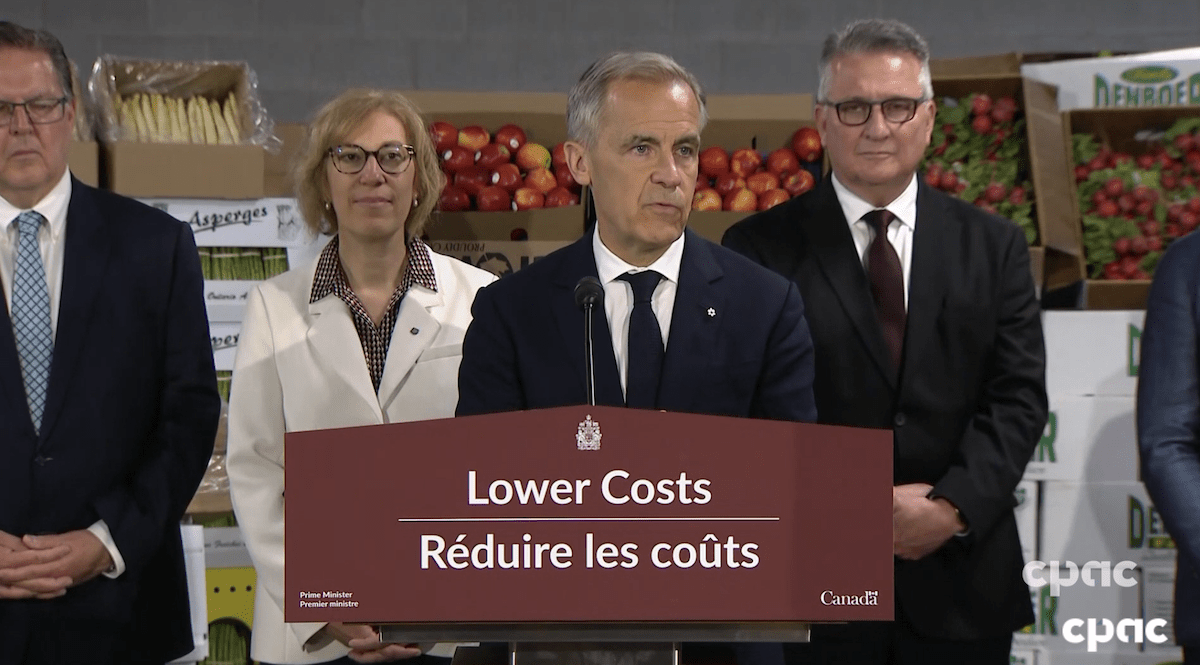
Prime Minister Mark Carney launched Canada’s first-ever National Food Security Strategy today, announcing more than $3 billion in investments over ten years to lower grocery costs, spur retail competition, and boost domestic food production.
The strategy arrives as shifting global trade dynamics, international conflicts, and climate change put growing pressure on food and energy systems, driving up shelf prices across the country. Government data shows that while Canada is the world’s ninth-largest exporter of agri-food products, domestic consumers continue to face some of the highest grocery costs in the G7. Food inflation in Canada has surged 31 per cent since January 2020, compounded by a heavy reliance on foreign suppliers and a severe lack of retail competition.
“Canada is one of the world’s great food producers. But too much of what we grow is processed elsewhere, and too many Canadians still rely on imported food at higher prices. Canadian farmers deserve more options to sell their produce, and Canadians deserve more options for where to buy their food,” Carney said. “Canada’s first-ever National Food Security Strategy will help grow and process more food here and put more Canada on Canadian plates – lowering costs, creating jobs, and building a food system that is more resilient, more competitive, and more our own.”
Canada Grocery Prices: Fighting Market Concentration with a $1B Food-Link Fund
Newly released federal data reveals that five major grocery retailers—Loblaw, Sobeys, Metro, Walmart, and Costco—currently control approximately 75 per cent of all domestic grocery sales. This intense retail consolidation forces independent grocers to rely on the wholesale and distribution networks of their direct corporate competitors.
To counter this concentration, the government is establishing a new ten-year, $1 billion Food-Link Fund to build independent food infrastructure, including expanded food terminals and distribution hubs. The initiative aims to expand the Ontario Food Terminal and construct two additional regional terminals by 2028 to give independent grocers direct access to competitively priced products without relying on large retail chains. The strategy will also fund 20 to 40 commercial food hubs in rural, remote, and northern communities to consolidate local supply and reduce transportation costs.
To enforce marketplace fairness, the government is providing nearly $130 million over ten years—amounting to $12.9 million annually—to enhance the enforcement capacity of the Competition Bureau and Competition Tribunal. The funds will be used to investigate anti-competitive business practices, such as algorithmic collusion, surveillance pricing, and restrictive real estate property controls that prevent new grocery stores from operating.
National Food Security Strategy: Insulating Supply Chains From Geopolitical Shocks
The strategy also aims to insulate Canada from global shocks, noting that international geopolitical conflicts have severely impacted farm operating expenses. Federal analysis notes that Canada imported 35 per cent of its $9.8 billion fertilizer supply in 2023, leaving farmers vulnerable to price spikes because fuel and fertilizer account for more than half the cost of producing an acre of corn. Additionally, climate change threatens long-term yields, with the OECD estimating potential global price hikes of 26 per cent for wheat and 28 per cent for corn by mid-century.
To scale up domestic processing capacity, the government is launching a new $1 billion Agri-food Project Finance Fund through Farm Credit Canada to provide seed capital for capital-intensive businesses. This is paired with a $150 million Food Security Fund under the Regional Tariff Response Initiative to help small and medium-sized businesses upgrade equipment, and a $100 million Collaborative Food Innovation Fund through Canada’s Global Innovation Clusters to help producers expand agri-food processing.
Federal data highlights significant gaps in current domestic capacity, revealing that Canada exported 24 per cent of its live hogs and 20 per cent of its live cattle to the United States in 2025 due to a lack of processing plants, while simultaneously importing 30 per cent of its pork and 26 per cent of its beef to meet consumer demand.
Greenhouse Technology and Vertical Farming: Scaling Year-Round Fruit and Vegetable Production
Because Canadians currently rely on imports for 88 per cent of fresh fruit and nuts and 72 per cent of vegetables, the plan earmarks $750 million over seven years for the Controlled Environment Agriculture Growth Pathway. This includes a $650 million stream to help producers adopt automation, robotics, and digital growing tools in greenhouses and vertical farms, alongside a $100 million stream to expand local food production in rural and northern communities.
The mandate sets a performance target to double indoor agricultural production value to $1.55 billion and reduce dependence on imported crops by 20 per cent by 2032.
Cutting Agricultural Red Tape: Streamlining CFIA Approvals and Interprovincial Trade
To reduce regulatory burdens on producers, the government plans to amend the Canadian Food Inspection Agency Act and the Pest Control Products Act to force regulators to consider domestic food security and consumer costs alongside health and safety. Supported by $11.3 million over four years, the initiative aims to eliminate CFIA approval backlogs by the end of 2026 and accelerate future approvals for seeds, feed, fertilizers, and veterinary products by at least one-third.
Furthermore, Ottawa will provide $12 million over three years to help 4,000 provincially licensed food businesses meet federal requirements, while giving provincial abattoirs a time-limited exemption from Safe Food for Canadians Regulations to address localized slaughter shortages and facilitate easier interprovincial trade.
“The National Food Security Strategy is about giving Canadians greater choice, control, and access to affordable, locally produced food,” said Heath MacDonald, Minister of Agriculture and Agri-Food. “Through this made-in-Canada approach, we will process more of what our farmers grow here at home, creating jobs, driving economic growth, and strengthening Canada’s food self-sufficiency. By reducing red tape and helping innovative businesses get projects off the ground faster, we will unlock new opportunities for farmers, food processors, and entrepreneurs across the agri-food sector.”
Federal Affordability Measures: Integrating School Food Programs and Tax Relief
The government states the strategy builds on existing affordability measures, including the permanent establishment of the National School Food Program, the launch of the Canada Groceries and Essentials Benefit, and the cancellation of the consumer carbon price.
To provide immediate relief while long-term infrastructure is built, the government has committed $20 million to food banks through the Local Food Infrastructure Fund, implemented immediate tax expensing for greenhouse construction, and scheduled an early wave of proposals through the Strategic Response Fund for June 2026. The strategy binds its accountability to a final key performance indicator: increasing the domestically produced share of healthy food available to Canadians from 75 per cent to 85 per cent by 2032.