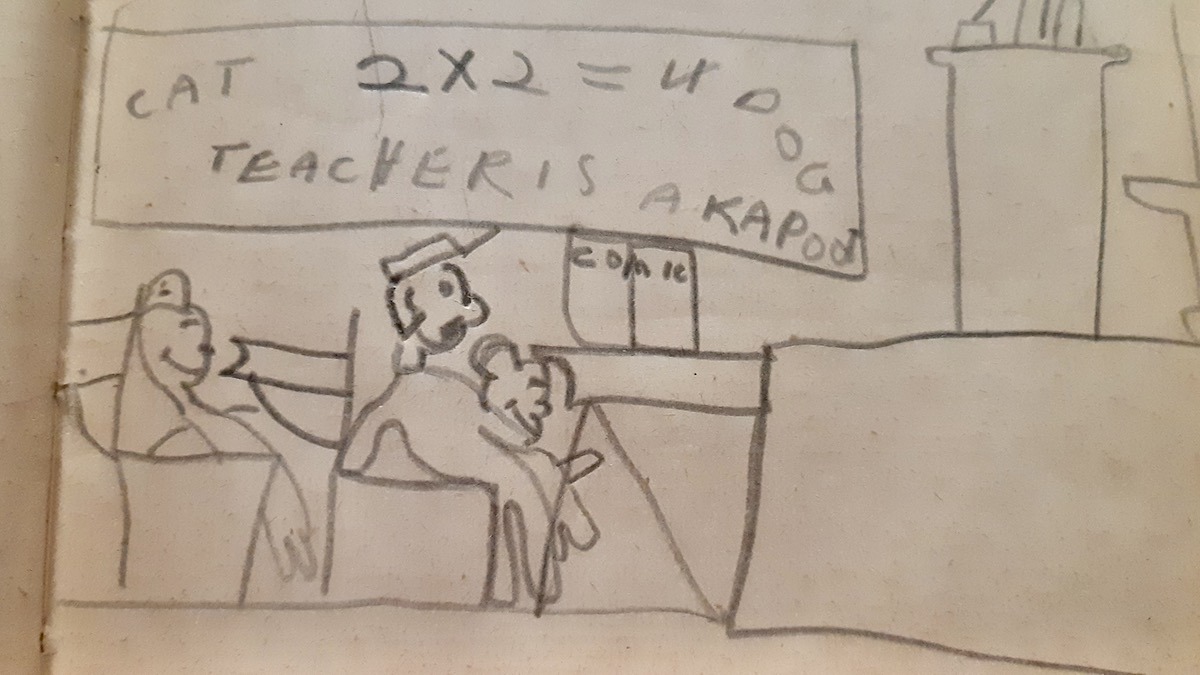
The Kapoot Manifesto: Uncovering the Silent Coup Inside the Old Dyment Schoolhouse
The textbooks in the Dyment library are supposed to be quiet records of rural education, but between the pages of the 1940s curriculum, the students are still talking back. Long before the schoolhouse became an archive, it was a place of heavy wooden desks and the rhythmic scratch of pencils. In the margins of one such book, a bored revolutionary left behind a masterpiece of mid-century defiance: a sketch of a classroom where the teacher is “kapoot” and the only thing worth reading is a hidden comic book.
The drawing is a perfect hit-piece on the monotony of the “Three Rs.” On the blackboard, the child has dutifully noted that 2 x 2 = 4 and “CAT” is spelled exactly how you’d expect. But the real action is happening on the desk. A “COMIC” book—the ultimate contraband of the 1950s—is propped up like a middle finger to the lesson plan. By labeling the teacher “KAPOOT” (a wonderfully phonetic take on the German kaputt), the artist wasn’t just being a brat; they were declaring the entire rigid structure of the era’s education system officially broken.
The word marginalia refers to these unauthorized marks, doodles, and protests found in the white spaces of books. It is the history of the “un-listened to.” While the printed text represents the authority of the school board, the marginalia represents the soul of the student. It’s where a dry geography lesson becomes a canvas for a dog in a hat, or where a spelling book becomes a platform for calling out a boring lecture. It is the unfiltered, human side of an otherwise sterile historical record.
Finding this “Kapoot Manifesto” inside the Dyment library collection reminds us that school has always been a tug-of-war between the head and the heart. The child who drew this probably grew up to be a pillar of the community, but for one afternoon in 1952, they were a rebel with a pencil.
These margins offer a bridge to the past that no official school photo ever could—a messy, funny, and deeply human reminder that boredom is the true mother of invention.