Executive Summary
The Nuclear Waste Management Organization (NWMO) proposes the Revell Site Deep Geological Repository (DGR) as a multi-generational infrastructure project expected to generate significant socio-economic benefits for Northwestern Ontario. These benefits are primarily categorized as direct employment, regional procurement, infrastructure capacity building, and long-term community investment through Hosting Agreements. Proponent documentation suggests that the project will act as an “anchor institution,” revitalizing the Township of Ignace and providing economic sovereignty for the Wabigoon Lake Ojibway Nation (WLON) [Analysis: iv. Township of Ignace Story]. However, forensic analysis of the public registry and technical submissions reveals a stark disparity in the distribution of these benefits, particularly for unorganized territories like Melgund Township, which face the majority of proximity risks without equivalent compensatory frameworks [Analysis: 19.2.3.12 NON-INDIGENOUS ECONOMIC CONDITIONS].
Detailed Socio-Economic Analysis
Employment and Workforce Development
The NWMO estimates that the project will create substantial long-term employment opportunities during its 160-year lifecycle. The construction phase (2030–2042) is projected to require a significant workforce, followed by a 50-year operational phase processing approximately 120,000 fuel bundles annually [Analysis: 10. Estimated Maximum Production Capacity of the Project]. Supporters of the project highlight the potential for high-paying, non-polluting jobs that could allow local youth to remain in the region rather than migrating to urban centers [Comment Ref: 101, 653]. The proponent has committed to workforce training and business-readiness initiatives to align local capacity with project needs [Analysis: 4.3.2 Areas of Focus and Shared Commitments with the Township of Ignace].
Infrastructure and Municipal Capacity
A core benefit cited by the proponent is the enhancement of municipal infrastructure. The Hosting Agreement with the Township of Ignace is designed to build capacity in areas such as water and wastewater systems, which are currently nearing the end of their functional lifespans [Analysis: 15.7 Infrastructure and Services]. The project includes the construction of a primary access road and potential rail spur connecting to Highway 17, which may improve regional logistics [Analysis: 9.5 Construction]. However, the City of Dryden has raised concerns that these benefits may be offset by the increased demand on healthcare and emergency services, which are already operating at or near capacity [Comment Ref: 651, 294].
Indigenous Economic Sovereignty
For the Wabigoon Lake Ojibway Nation, the project is framed as a catalyst for economic development and cultural reclamation. The confidential Hosting Agreement covers business opportunities, employment, and training [Analysis: 21. Potential Effects on Anishinaabe People]. The WLON narrative emphasizes that the project has already sparked renewed interest in community research and leadership, with off-reserve members expressing a desire to return home to contribute to the Nation’s future [Analysis: iii. Wabigoon Lake Ojibway Nation Story].
Evidence from Public Registry
Public sentiment regarding socio-economic benefits is deeply polarized. Supporters view the DGR as a “vital economic opportunity” that will provide stability to a region historically dependent on cyclical forestry and mining industries [Comment Ref: 539, 672]. Conversely, residents of unorganized territories like Melgund Township (including Dyment and Borups Corners) express a sense of “distributive unfairness.” They argue that while Ignace and WLON receive financial support, the immediate neighbors within 10 km of the site receive no direct benefits while facing potential property devaluation and the loss of a quiet, nature-based lifestyle [Comment Ref: 192, 391]. There is also significant concern that the “stigma” of a nuclear waste site will decimate the local tourism and outfitting sectors [Comment Ref: 272, 451].
Technical Deficiencies & Gaps
Internal analysis identifies several critical gaps in the proponent’s socio-economic benefit claims:
- Exclusion of Unorganized Territories: The baseline data primarily focuses on incorporated municipalities, effectively rendering the residents of Melgund Township invisible in the economic impact modeling [Analysis: 15.5 Population and Demographics].
- Lack of “Dutch Disease” Analysis: The proponent has not conducted a formal risk screening for negative economic externalities, such as local price inflation or the displacement of workers from existing businesses like the local fiber mill [Analysis: 19.2.3.12 NON-INDIGENOUS ECONOMIC CONDITIONS].
- Emergency Service Reliance: The project relies on volunteer fire departments in neighboring communities (Oxdrift/Wabigoon) without demonstrating how these services will be upgraded to handle specialized industrial or radiological incidents [Analysis: 15.7 Infrastructure and Services].
- Data Maturity: The proponent admits that Indigenous socio-economic data is not yet fully represented, which undermines the “informed” nature of the current benefit projections [Analysis: Acknowledgment of Truths].
Recommendations & Mandates
To ensure that the potential socio-economic benefits are realized equitably and do not result in net negative impacts for the region, we provide the following mandates:
- Strongly recommend the development of a “Melgund Infrastructure and Mitigation Fund” to provide the unorganized territory with direct financial support for road maintenance and community services, equivalent to the protections afforded to incorporated host communities.
- Strongly recommend a quantitative “Project-Induced Inflation Study” to model the impact of high-salaried in-migration on the cost of the food basket and housing for fixed-income seniors in the Ignace-Dryden corridor.
- Strongly recommend that the proponent demonstrate 100% self-sufficiency for emergency medical, fire, and security services at the Revell Site and the worker accommodation camp to prevent the displacement of essential services for local residents.
- Strongly recommend the implementation of a “Property Value Protection Program” for all residents within a 15 km radius of the project centroid to mitigate the documented risk of socio-economic stigma.
Conclusion
While the NWMO Nuclear Waste Repository offers a theoretical path to regional economic revitalization through jobs and infrastructure investment, these benefits are currently concentrated within specific political jurisdictions. The unorganized communities of Melgund Township bear the highest proximity risks—including industrial noise, heavy traffic on Highway 17, and potential groundwater threats—without a formal mechanism for benefit-sharing or risk mitigation. The path forward requires a transition from municipal-centric agreements to a regional equity framework that protects the most vulnerable neighbors of the Revell Site.
About the Deep Geological Repository (DGR) for Canada’s Used Nuclear Fuel Project
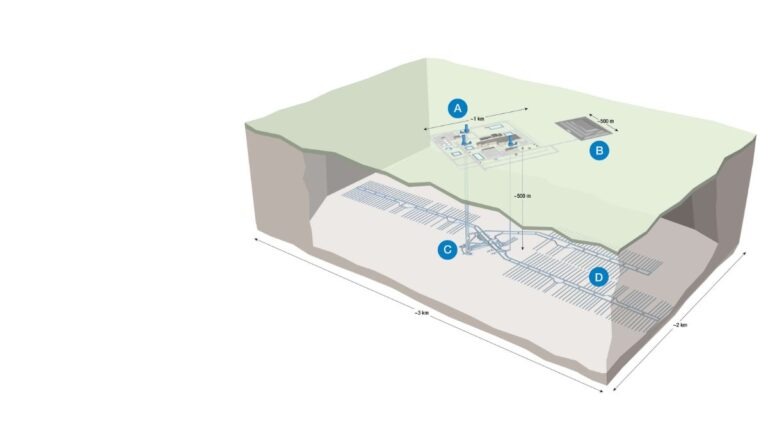
The Nuclear Waste Management Organization (the NWMO) is proposing a new underground deep geological repository system designed to safely contain and isolate used nuclear fuel. Wabigoon Lake Ojibway Nation (WLON) and the Township of Ignace have been selected as the host communities for the proposed project, which is located 21 kilometres southeast of the WLON and 43 kilometres northwest of the Town of Ignace, Ontario along Highway 17. As proposed, the Deep Geological Repository (DGR) for Canada’s Used Nuclear Fuel Project would provide permanent storage for approximately 5.9 million bundles of used nuclear fuel. The project is expected to span approximately 160 years, encompassing site preparation, construction, operation and closure monitoring. The project assessment is being conducted in collaboration with the Canadian Nuclear Safety Commission.
Learn more about the Integrated Impact Assessment process which is led by the Impact Assessment Agency of Canada and Canadian Nuclear Safety Commission.
- Read the Summary of Issues (February 16, 2026)
- Read the Summary of the Initial Project Description (January 5, 2026)
- Read the Initial Project Description (January 5, 2026)
- Learn More about the Melgund Integrated Nuclear Impact Assessment (MINIA) Project
- Learn More about the Nuclear Waste Management Organization (NWMO)
About the Author