Why this bright, sun-loving wildflower thrives along our roadsides
Drive down any backroad or hike a sunny trail in Northwestern Ontario during the summer, and you will inevitably see flashes of brilliant gold piercing through the grass. At first glance, you might mistake them for tall dandelions, but a closer look reveals something far more intricate. These are yellow hawkweeds, a group of highly resilient perennials known for their striking contrast of sunny petals and dark, fuzzy details.
Documenting these species is a big part of our summer routine. Every year, our arts incubator program works to capture the local plants, berries, and flowers growing in and around Melgund Township and the wider region. We want to celebrate the local landscape and show how these native plants shape our ecosystem. While casual observers might brush this plant off as a simple weed, capturing its unique architecture highlights the hidden complexity of our northern fields.
The Tight Cluster and Hairy Buds
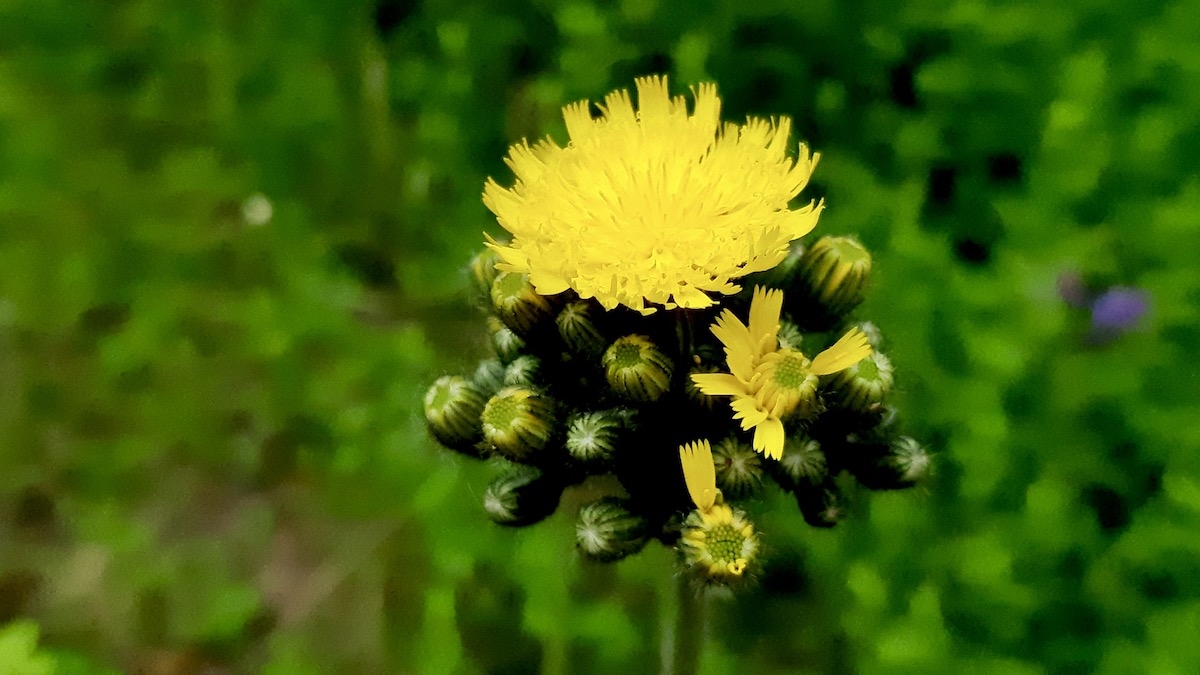
The easiest way to tell a hawkweed apart from other yellow composite flowers is to look right beneath the blossom. Instead of a single flower on a smooth stem, hawkweeds produce a tight, crown-like cluster of rounded flower buds waiting their turn to open.
These dark green, almost blackish buds are densely covered in stiff, tiny hairs. When the main flower opens, it reveals a dense ring of fringed, square-tipped petals that look like they were carefully trimmed with pinking shears. This cluster design ensures that even if one flower gets damaged, a succession of backups is ready to take its place, extending the plant’s blooming season for weeks.
Built for the Open Sun
Hawkweed is a master of colonizing open spaces where it doesn’t have to compete with deep forest shade. It thrives in poor, sandy soils, gravelly clearings, and the thin dirt collecting in the crevices of the Canadian Shield. The plant stays grounded with a small rosette of hairy leaves at the base, sending up a single, bristly leafless stalk to hoist the flowers high enough to catch the breeze and attract low-flying bees.
A Story of Resilience
Ancient folklore claimed that hawks ate the sap of this plant to sharpen their eyesight, which is how it earned its unusual name. In reality, the plant is simply a fierce competitor in the natural world. It spreads efficiently through underground runners, quickly establishing bright patches of color that provide an abundant source of summer pollen. It serves as a reminder of how tough a plant has to be to carve out a life in the sun-baked clearings of the north.