How this tough, low-growing native sedge awakens the northern forest floor before the trees even leaf out.
If you take a stroll through the dry woodlands or sandy clearings of Melgund Township in late May, you will likely notice a soft, bright green carpet underfoot, punctuated by tiny golden tassels. This is Pennsylvania Sedge (Carex pensylvanica), a native perennial that is among the very first plants to wake up after the long northern winter. Reaching just 15 to 30 centimeters in height, its low-growing habit is a brilliant evolutionary strategy. By keeping close to the earth, this hardy sedge steers clear of drying spring winds and maximizes its intake of early-season warmth radiating from the forest floor.
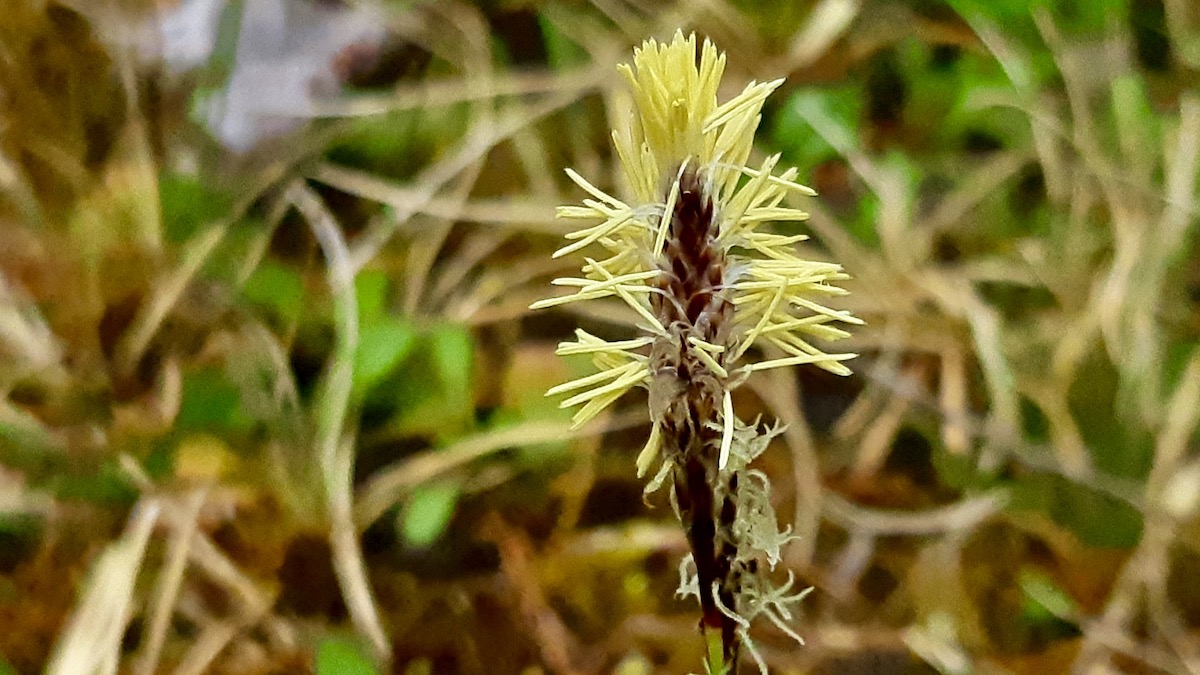
What makes this plant truly unique is its striking, two-toned flowering structure. That miniature “bottle-brush” crowning the stem is the staminate (male) spike, where creamy-yellow anthers contrast beautifully against dark purple scales.
Because Pennsylvania sedge is wind-pollinated, timing is everything. It deliberately blooms in early spring before the overhead tree canopy fills in, allowing the wind to freely carry its pollen across the forest floor. Additionally, as a true sedge, it features distinctly three-sided, triangular stems, perfectly embodying the old naturalist rhyme: “Sedges have edges, rushes are round, and grasses are hollow right down to the ground.”
Despite its delicate, grass-like appearance, this sedge is an ecological powerhouse in Northwestern Ontario. It spreads via creeping underground rhizomes, weaving a dense, living mulch that tightly anchors loose, sandy, or sloped woodland soils against erosion. It serves as a vital host plant for the caterpillars of several native skipper butterflies and forest moths. Later in the summer, its seed heads provide a high-energy snack for woodland birds and small mammals, while its fine, arching green blades are heavily harvested by local songbirds to build warm, insulated nests.