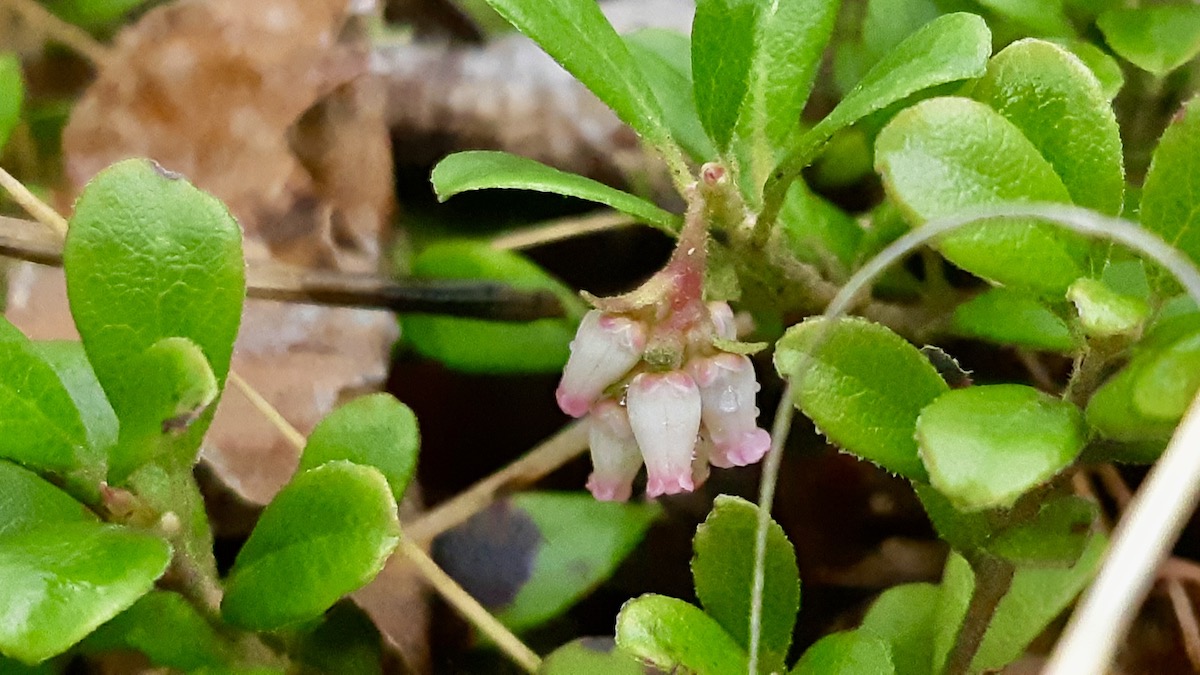
Kinnikinnick, the low-growing evergreen shrub anchoring the northern wilderness.
If you look closely at the rocky outcrops and sandy clearings of Melgund Township right now, you will spot clusters of tiny, pink-tipped bells dangling beneath leathery green leaves. This is Bearberry (Arctostaphylos uva-ursi), a remarkably tough, trailing evergreen shrub that thrives where other plants fail.
While it looks like a delicate woodland flower, bearberry is actually a woody powerhouse. Its ground-hugging, mat-forming growth habit keeps it safely beneath the worst of the biting northern winds, allowing it to carpet the Canadian Shield in a vibrant, year-round blanket of green.
The most striking feature of bearberry in late May is its uniquely shaped blossoms. These “urceolate” (urn-shaped) flowers look like miniature upside-down vases. This narrow-mouthed design is a clever evolutionary defense mechanism; it effectively protects the plant’s precious nectar and pollen from heavy spring rains and freezing temperatures. Because the opening is so tight, it requires specialized pollinators—like heavy native bumblebees—who use “buzz pollination” to vibrate the flower at just the right frequency to release the pollen inside.
Beyond its neat design, bearberry holds deep ecological and cultural significance. Its scientific name, uva-ursi, literally translates to “grape of the bear,” hinting at the bright red berries that will replace these pink bells by late summer. These berries persist well into winter, providing a critical survival food source for bears, grouse, and small mammals when other resources vanish. Culturally, Kinnikinnick has been used for centuries by Indigenous peoples in traditional smoking mixtures and medicinal teas. On top of that, its extensive, matting root systems act as nature’s anchor, preventing soil erosion along Ontario’s rugged, sandy slopes.