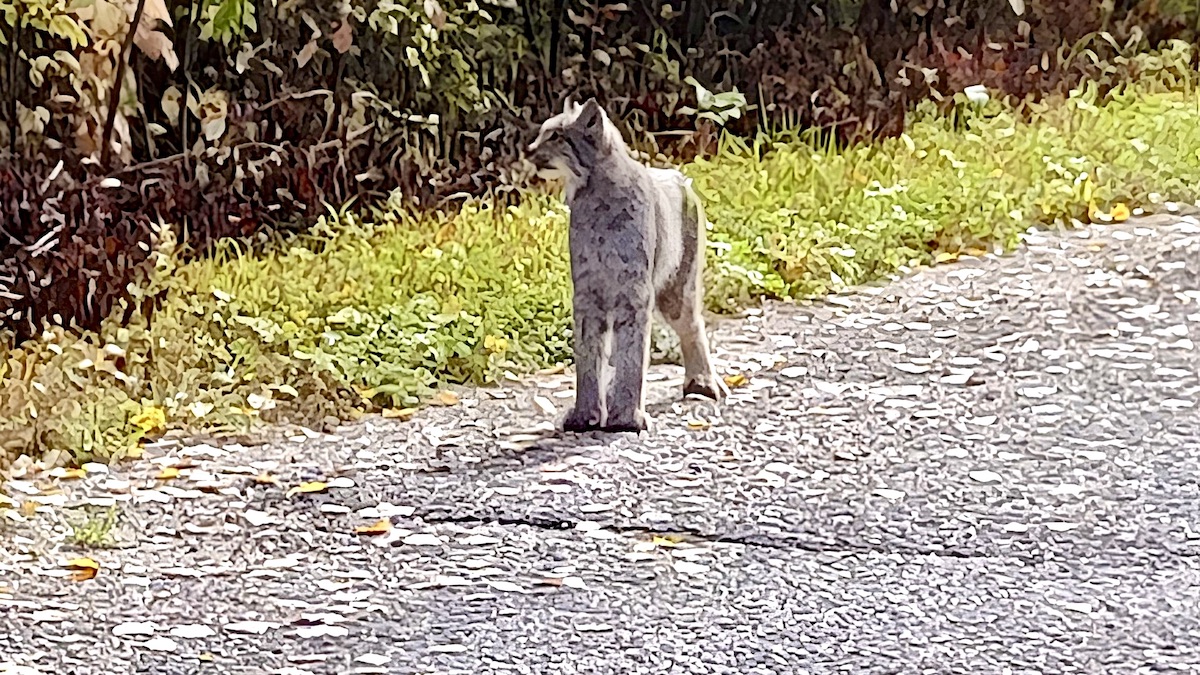
A young predator moves through Northwestern Ontario as the forest prepares for snow.
October changes the feel of the forest in Northwestern Ontario. The leaves are coming down, the mornings are colder, and the long green season is giving way to the first signs of winter. Somewhere in that changing forest, a young Canada lynx is busy doing what young lynx do: hunting, travelling, watching and learning.
For a young lynx, autumn is not a quiet time. It is a time of movement. The animal is growing into its independence and learning the forest as it goes. It follows trails, investigates sounds and scents, searches for prey and gradually becomes familiar with the places that will matter when winter arrives. Much of this happens quietly. Lynx are elusive animals, and even when one is nearby, there is a good chance we will never see it.
Food is at the centre of that life. In the boreal forest, Canada lynx are closely associated with snowshoe hares, which make up most of their diet. October brings a forest floor that is increasingly open as leaves disappear, but there is still plenty of cover for a lynx moving through the woods. It hunts by travelling quietly and using the forest around it, often waiting and watching before making a sudden move.
Winter is coming, and the young lynx is built for it. Its enormous paws will help it move across deep snow, while its thick coat will provide insulation through the cold months. But those adaptations are only part of the story. A young lynx still has to learn where to go, where prey can be found and how to move through a landscape that will look very different once it is covered in snow.
That is what makes an October sighting so interesting. We are seeing an animal at a particular moment in its life, but also seeing it in the middle of a much larger seasonal change. The forest is preparing for winter, and so is the lynx. It does not need to know that the seasons are changing. It simply responds to them: moving farther, hunting, exploring and learning.
For a few seconds, a young lynx may appear at the edge of a road, among the trees or across an opening before disappearing back into the boreal forest. Then it is gone. The forest carries on changing around it, and the young lynx carries on learning how to live there.