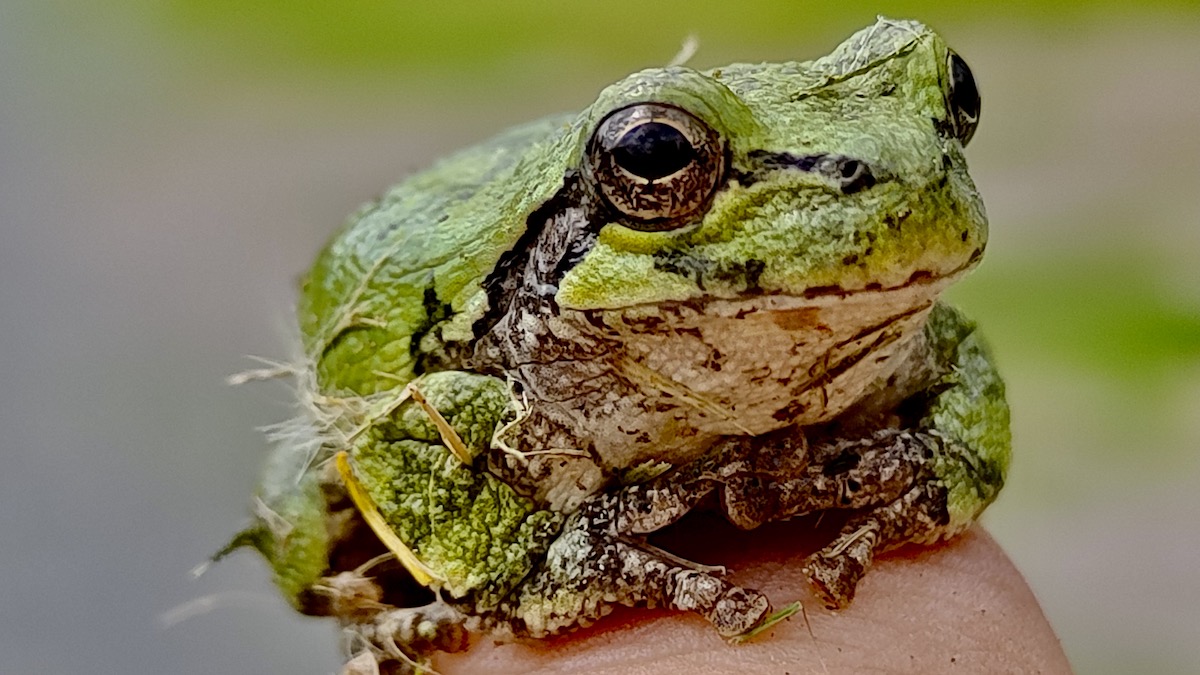
Despite its name, Ontario’s Gray Treefrog flashes brilliant green hues and sticky-toed acrobatics during spring breeding season
A tiny, bug-eyed resident of the Boreal forest has emerged to steal the spotlight in Northwestern Ontario this week, proving that some of the region’s most fascinating wildlife comes in very small packages.
Perched casually on a human fingertip, a vibrant green Gray Treefrog showcased the spectacular biodiversity hidden in the local canopy. Despite its official name, the Gray Treefrog, scientifically known as Hyla versicolor, is a master of disguise capable of shifting its skin tone from granite gray and dark brown to a vivid, leafy green depending on its surroundings, temperature, and activity levels.
The crisp close-up highlights the specialized adaptations that make this little amphibian a powerhouse of tree-dwelling survival. Prominently visible on its feet are large, circular toe pads that act like natural suction cups, secreting a sticky mucus that allows the frog to effortlessly scale vertical tree trunks, slick leaves, and even smooth window glass.
Observers can also spot a distinct light-colored patch right beneath the frog’s eye, which serves as a classic identification mark for the species. While the frog appears perfectly camouflaged from above, it hides a secret defensive weapon underneath, sporting a flash of bright yellow or orange on its inner thighs to startle and confuse predators during a leap.
Beyond its striking looks and climbing prowess, the Gray Treefrog possesses a legendary tolerance for the harsh Northwestern Ontario climate. To survive the winter, this resilient creature hibernates locally under the leaf litter and literally freezes solid. By producing massive amounts of glycerol that act as a natural internal antifreeze, the frog protects its vital organs while its heart completely stops beating and its breathing ceases.
When the spring thaw arrives, the frog wakes up unharmed and heads straight to local wetlands. Residents of Melgund Township can currently hear the males making their presence known on warm June evenings, filling the twilight air with loud, musical, bird-like trills to attract mates.