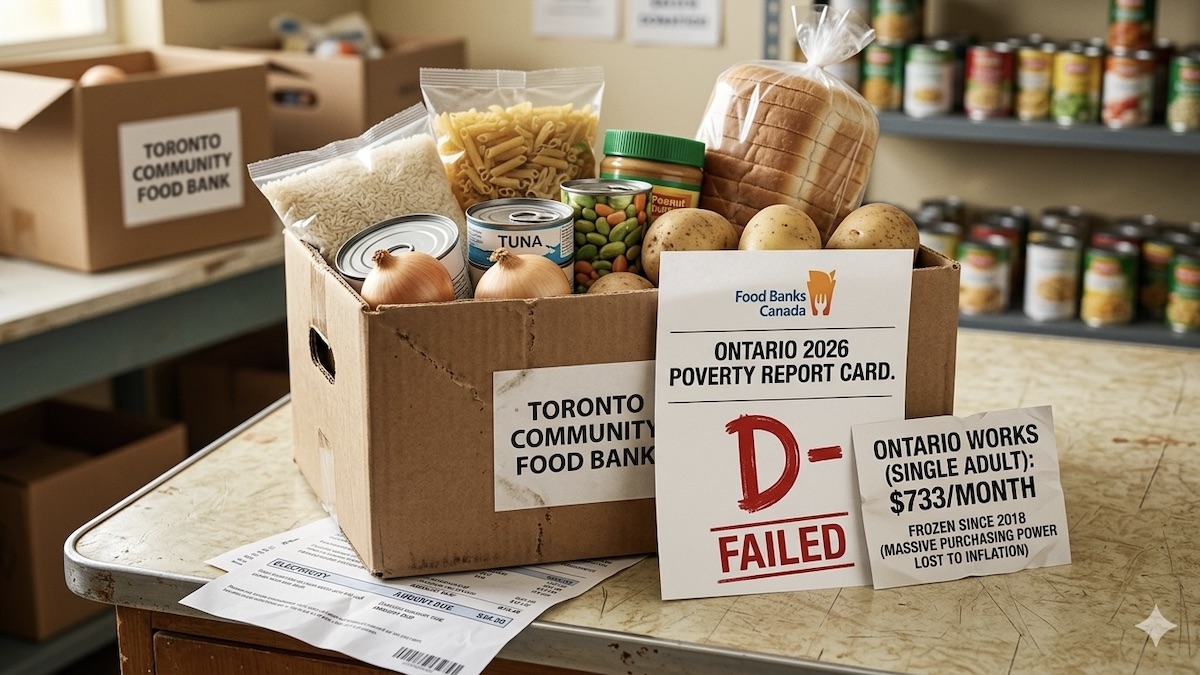
Food Banks Canada 2026 Poverty Report Cards show 43 per cent of Ontarians paying unsustainable shelter costs
TORONTO — Ontario’s provincial poverty reduction efforts have completely stalled, leaving the province locked in a dismal cycle of financial precarity and forcing record numbers of residents to rely on frontline food programs, according to a national report released today.
The Food Banks Canada 2026 Poverty Report Cards reveal that Ontario saw minimal change in its annual performance evaluation, receiving a failing D- grade once again. The stagnation indicates that the provincial government’s legislative measures have completely failed to keep pace with the real-world erosion of household purchasing power, earning the province a flat F for legislative progress this year.
Frontline organizations confirm that the provincial grade reflects a worsening environment on the ground. An intense local affordability crisis is actively pushing individuals into emergency food streams as rents and grocery prices scale far beyond what average local wages or public transfers can accommodate.
The report highlights a deeply precarious housing environment across the province, with 43 per cent of Ontarians now forced to spend 30 per cent or more of their total income strictly on shelter. This severe housing cost burden leaves families with little financial flexibility, as everyday survival has become exceptionally rigid. Outside of monthly rental or mortgage obligations, Ontario residents are dedicating an average of 56.5 per cent of their household income strictly to non-housing fixed costs, such as energy utilities, transportation, and health expenses—a rate higher than the national average and worse than both British Columbia and Quebec.
Compounding this financial strain is a collapsing healthcare access indicator. The report reveals that 36 per cent of Ontarians now report having trouble accessing health care, triggering an F grade and marking Ontario as the worst among all the large provinces for this metric. Furthermore, a staggering 71 per cent of government support recipients in Ontario report that their rates are completely insufficient to keep up with the cost of living, which stands as the highest rate of dissatisfaction in the entire country.
Welfare advocate networks argue that the depth of low-income desperation is being heavily exacerbated by systemic provincial policy failures. The baseline social assistance transfer for single adults under the Ontario Works program has remained entirely frozen at just $733 per month—a rate unchanged since 2018 that has lost massive purchasing power to inflation. Currently, provincial social assistance provides just 32.7 per cent of the income needed to reach the official Market Basket Measure (MBM) poverty line, ranking among the lowest support rates in Canada. Disability assistance under ODSP fares little better, covering just 54.7 per cent of the poverty line.
These frayed social safety nets are colliding with a brutal provincial labour market. Ontario’s unemployment rate has climbed to 7.6 per cent, representing the highest unemployment rate among all Canadian provinces and the weakest performance on this indicator nationally. This economic instability has pushed the provincial food insecurity rate to 25.4 per cent, meaning more than one in four Ontarians struggle to secure basic nutrition. Meanwhile, the province’s broader poverty rate sits at 12.5 per cent, tracking noticeably above the national average of 11.1 per cent.
While Ontario did see a modest gain in its Material Deprivation Index to a B-, with severe deprivation dropping to 19 per cent, researchers note that broader deprivation persists as 28 per cent of residents still endure an inadequate standard of living.
To reverse Ontario’s multi-year stagnation, Food Banks Canada has issued a series of policy recommendations for the provincial government. The directive explicitly demands that Ontario immediately end its rate freeze to significantly increase Ontario Works baseline transfers, restore full rent control coverage across all rental units to halt escalating shelter costs, and introduce a completely modernized poverty reduction strategy pinned to clear, legally enforceable targets.