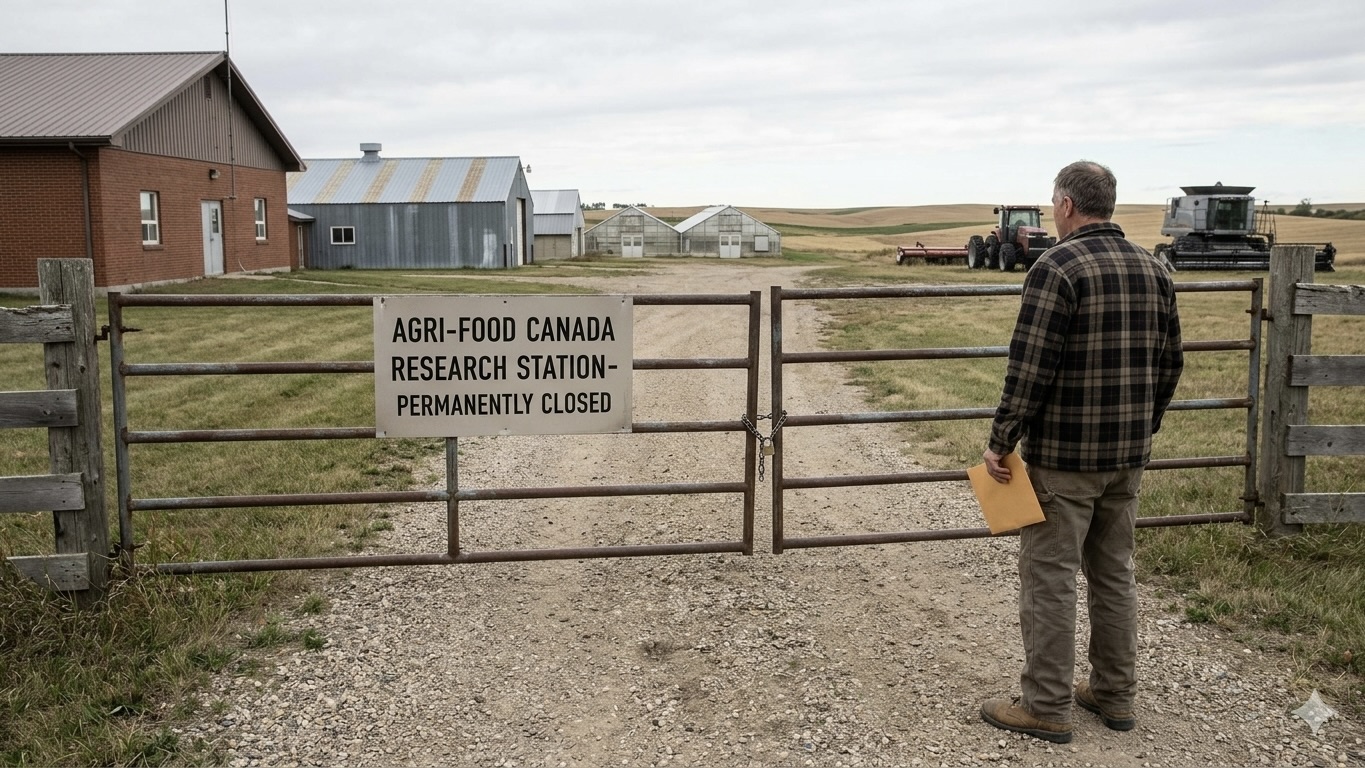
Local mayors and union officials voice anger over the planned closure of historic agricultural research stations and a directive ordering public servants to stay silent.
OTTAWA — Small agricultural communities and public sector workers across Canada are bracing for severe economic fallout following a parliamentary report confirming that federal plans to shutter multiple research stations will eliminate far more jobs than the government initially acknowledged.
While federal administrators claimed the looming closures would directly affect only 27 front-line researchers, testimony presented to the House of Commons Standing Committee on Agriculture and Agri-Food reveals a much starker reality for rural economies. Labor leaders revealed that 494 union members—including laboratory technicians, greenhouse staff, facility maintenance crews, and administrative clerks—face sudden layoffs or forced relocations.
Small Towns Hit by Sudden Job Losses
The scheduled shutdowns target major research development centres in Lacombe, Quebec City, and Guelph, Ont., along with key experimental satellite farms in Nappan, N.S., Portage la Prairie, Man., and Indian Head and Scott in Saskatchewan. For many of these smaller municipalities, the federal facilities have served as foundational economic pillars for generations.
In Saskatchewan, the closure of the Indian Head facility threatens 30 permanent, full-time positions, alongside dozens of seasonal jobs created during the peak summer field season. Indian Head Mayor Steven Cole warned lawmakers that the sudden loss of these salaries will trigger an immediate downward spiral for local businesses, schools, and families.
The crisis is mirrored in central Alberta, where the Lacombe Research and Development Centre currently employs more than 120 people. City Mayor Thalia Hibbs stated that the community of 15,000 will lose resident families, student training opportunities, and the international trade delegations that regularly visit the world-class facility.
Millions in Recent Upgrades Abandoned
Compounding the frustration for local leaders is the revelation that the government recently poured millions of dollars into upgrading the very facilities it now plans to abandon.
Witnesses testified that extensive building renovations were actively underway in Quebec City when employees received their termination notices. Similarly, the Scott Research Farm in Saskatchewan was recently outfitted with a brand-new, $6-million chemical facility. In Lacombe, a newly constructed $4-million biosecure cold storage unit will be left vacant. Agricultural entrepreneur Alison Sunstrum labeled the decisions a reckless waste of generational public investment.
Silencing the Front Lines
The parliamentary inquiry also exposed a contentious communication ban implemented by federal management. Affected workers across multiple provinces were strictly ordered via email not to discuss the closures with journalists, the public, or local elected officials.
Mayor Hibbs confirmed she was stone-walled by facility administrators, who stated they were barred from talking to municipal authorities. Patrick St-Georges, representing the Agriculture Union, testified that workers were even instructed to lock gates and block outside visitors from entering the grounds.
In response, the committee recommended that the federal government immediately pause the closures, lift the communication restrictions, and allow public servants to speak out when government actions actively harm the public interest.