Revell Site DGR: Impact Assessment and the Crown’s Duty to Consult
This report provides a forensic analysis of the Revell Site Deep Geological Repository (DGR) proposal, focusing on the intersection of the impact assessment process and the Crown’s constitutional Duty to Consult. It synthesizes public registry data, technical reviews, and the proponent’s (NWMO) submissions to identify significant regulatory and social gaps.
Executive Summary
The impact assessment process for the Revell Site DGR is currently failing to satisfy the Crown’s Duty to Consult. Indigenous Nations, particularly those within Treaty #3, assert that the current process is ad hoc, lacks transparency, and ignores their inherent jurisdiction and traditional laws, such as the Manito Aki Inaakonigewin (MAI) [Comment Ref: 705]. The proponent’s attempt to scope transportation out of the assessment is a primary point of contention, as it fragments the project and avoids scrutiny of risks along transit corridors [Comment Ref: 660, 627].
Detailed Analysis
The Crown’s Duty to Consult is not merely a procedural requirement but a substantive obligation to engage in a meaningful, nation-to-nation dialogue. The current process is widely viewed by Indigenous stakeholders as a ‘sham’ that prioritizes the proponent’s timelines over constitutional obligations [Comment Ref: 592].
- Jurisdictional Conflict: The Grand Council Treaty #3 asserts that the NWMO, as a non-Crown entity, lacks the authority to make determinations regarding Section 35 rights [Comment Ref: 705].
- Scope of Assessment: The exclusion of used nuclear fuel transportation from the federal impact assessment is a major red flag. Indigenous Nations argue that transportation is an ‘incidental activity’ that poses significant risks to lands and waters across Treaty #3 territory [Comment Ref: 660, 485].
- Consent vs. Consultation: There is a profound gap between the NWMO’s ‘willing host’ model and the requirement for Free, Prior, and Informed Consent (FPIC) under UNDRIP [Comment Ref: 627, 596].
Evidence from Public Registry
Public sentiment is heavily polarized. Opponents cite the ‘permanent environmental devastation’ and the risks of transporting waste across accident-prone highways like Highway 17 [Comment Ref: 685, 609]. Conversely, supporters highlight the potential for economic revitalization in the unorganized territories and the necessity of nuclear energy for Canada’s net-zero goals [Comment Ref: 672, 653].
Technical Deficiencies & Gaps
Our internal analysis identifies a critical lack of baseline data regarding the health, social, and economic conditions of Treaty #3 First Nations [Analysis: Section 15]. Furthermore, the proponent’s reliance on ‘industry-standard’ mitigation measures for a project of this unprecedented duration (160+ years) is technically insufficient [Analysis: Section 19].
Recommendations & Mandates
We strongly recommend that the Impact Assessment Agency of Canada (IAAC) mandate a full, integrated panel review that includes the transportation of used nuclear fuel as a core component of the project scope. The proponent strongly recommend establishing a formal, Indigenous-led oversight body with the authority to co-design environmental monitoring programs. This body must have the power to trigger ‘stop-work’ orders if pre-defined safety or cultural thresholds are breached.
Conclusion
The Revell Site DGR project faces significant social and legal hurdles. Without a fundamental shift toward a co-management model that respects Indigenous jurisdiction and addresses the legitimate safety concerns of corridor communities, the project lacks the necessary social license to proceed.
About the Deep Geological Repository (DGR) for Canada’s Used Nuclear Fuel Project
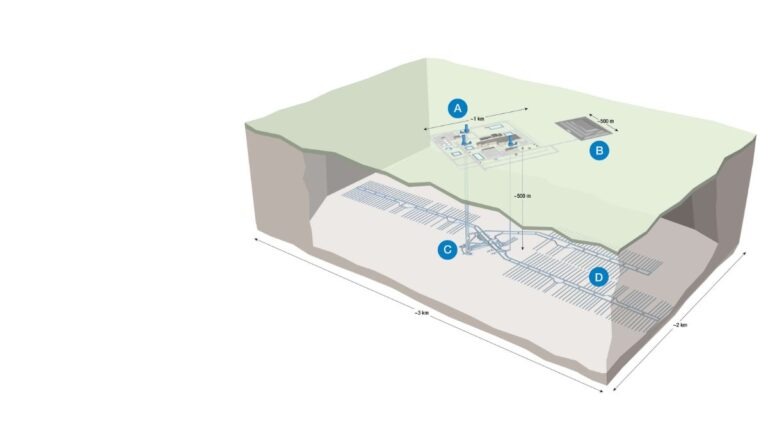
The Nuclear Waste Management Organization (the NWMO) is proposing a new underground deep geological repository system designed to safely contain and isolate used nuclear fuel. Wabigoon Lake Ojibway Nation (WLON) and the Township of Ignace have been selected as the host communities for the proposed project, which is located 21 kilometres southeast of the WLON and 43 kilometres northwest of the Town of Ignace, Ontario along Highway 17. As proposed, the Deep Geological Repository (DGR) for Canada’s Used Nuclear Fuel Project would provide permanent storage for approximately 5.9 million bundles of used nuclear fuel. The project is expected to span approximately 160 years, encompassing site preparation, construction, operation and closure monitoring. The project assessment is being conducted in collaboration with the Canadian Nuclear Safety Commission.
Learn more about the Integrated Impact Assessment process which is led by the Impact Assessment Agency of Canada and Canadian Nuclear Safety Commission.
- Read the Summary of Issues (February 16, 2026)
- Read the Summary of the Initial Project Description (January 5, 2026)
- Read the Initial Project Description (January 5, 2026)
- Learn More about the Melgund Integrated Nuclear Impact Assessment (MINIA) Project
- Learn More about the Nuclear Waste Management Organization (NWMO)
About the Author