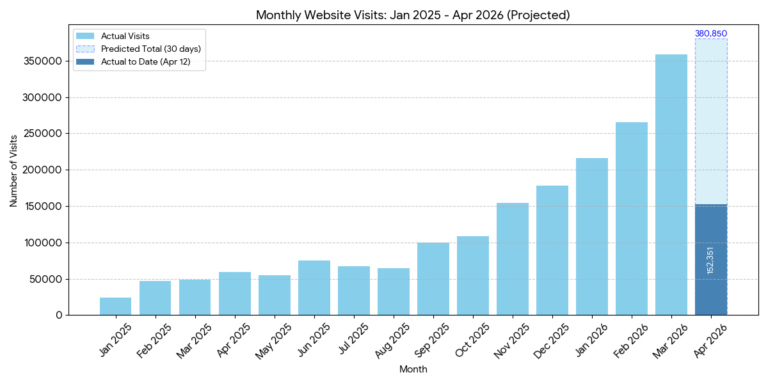
Website hits track every interaction, from human visits to automated requests, revealing patterns of attention and engagement online.
What an Old Web Metric Reveals in the Age of AI
For years, “hits” were treated like a punchline in analytics circles. Serious marketers and IT professionals learned early to roll their eyes at them. One page load could generate dozens of hits, inflating numbers without telling you anything meaningful about who visited, what they read, or whether they cared.
As analytics matured, hits were pushed aside in favour of cleaner, more human-centered metrics: sessions, unique visitors, engagement time, and conversions. Hits were framed as a relic of a naive internet—technically accurate, strategically useless.
And then the web changed again.
What’s brought hits back into the conversation isn’t a reversal of that critique, but a shift in what the web is for and who is reading it. In the age of AI and platform-driven distribution, websites no longer serve just human visitors. They are constantly read, scanned, summarized, previewed, indexed, and reprocessed by machines. Bots, crawlers, scrapers, social preview engines, monitoring services, caching layers, and large language models all interact with content in ways that don’t look like traditional “visits.” Hits, once dismissed as noise, have quietly become one of the clearest indicators that this machine layer is paying attention.
In practical terms, hits now measure systemic visibility. Every access, whether a human loading a page, clicking links, or fetching assets — generates hits, as do automated systems like AI crawlers, social platforms generating link previews, or services checking for updates and extracting metadata. Hits capture all these requests, providing a raw view of content engagement across humans and machines.
When hit counts rise while pageviews or sessions remain relatively stable, it often signals that content is being repeatedly accessed, not just by humans but also by the automated systems that influence what gets surfaced, ranked, summarized, or recommended next. In this way, hits are no longer just a noisy metric, they reveal how content achieves systemic visibility across the computational layers of the modern web.
Social media accelerates this dynamic dramatically. A single share can trigger a chain reaction: preview bots request Open Graph data, image proxies pull media files, caches refresh, moderation systems scan text, and ranking algorithms probe relevance. Each step produces traffic that doesn’t show up as engagement but absolutely reflects circulation. Hits capture this shadow activity—the infrastructure-level attention that surrounds cultural movement online. In many cases, hits spike before any noticeable increase in human traffic, acting like tremors before an earthquake.
Hits in the Age of AI
This is where hits take on new meaning. They are no longer pretending to describe human intent; instead, they reveal whether content is legible to machines. In an AI-mediated internet, being legible is not optional. If systems can’t parse your content, understand its structure, or associate it with existing knowledge graphs and social signals, it effectively doesn’t exist—no matter how thoughtful or well-crafted it may be. Hits become a rough but telling signal of whether your work is entering these automated feedback loops.
None of this means we should return to hits as a primary success metric. They still can’t tell us if something was persuasive, moving, or useful. But they now sit alongside engagement metrics as a different class of signal altogether. Where time-on-page and conversions measure human response, hits measure presence. They answer a quieter but increasingly important question: is this content being seen by the systems that shape attention itself?
In that sense, the renewed interest in hits reflects a deeper cultural shift. We are no longer publishing solely for readers; we are publishing into an ecosystem where machines are the first audience and humans are often the second. Hits are popular again not because we forgot their flaws, but because the web has grown a second layer of meaning—one where visibility, circulation, and survival depend on how culture is read by algorithms.
The irony is hard to miss. Hits were once criticized for being too mechanical to capture human experience. Today, that mechanical quality is exactly what makes them useful. They show us when culture has become machine-legible without losing its human meaning—and when it hasn’t.
Understanding hits in this way can help creators, marketers, and analysts better track the circulation of their content in a world now dominated by both human and machine attention.
About the Author