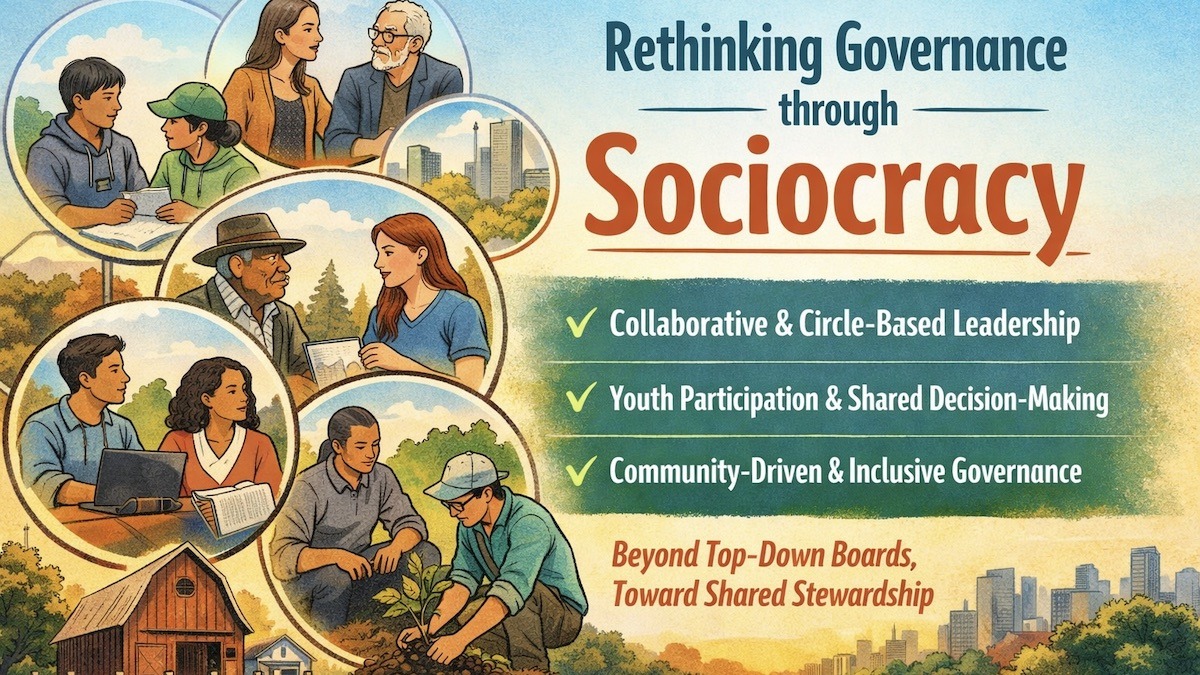
What Is Sociocracy? Rethinking Governance Through Collaboration, Youth Participation, and Shared Stewardship
Most people think of a board as a small group of people sitting around a table making decisions from a distance. In many organizations, especially nonprofits, governance can feel formal, slow, and disconnected from the actual people doing the work. Artists make projects, youth organize events, communities participate in programs — and then somewhere else, a board approves things behind closed doors. That model works for some organizations, but for groups working in community arts, climate engagement, cultural storytelling, and local stewardship, it can start to feel limiting.
As organizations grow more collaborative and community-based, many are beginning to ask a simple question: what if governance itself could feel more human?
One approach that has been gaining attention is called sociocratic governance, sometimes described as a “circle-based” or “complementary boards” model. The idea is actually pretty straightforward. Instead of one central board trying to control everything, the organization is made up of smaller circles or groups that focus on different areas of work. One group might focus on youth programming. Another might focus on exhibitions or research partnerships. Another could focus on operations or finances. Each group has some independence, but they stay connected to one another through shared communication and rotating representatives.
What people often like about this model is that it feels less hierarchical and more relational. Instead of decisions always flowing from the top down, people closer to the work are trusted to help shape it. Someone organizing a community exhibition or working directly with youth participants may have just as much insight into what is needed as someone sitting on a formal board. The structure recognizes that knowledge exists in many different places.
The decision-making process is different too. Rather than relying only on majority votes, sociocratic systems usually work through consent. That means an idea moves forward unless someone raises a serious concern that would genuinely harm the project or organization. The goal is not endless debate or everyone agreeing on everything. It is more about listening carefully, improving ideas together, and making decisions people can live with and support. In practice, this often creates conversations that feel more collaborative and less adversarial.
One of the most interesting parts of the model is something called “double-linking.” That sounds technical, but it is actually very human. It simply means people move between circles to keep communication open. A youth representative might participate in planning meetings. Someone focused on operations might also sit in on community programming discussions. Information moves both ways instead of staying trapped at the top. It helps organizations stay grounded in the realities of the people actually participating in them.
For organizations like our arts incubator in Winnipeg, or place-based cultural initiatives connected to places like Northwestern Ontario, this kind of governance can feel especially natural. The work already depends on collaboration between artists, researchers, community members, youth, and local partners. A rigid corporate-style board structure may not reflect the spirit of the work itself. A circle-based model allows governance to become part of the organization’s culture instead of something separate from it.
It can also create much more meaningful opportunities for youth involvement. In many organizations, young people are invited to participate symbolically — maybe through a youth advisory committee that has little real influence. A sociocratic structure can change that. Young people can participate directly in areas like storytelling, exhibitions, digital media, outreach, environmental projects, or programming. They are not just being “consulted.” They are helping shape the organization alongside older generations.
Of course, organizations still need legal and financial accountability. Most nonprofits in Canada still require a formal board responsible for budgets, insurance, and compliance. But that does not mean all power needs to stay concentrated there. Many organizations are beginning to explore hybrid models where a small legal board handles fiduciary responsibilities while broader community circles help guide programming, ethics, partnerships, and long-term vision.
At its heart, this model is really about trust. It asks whether organizations can move away from purely top-down systems and build structures that reflect participation, care, shared responsibility, and community knowledge. For groups working in arts, climate engagement, heritage, and community storytelling, that shift can feel less like an administrative experiment and more like a natural extension of the work itself.
New Models for Board Governance in the Arts: What We’re Learning from MOMENTUM
We’ve been learning a lot from the MOMENTUM program, led by Creative Evolutions in partnership with Theatre Communications Group, especially around how governance can be rethought when it’s treated less like a fixed structure and more like something living, adaptable, and collectively built.
MOMENTUM is a rolling convening where creative leaders gather in small cohorts across multiple sites—each group building on the ideas of the last. Rather than trying to “solve” boards or replace them outright, participants focus on expanding what’s possible: naming emerging models, testing real-world approaches, and refining governance ideas through shared iteration.
For anyone interested in governance, organizational design, or creative leadership, it’s a space worth paying attention to—not because it offers a single answer, but because it’s actively widening the range of options we can choose from.