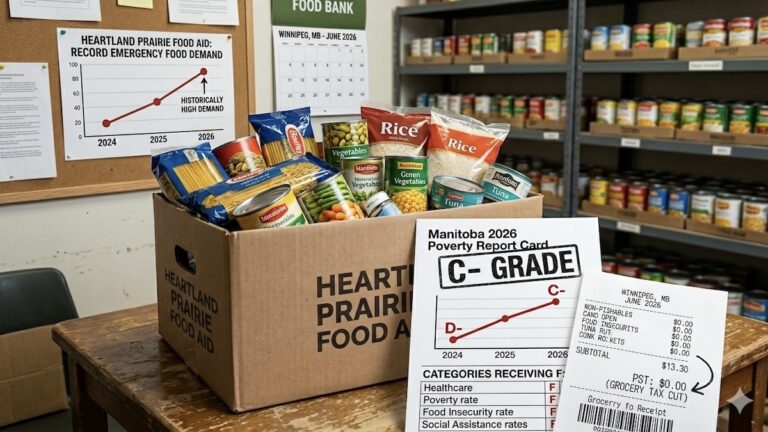
Ontario’s abysmal D- poverty grade pulls back the curtain on a province experiencing a total structural collapse of household financial stability. By deliberately freezing Ontario Works rates since 2018 amid rampant inflation, provincial policy has effectively criminalized poverty while securing the weakest job market performance in Canada. The result is a manufactured crisis of hunger and housing insecurity that now outpaces national baselines.
Crushing fixed costs and a collapsing safety net land Ontario worst-in-class rankings among large provinces
TORONTO — Ontario has been handed a devastating overall grade of D- in the latest Food Banks Canada Poverty Report Card, driven by skyrocketing housing instability, failing social safety nets, and the weakest job market performance in Canada.
The report outlines a severe structural failure in housing security across the province, revealing that approximately 85,000 people are currently unhoused. Children and youth are bearing a massive brunt of the crisis, making up an estimated 23 percent of the entire unhoused population. The current homelessness figure represents a surge of nearly 8 percent since 2024, and the report issues a damning long-term forecast: if current policy trajectories continue, Ontario is projected to face a catastrophic total of 300,000 unhoused people by 2035.
Economic and poverty metrics show Ontario severely underperforming compared to national averages across nearly every major category. The province’s poverty rate has reached 12.5 percent, sitting above the national average of 11.1 percent. Furthermore, Ontario’s unemployment rate has climbed to 7.6 percent, marking the highest rate among all provinces and the weakest job market performance in the country. Food insecurity has also gripped the province, with 25.4 percent of residents affected compared to the national average of 24 percent.
The report issued a failing ‘F’ grade for provincial legislative progress, noting that while the government introduced broad affordability measures, they have had a limited impact on low-income households. Core social assistance rates have been effectively frozen; Ontario Works (OW) rates have not increased since 2018, remaining at just $733 per month. This covers a mere 32.7 percent of the income required to reach the poverty line, ranking among the lowest across Canada. Meanwhile, the Ontario Disability Support Program (ODSP), despite recent indexing adjustments, only reaches 54.7 percent of the poverty line.
According to the findings, current provincial policies are unlikely to reduce poverty and are actively contributing to worsening outcomes. A staggering 71 percent of government support recipients in Ontario reported that their benefit rates are completely insufficient to keep up with the cost of living—the highest rate of support inadequacy in the country.
The economic strain is further compounded by severe affordability pressures, with 43 percent of residents experiencing housing stress by spending 30 percent or more of their income on shelter. Outside of rent or mortgages, Ontarians are forced to devote 56.5 percent of their income just to cover fixed essentials, a figure that tracks significantly worse than the national average.
The report also highlights a fracturing healthcare system, with 36 percent of residents reporting trouble accessing care, making Ontario the worst among all large provinces for healthcare access.
About the Author