Embracing the creative decomposition necessary for your next phase of organic growth.
Why are you so afraid of your own decomposition? You treat your stagnation like a failure of the soil.
You look at the cracks in the pavement near Portage and Main and see only neglect. But the green things pushing through don’t care about the city’s maintenance budget or the aesthetic of the revitalised downtown. There is a specific kind of intelligence in the weed that grows through the concrete, a slow-motion heist of space and light. Your own creative pauses are exactly this—a subterranean gathering of forces that the surface world interprets as laziness. We are obsessed with the bloom, but the real work happens in the damp dark of the root system where nothing looks like a finished product. You are currently building a foundation that the light cannot yet see.
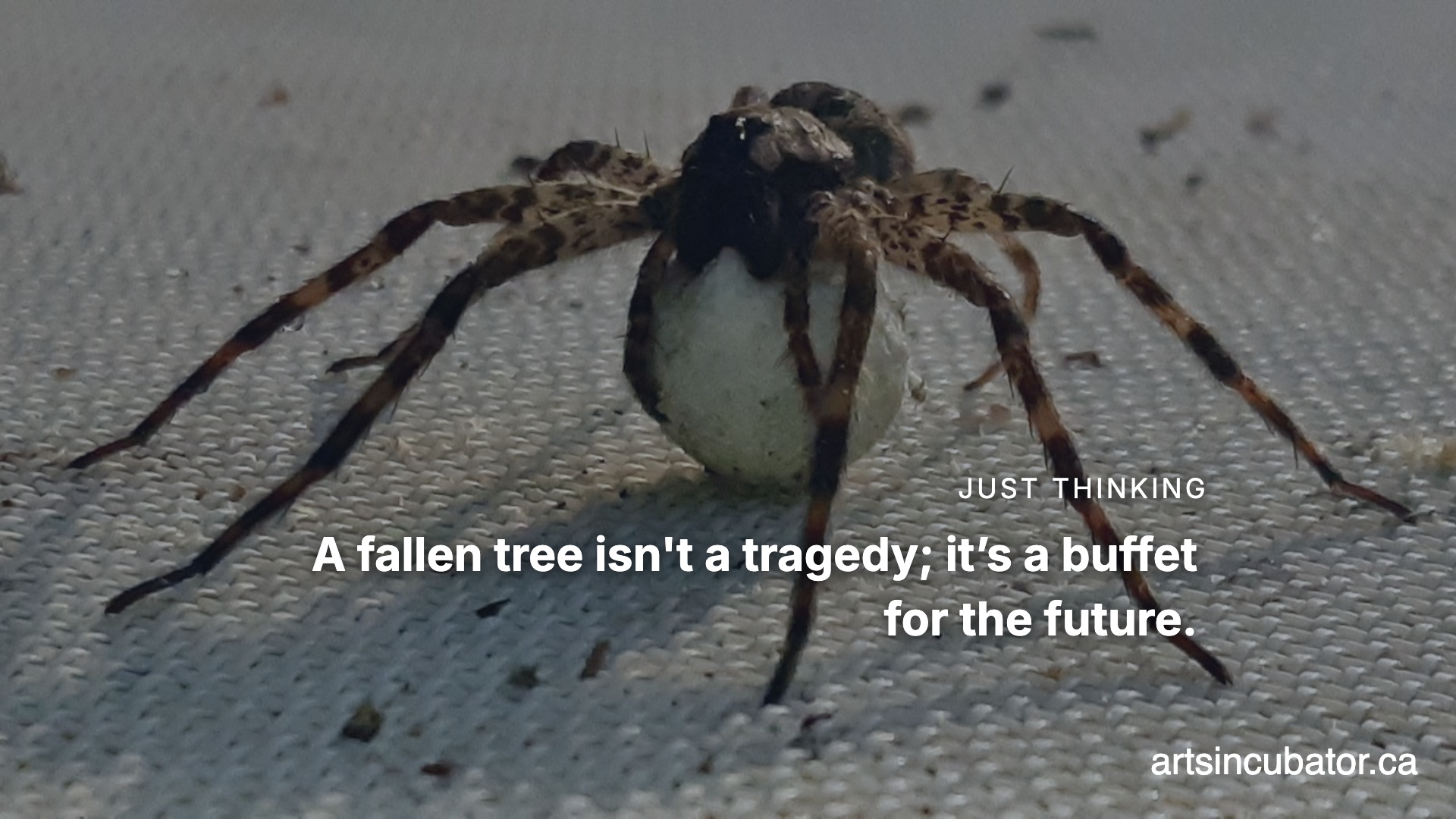
Think about the way a forest floor processes death. A fallen tree isn’t a tragedy; it’s a buffet for the future. You are currently composting every bad idea, every rejected application, and every moment of paralyzing self-doubt you’ve felt since the start of 2026. This isn’t rotting in the sense of waste; it’s the conversion of old grief into the nitrogen your next project will need to actually breathe. The infrastructure of your mind needs these fallow periods to break down the heavy metals of societal expectation. If you are feeling heavy, it might just be the weight of all that potential energy waiting to be digested by your subconscious. You are becoming nutrient-dense through your silence.
We live in a culture that treats humans like annuals—bloom once, look pretty for the camera, and then get cleared away for the next cycle. But you are a perennial, a rhizome that spreads horizontally beneath the surface, connecting with others in ways that aren’t visible to the naked eye. The arts community in this city works exactly like mycelium. We aren’t a series of isolated creatives competing for a tiny slice of the sun; we are a massive, tangled network sharing resources through the dark. When one of us fails, the lessons from that failure leak back into the soil for everyone else to use. Your personal setback is actually a communal contribution to the collective growth.
There is no hierarchy in the rot. The moss on a brick wall doesn’t ask permission to exist, and it doesn’t wait for a grant to start spreading. It just inhabits the moisture and the shadow. You can do the same. Allow yourself to be unorganised, messy, and non-linear. Your thoughts don’t need to be a tidy garden; they can be a wild, overgrown lot where the most interesting things are happening under the leaves. Resistance in 2026 isn’t just about shouting; sometimes it’s about staying still enough to let the world grow over you. There is a quiet power in being unreachable while you recalibrate your internal chemistry.
Validation is a nutrient, but it’s not the only one. You need the grit of the struggle and the dampness of the quiet moments to truly develop a root system that won’t snap in the first winter storm. Trust the process of your own decay. Everything that you are losing right now is just being repurposed into the foundation of what comes next. The city will keep trying to pave over the gaps, but the roots will always find a way to heave the stone. You are the heave, and the stone is just a temporary obstacle in your slow, inevitable expansion.
Thoughts on art and the state of the world!
This section presents reflections, observations, and commentary on issues affecting communities in Manitoba, Northwestern Ontario, and beyond. It focuses on local perspectives, community dynamics, and topics relevant to residents, offering insight into social, cultural, and civic matters.
Content is designed to inform, provide context, and highlight developments or considerations that impact everyday life and community well-being. Readers can engage with current discussions, explore diverse viewpoints, and stay connected to ongoing conversations shaping the region.
Explore more on our thoughts page.
About the Author