
A Plain-Language Guide for Small Arts and Community Groups
This fall and winter, our arts incubator program will be launching a new governance and training program. We know that words like “succession planning” and “leadership pipeline” can sound like corporate jargon. They’re not. For a small arts group running on volunteer energy, these concepts can mean the difference between surviving a key person’s departure and watching years of community work unravel.
This post is meant to introduce some of these ideas in plain language, grounded in what national data tells us and what we have learned from other grassroots organizations. We invite you to read, reflect, and join us in the conversations ahead.
The Problem in Plain Terms
If you run a small arts organization, a community centre, or a festival committee, you already know the feeling. The person who has managed your grants for ten years is moving away. The board chair who founded the organization is retiring. The volunteer who coordinates your annual event is burned out and has not shown up in months. And when you ask around for someone to step in, you hear the same thing: “I would love to help, but I just don’t have the time.”
You are not alone. According to Statistics Canada’s most recent national survey, the share of Canadians volunteering through organizations dropped from 41 percent in 2018 to 32 percent in 2023. Total volunteer hours fell by 28 percent (Statistics Canada, 2025). Among Canadians aged 25 to 34—the people who should be stepping into leadership roles—volunteer hours plummeted by 42 percent (Statistics Canada, 2025). And while the most dedicated volunteers kept giving at the same rate, everyone else pulled back. The top 10 percent of volunteers still supplied 61 percent of all hours (Statistics Canada, 2025).
What this means for a small group is simple but serious: the old way of finding leaders—waiting for someone to show up, stick around, and eventually take charge—is not working anymore. We need new ways of thinking about how people move from “I want to help” to “I can lead.”
Two Ideas That Sound Similar But Are Different
Succession Planning: Your Backup Plan
Succession planning is the less glamorous of the two ideas, but it is essential. It simply means having a plan for what happens when a key person leaves. Not if. When.
According to the National Council of Nonprofits, only 29 percent of nonprofits have a written succession plan in place (National Council of Nonprofits, 2017). That means most organizations are one departure away from crisis. For a small arts group, this might mean:
- Your treasurer, who has managed the books for eight years, suddenly cannot continue. Does anyone else know the password to the accounting software? Does anyone else understand the grant reporting deadlines?
- Your festival director, who has all the vendor relationships in their head, steps down. Do you have a contact list? A timeline? A sense of what went wrong last year and what to fix?
- Your board chair, who has been the public face of the organization, moves on. Is there someone ready to speak to the media, meet with funders, and chair a meeting?
Succession planning does not have to be complicated. It can be as simple as a shared document that lists key roles, what each person does, and who could step in if needed. The National Council of Nonprofits recommends ten basic steps, including identifying leadership development opportunities for staff and board members, cross-training current volunteers, and adopting an emergency leadership transition plan (National Council of Nonprofits, 2017). For a small organization, the goal is not perfection. It is preparedness.
Leadership Pipeline Development: Growing Your Own Leaders
If succession planning is your backup plan, a leadership pipeline is your growth plan. It is the deliberate process of helping volunteers develop the skills, confidence, and relationships they need to take on bigger roles over time.
Think of it like a garden. Succession planning is having a spare tomato plant ready if your main one dies. A leadership pipeline is planting seeds, watering them, and giving them sun so that you have a continuous harvest. You are not just replacing leaders. You are growing them.
Research on volunteer leadership emphasizes that organizations should identify volunteers’ interests, skills, and motivations, and match them with opportunities that align with their aspirations (BoardBuild, 2024). This sounds obvious, but in practice, many small groups do the opposite: they recruit for a specific task, use the volunteer until they burn out, and then wonder why no one wants to step up to lead.
A leadership pipeline asks a different set of questions: Who among our volunteers shows curiosity about how decisions get made? Who asks good questions at meetings? Who has skills—social media, bookkeeping, community outreach—that could grow into something bigger if we gave them room? And most importantly: What are we doing to help them grow?
Why This Matters for Small and Rural Organizations
The challenges of volunteer recruitment and retention are not the same everywhere. In rural northwestern Ontario, the pool of potential volunteers is already small. As volunteer management consultant Karen Knight, who grew up in a rural British Columbia community of about a hundred people, notes: “The one key issue that affects them all is a very small pool of people from whom to recruit” (Knight, 2023). In these communities, every volunteer matters deeply, and losing even one can feel catastrophic.
Knight’s advice for rural volunteer programs is especially relevant for arts groups in smaller centres. She recommends building relationships with local influencers—not necessarily the mayor, but the people whose opinions everyone listens to. She advises being explicit about what volunteers gain from helping, not just what the organization needs. And she warns against the “black hole” effect: pulling a volunteer in for a small task and gradually asking them to do more and more until they are running the entire organization and burning out in plain sight (Knight, 2023).
In Winnipeg, the dynamics are different but no less pressing. A larger city offers a bigger pool, but it also offers more competition for people’s time and attention. Young professionals, students, and newcomers may be interested in the arts but face competing demands from work, family, and cost-of-living pressures. The 42 percent drop in volunteer hours among 25- to 34-year-olds is not because young people do not care about the arts. It is because they are stretched thin (Statistics Canada, 2025).
What the Data Tells Us About How People Want to Engage
The national data reveal something important that small organizations can use. While formal volunteering through organizations declined sharply, the number of Canadians helping friends, neighbours, and family directly barely changed (Statistics Canada, 2025). What collapsed was participation in collective, institution-based activities: attending public meetings fell by 40 percent, coordinating community events fell by 34 percent, and total hours spent on community improvement fell by 34 percent (Statistics Canada, 2025).
This tells us that people still want to help. They are just less willing to commit to the structures that traditional volunteering has required: monthly meetings, multi-year board terms, and rigid schedules. For arts organizations, this is both a challenge and an opportunity. It means we may need to rethink what leadership looks like. Does a board member need to attend twelve meetings a year, or could some of that work happen asynchronously? Does a festival coordinator need to be on call for six months, or could the role be split among three people with different strengths?
The Older Adult Centres’ Association of Ontario, in partnership with Volunteer Canada, has documented a similar shift. Their research found that volunteers increasingly seek remote, virtual, episodic, and micro-volunteering opportunities—short-term commitments that fit around other responsibilities (OACAO & Volunteer Canada, 2024). The report notes that “the social purpose sector is in a crisis” and that organizations must redesign roles to meet volunteers where they are (OACAO & Volunteer Canada, 2024).
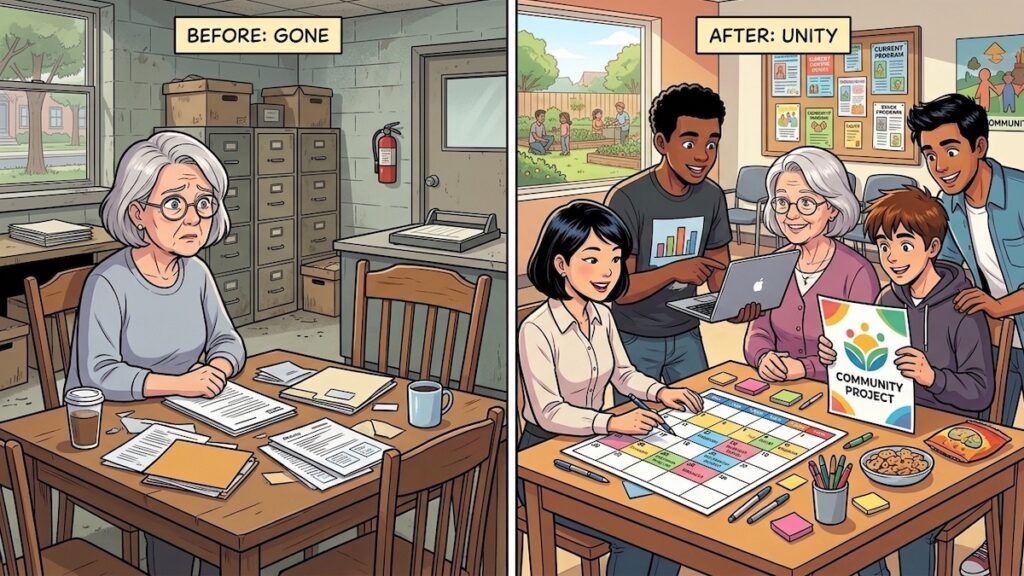
Simple Ideas to Discuss for Building a Pipeline
You do not need a corporate HR department to build a leadership pipeline. Here are practical ideas that small arts and community groups can start using right away.
Map Your Volunteer Journey
The Volunteer Engagement Cycle, developed by Volunteer Toronto and widely used across Canada, includes six stages: planning, outreach, engagement, support, recognition, and evaluation (HR Intervals, 2026). Think about your organization at each stage. Where do volunteers first hear about you? What is their first experience like? Who checks in with them after their first event? Where do they go from there?
Mapping this journey helps you spot the leaks. Maybe people show up for one event and never return because no one followed up. Maybe they stay for a year but leave because they do not see a path to doing more meaningful work. The first step to fixing the pipeline is seeing where it breaks.
Write Down What You Know
In small organizations, critical knowledge often lives in one person’s head. The grant writer knows which funders to approach. The tech person knows how the website works. The event coordinator knows which vendors are reliable. This is not a strength. It is a vulnerability.
Succession planning can start with something as simple as a shared folder or a running document. List the key tasks that keep your organization running. Note who currently does them. Jot down the basic steps, passwords, and contacts. Identify one or two other people who could learn each task. You do not need to train them tomorrow. You just need to know who they are.
Create Stepping-Stone Roles
Not everyone is ready to be a board member. But many people are ready to do more than they are currently doing if you give them the right stepping stone. Consider creating roles like:
- Event assistant to the event coordinator, with a clear path to co-coordinator
- Social media contributor who starts with one post per week and can grow into communications lead
- Committee member who attends meetings for six months before being invited to chair a subcommittee
- Shadow board member who attends board meetings as an observer, with the understanding that they may be invited to join formally after a year
These stepping stones signal to volunteers that their growth is intentional, not accidental. As one volunteer leadership guide puts it, organizations should “identify leadership development opportunities for staff and board members to expand their leadership skills so that the organization will have a ‘deeper bench’ of future leaders” (National Council of Nonprofits, 2017).
Be Explicit About Growth
Many volunteers leave because they do not know what is possible. They show up, do good work, and assume that leadership roles are reserved for founders or insiders. Break that assumption. Tell volunteers directly: “We are looking for people who might want to grow into X role. If that interests you, let’s talk.”
Imagine Canada, which sets standards for Canadian charities and nonprofits, recommends that boards review succession plans at least annually, using the review to assess internal talent development and the board’s readiness for transition (Imagine Canada, 2016). For a small organization, this review can be a thirty-minute conversation at an annual meeting. Who has stepped up this year? Who has shown potential? Who are we at risk of losing, and what would happen if they left?
Recognize That Leadership Looks Different Now
The traditional image of a nonprofit leader—someone with unlimited time, deep institutional memory, and a willingness to attend every meeting—is no longer realistic for most people. Leadership in a small arts organization might look like:
- A parent who can only volunteer during school hours but has exceptional design skills
- A young professional who wants to build their resume by managing a specific project
- A retiree who wants to mentor but does not want to chair a committee
- An artist who wants to contribute their creative skills without joining the board
A healthy leadership pipeline makes room for all of these contributions. It does not force everyone into the same mould.
What We Are Doing This Fall and Winter
This fall and winter, our arts incubator and its nonprofit partners will be exploring these ideas in depth through a new governance and training program. We will be looking at:
- How to build simple succession plans that do not require a consultant or a budget
- How to create leadership pathways that work for volunteers with jobs, families, and limited time
- How to document institutional knowledge so it does not walk out the door with one person
- How to build boards and committees that reflect the communities we serve
- How to keep volunteers engaged without burning them out
These sessions are designed for people who are already doing the work—not for professional administrators, but for artists, community organizers, and volunteers who are figuring it out as they go. We believe that the best ideas come from the people living these challenges every day.
An Invitation
We do not pretend to have all the answers. The data tells us that volunteerism is declining, that leadership pipelines are thinning, and that small organizations are especially vulnerable. But the data also tells us that Canadians still care deeply about their communities. They are still showing up for friends and neighbours. They still want to contribute. The question is whether we, as organizations, are ready to meet them where they are.
If you are part of a small arts group, a community centre, a festival committee, or any organization that runs on volunteer energy, we invite you to join us this fall. Bring your questions, your frustrations, and your ideas. Whether you are in Winnipeg, in a small town in northwestern Ontario, or anywhere else in Canada, the challenges are similar—and so are the possibilities.
Leadership pipelines and succession planning are not corporate luxuries. They are survival tools for the organizations that make our communities vibrant, creative, and connected.
We’d like to hear from other groups and organizations and how they’re approaching these challenges and opportunities. Contact us or send us an e-mail at info@artsincubator.ca.
Let’s build them together.
References
BoardBuild. (2024, October 7). Volunteer recruitment & building a leadership pipeline. https://boardbuild.org/volunteer-recruitment-building-a-leadership-pipeline/
HR Intervals. (2026, April 13). From recruitment to closing roles: The volunteer engagement cycle. https://hrintervals.ca/resources/the-volunteer-engagement-cycle/
Imagine Canada. (2016, January 10). You need a succession plan—here’s how to put one together. Imagine Canada Blog. https://imaginecanada.ca/en/360/you-need-succession-plan-heres-how-put-one-together
Knight, K. (2023, December 6). Rural volunteer programs. Karen Knight Consulting. https://karenknight.ca/rural-volunteer-programs/
National Council of Nonprofits. (2017, March 14). Succession planning for nonprofits: Managing leadership transitions. https://www.councilofnonprofits.org/running-nonprofit/governance-leadership/succession-planning-nonprofits-managing-leadership
Older Adult Centres’ Association of Ontario & Volunteer Canada. (2024, March 20). Strengthening volunteer engagement: A reference guide. https://www.oacao.org/wp-content/uploads/2024/03/StrengtheningVolunteerEngagement_OACAO2024_EN.pdf
Statistics Canada. (2025, June 23). The Daily—Volunteering and charitable giving in Canada, 2018 to 2023. https://www150.statcan.gc.ca/n1/daily-quotidien/250623/dq250623b-eng.htm