Why this maple-mimicking beauty is a boreal forest favourite
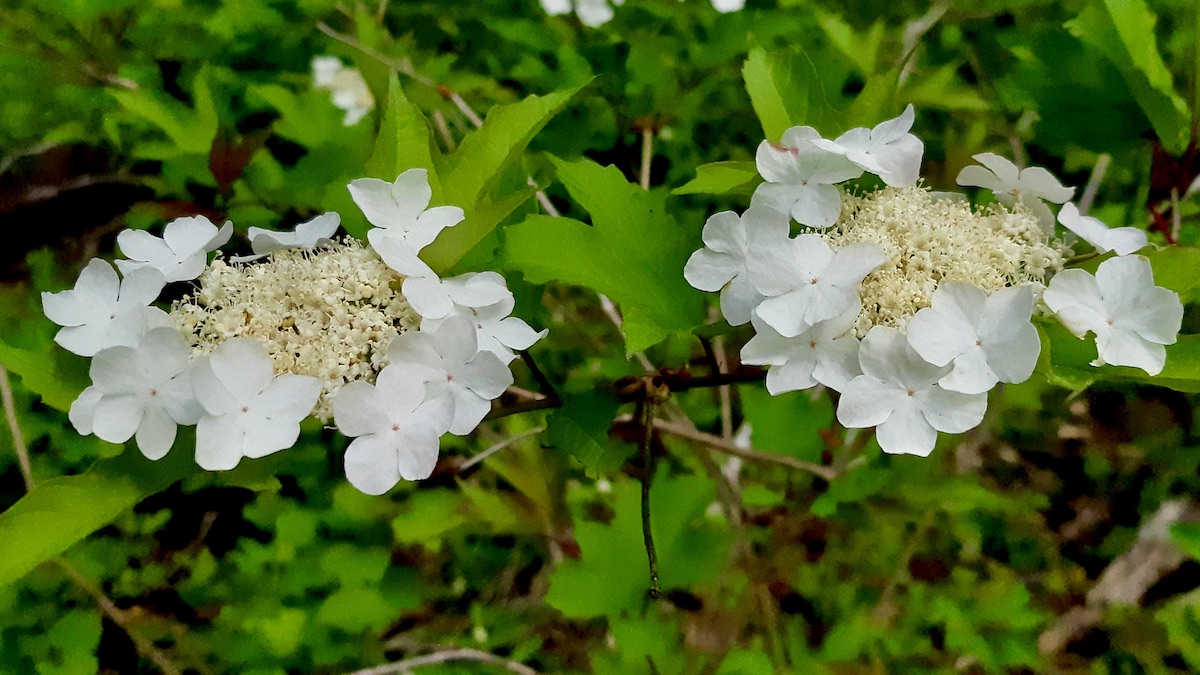
Anyone spending time in the woods around Northwestern Ontario in June might notice a sudden burst of white flowers standing out against the early summer greenery. These flat, wide clusters belong to the highbush cranberry. Despite the name, it isn’t actually a true cranberry. It belongs to the viburnum family, making it a closer relative to honeysuckle, but the old name stuck because the late-summer fruit looks and tastes incredibly similar to the bog berries we buy at the grocery store.
Documenting these species is a big part of our summer routine. Every year, our arts incubator program works to capture the local plants, berries, and flowers growing in and around Melgund Township and the wider region. We want to celebrate the local landscape and show how these native plants shape our ecosystem. The highbush cranberry is a perfect example of the hidden details we love to highlight through our work.
The Two-In-One Flower Strategy
If you get close to one of these flower heads, you will notice something unusual about how they are built. The cluster forms a flat wheel with two completely different types of flowers working together.
The large, showy white petals on the outer edge are sterile. They have no reproductive parts and exist solely to get the attention of passing pollinators from a distance. Once bees and flies land, they move into the dense, fuzzy center. This middle section holds the tiny, fertile flowers that actually do the work of producing the plant’s seeds and fruit.
The Leaves: A Maple Lookalike
When the white flowers eventually fade, you can still spot this shrub by looking at the leaves. They look deceptively like maple leaves, with three distinct lobes and a rough, textured surface. They grow directly opposite each other along the woody stems, forming a thick, lush bush that thrives in the damp, well-drained soil along our forest edges and roadsides.
Autumn’s Harvest and Winter Wildlife
Later in the season, those flower clusters turn into heavy bunches of bright, translucent red berries. Eating them raw right off the bush will give you a shock because they are incredibly tart and bitter.
A hard frost sweetens them up a bit, but they really shine when you cook them down with plenty of sugar. The result is a beautiful, clear red jelly that pairs perfectly with wild game or fresh bread. If you leave them on the branch, they will hang on through the heavy snow, providing a crucial food source for local birds like cedar waxwings and grouse when everything else is buried.