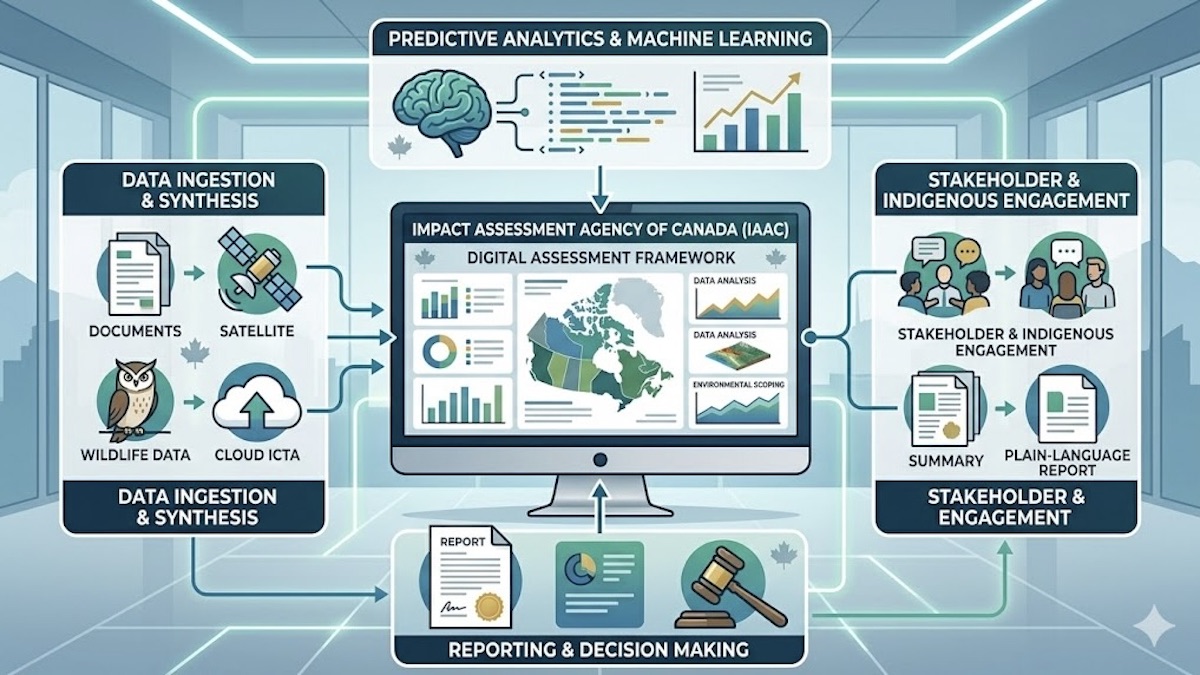
Canada’s Impact Assessment Agency 2026–27 digital plan includes using ChatGPT Enterprise and internal automation to slash project review timelines.
Much like the international nuclear energy sector’s pivot toward securing and streamlining its multi-decade infrastructure loops, the regulatory machinery overseeing Canada’s major resource and clean growth developments is staging its own digital transformation.
The Impact Assessment Agency of Canada (IAAC) has unveiled an aggressive blueprint to integrate generative artificial intelligence into the federal regulatory apparatus. Facing a strict federal mandate to deliver comprehensive reviews of major designated projects within a tight two-year window, the agency is leveraging automated systems to strip away bureaucratic drag, cut escalating technology overhead, and accelerate strategic planning.
According to the IAAC’s 2026–27 Departmental Plan, the central pillar of this modernizing strategy is the newly operationalized “Impact Lab.” This internal incubator is tasked with developing, testing, and scaling AI-assisted workflows to process voluminous environmental, economic, and social data sets, transforming the agency from a manual processing center into a leaner, tech-driven oversight model.
The Internal Strategy: Driving Productivity and Cutting Tech Overhead
To engineer a more efficient federal assessment regime, the IAAC is introducing commercial enterprise intelligence networks, including ChatGPT Enterprise and Microsoft Copilot, directly into its daily workflows. The internal Impact Lab will divide its focus between immediate individual productivity tools and enterprise-level architecture designed to automate document drafting, data synthesis, and internal collaboration.
Federal officials project that the deployment will generate quantifiable improvements in operational speed and consistency. Operational value will be monitored via tracked reductions in processing times, decreased human manual effort, and standardized quality testing derived from structured pilot programs and active user surveys.
Simultaneously, the agency is wielding AI as a fiscal weapon to drive down government operating costs and shrink its overall digital footprint. By utilizing process mapping and automation pilots for drafting reports and transcribing lengthy meeting notes, the agency aims to minimize documentation errors, curtail rework, and sharply accelerate regulatory turnaround times.
Notably, the IAAC plans to use artificial intelligence to build custom, license-free internal code. This strategy is designed to intentionally decrease the federal government’s long-term reliance on commercial low-code and Software-as-a-Service (SaaS) platforms, reducing third-party software licensing fees and technology overhead. The agency explicitly notes that these compounding technical efficiencies are expected to mitigate employee overtime, lower its dependence on external temporary staffing contracts, and shift existing human personnel away from administrative processing and toward high-value analytical work.
Grassroots Innovation: Community-Led Research into AI Adoption
As the federal government accelerates its top-down software integration, grassroots organizations are establishing parallel oversight frameworks to evaluate the local social license of automated regulation. Specifically, regional collectives like Art Borups Corners and the Arts Incubator Winnipeg are actively studying exactly how advanced machine learning can be used to support community-led participatory research into AI adoption for impact assessments.
Operating at the intersection of media arts, civic technology, and environmental planning, these decentralized living labs are using their platforms to run community-based participatory research (CBPR) models. Seeded in 2024-2025 by initiatives like the OpenAI Researcher Access Program, the Arts Incubator Winnipeg and its Northwestern Ontario hub at Art Borups Corners are investigating how everyday citizens and under-resourced communities can use generative algorithms to participate in dense, often challenging federal regulatory impact assessments and processes.
In evaluating how rural and Indigenous populations adapt to automated documentation, these independent studies aim to ensure that machine learning serves as an inclusive mechanism for local environmental sovereignty rather than an exclusionary barrier to public intervention.
Re-Engineering Service Delivery and Public Consultation
Beyond internal accounting and grassroots research, the integration of automation is poised to directly reshape how the IAAC manages service delivery and communicates with external partners. The Impact Lab is actively embedding AI solutions into workflows responsible for synthesizing sprawling industrial technical reports, building automated records of decision, and managing regional backlogs.
In the 2026–27 fiscal cycle, the agency’s targeted applications for AI include:
- Data Pattern Recognition: Scanning massive informational filings to isolate environmental trends, automate repetitive administrative documentation, and streamline senior-level approvals.
- Stakeholder Analytics: Shifting data models to summarize extensive feedback from key stakeholders, scanning the broader landscape to identify emerging organizations relevant to the agency’s mandate, and automatically generating aligned federal briefing material and senior executive speaking notes.
- Financial Program Administration: Utilizing machine learning to optimize and manage internal budgets while strengthening service standards linked to the distribution of public participant funding programs.
Progress across these operational verticals will be strictly measured by the total volume of AI-enabled solutions actively deployed onto the regulatory frontline.
The Human-Centred Mandate: Protecting Indigenous and Public Consultation
Recognizing the complex constitutional and regulatory context in which it operates—particularly regarding shared federal-provincial jurisdictions and the legal Duty to Consult—the IAAC is implementing a strict, “human-centred” governance framework to address algorithmic risk and ensure transparency.
Through the Impact Lab, the agency is creating unique departmental policies, data readiness rules, and ethical guardrails. Crucially, the IAAC is mandating the use of standardized language across public files to explicitly disclose whenever AI tools have been used to draft, edit, or compile official federal documentation. Furthermore, a comprehensive, bilingual training program is being deployed nationwide to ensure all regional and headquarters staff can utilize the software safely and ethically.
By delegating manual informational synthesis to machine learning, the agency expects its field teams to secure a major operational advantage: reclaiming the human hours required to build and sustain deeper, reciprocal relationships with Indigenous groups. Rather than trapping regulatory personnel in office environments summarizing meeting notes for internal briefings, automated transcription and synthesis tools will free up staff to focus heavily on meaningful consultation and the integration of Indigenous Knowledge into final assessment outputs.
Finally, the IAAC will pilot AI systems engineered to foster meaningful public participation in complex regulatory hearings. By taking thousands of pages of highly technical engineering, health, and socio-economic assays, the AI tools will generate accessible, plain-language summaries tailored to diverse public audiences. By isolating core themes and stripping away dense industrial jargon, federal officials anticipate the technology will dismantle historical informational barriers, allowing public participants to engage in a more informed, transparent, and equitable dialogue regarding Canada’s clean growth future.