Connecting art, science, policy, and community feedback through immersive networks to reveal hidden relationships for nuclear impact assessment.
Most nuclear waste impact assessments generate enormous amounts of information—technical reports, environmental studies, regulatory documents, and thousands of pages of community feedback.
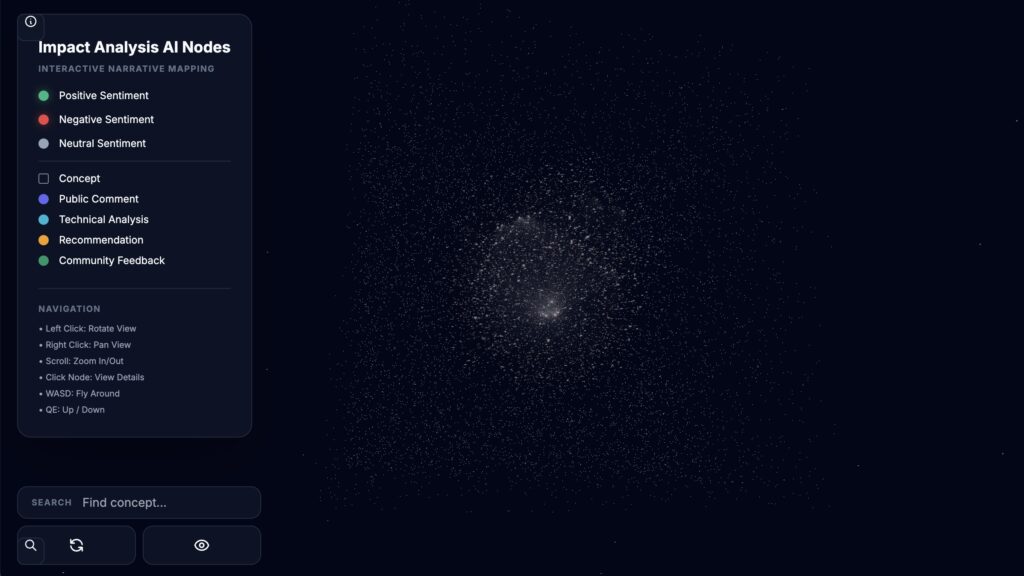
Reading through that material line by line can take months, and even then it can be difficult to see how all the pieces connect. The Nuclear Waste Impact Visualizer was designed to change that. Using technologies like Three.js and 3d-force-graph, it transforms dense datasets into an interactive three-dimensional “galaxy” of ideas that people can actually navigate and explore.
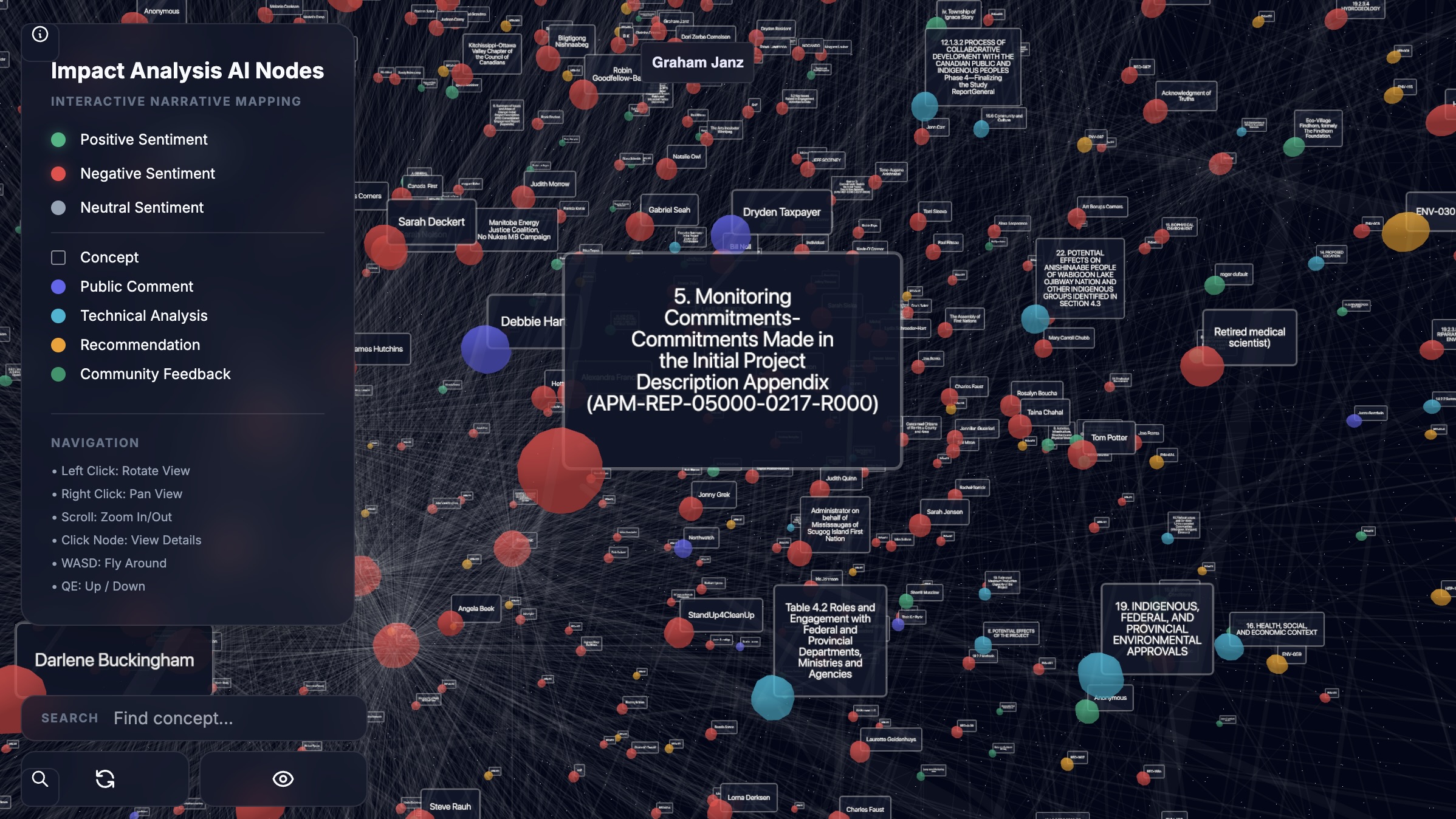
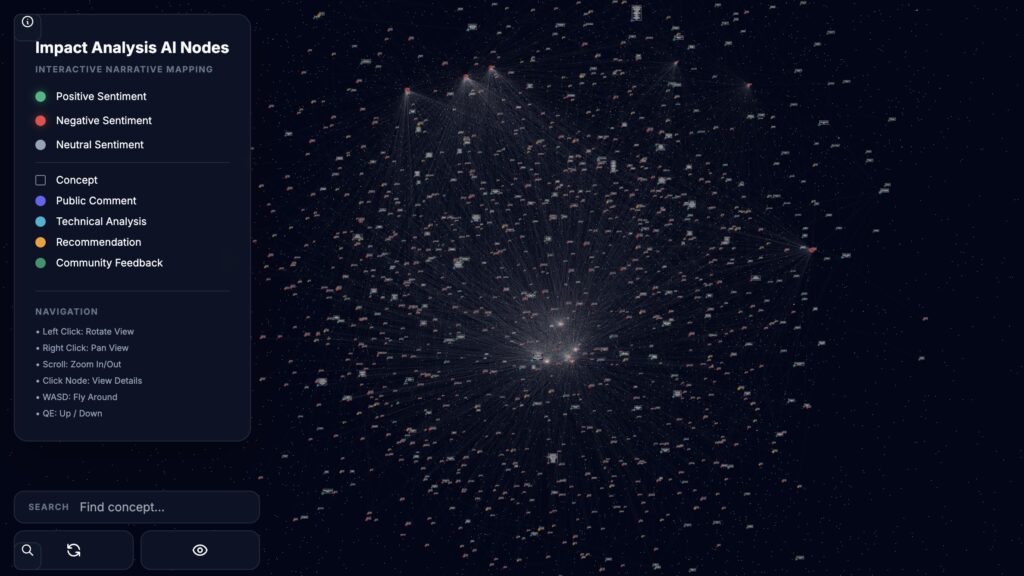
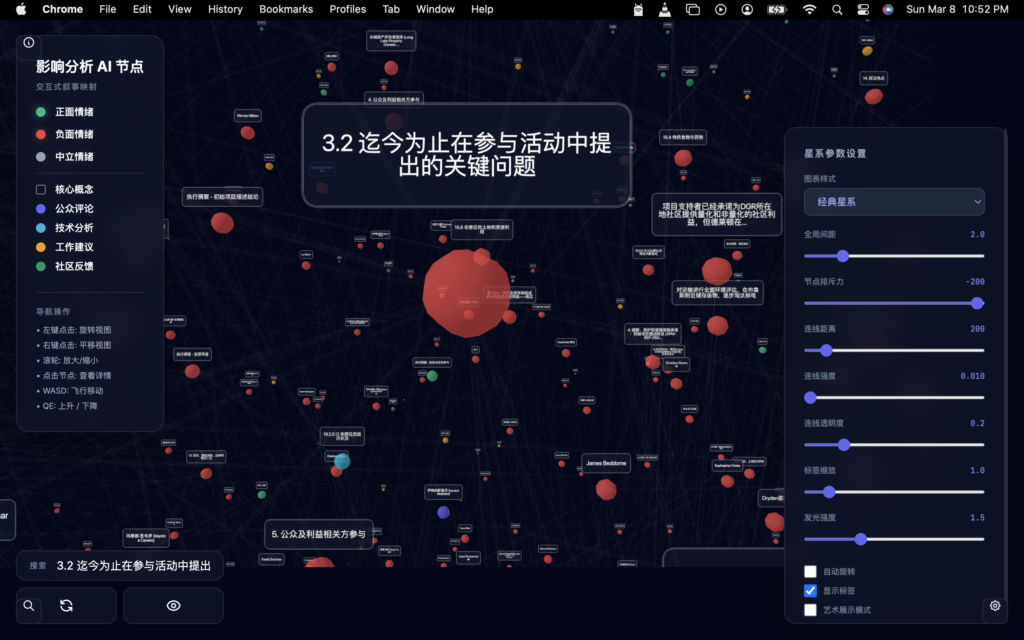
Instead of scrolling through documents, users move through a constellation of connected concepts. Topics like groundwater protection, transportation safety, geology, long-term monitoring, and community concerns appear as nodes floating in space.
The connections between them show where ideas intersect in reports, public consultations, or scientific analysis. When you click on a node, you can see where the information came from, how often it appears, and what other topics it connects to. In a sense, the system turns the entire impact assessment into a map of the conversation.
Applied AI Research in Northwestern Ontario
Artificial intelligence is what makes this possible. Our AI systems analyze large volumes of text—technical documents, transcripts from consultations, written submissions—and identify recurring themes and relationships. Instead of just storing that information in a database, the AI organizes it into a network of concepts and links.
That network becomes the backbone of the visual “galaxy.” As more documents or comments are added, the AI can update the map automatically, allowing the visualization to evolve along with the research and consultation process.
The Nuclear Waste Impact Visualizer isn’t just a technical tool—it’s also an exploration at the intersection of art, science, and technology. Incorporating arts-based and interdisciplinary approaches, the visualization encourages people to experience complex data in a more intuitive and creative way.
Designers and artists work alongside scientists and engineers to craft the look, feel, and interactive elements of the 3D network, turning raw information into something you can move through, respond to, and even enjoy visually.
Applied AI research powers this exploration, analyzing vast datasets while the artistic design helps make those patterns meaningful and engaging for human users. The result is a space where data, human insight, and creativity meet, transforming nuclear waste impact analysis into an interactive, reflective, and visually striking experience.
Digital Arts for Different Perspectives
What makes this especially powerful is how it brings different perspectives into the same space. Scientific analysis, community feedback, and policy recommendations all appear together in the network. You can quickly see where experts and communities are aligned, where concerns are concentrated, and where new ideas are emerging. Clusters of nodes form naturally around important topics, making it easy to spot patterns that might stay hidden inside traditional reports.
Tools like this matter because nuclear waste planning is one of the longest-term decisions humans make. Deep geological repositories are designed to safely contain radioactive material for tens of thousands of years. That means the decisions being made today must balance engineering, environmental protection, public trust, and long-term responsibility.
In turning complex data into something people can explore visually, the Nuclear Waste Impact Visualizer helps make that process more transparent, understandable, and collaborative.
In the end, the idea is simple but powerful: take a mountain of complicated information and turn it into something that feels more like exploring a universe of knowledge.
With AI doing the heavy lifting behind the scenes and art guiding the experience, the Nuclear Waste Impact Visualizer helps researchers, communities, and decision-makers see the bigger picture—and sometimes discover connections they didn’t even know were there.