Why bringing teens and local residents together around a shared canvas actually works.
We’ve all seen the standard community center flyers trying to get people together. Usually, it’s a dry town hall meeting or a sterile neighborhood cleanup where everyone stands around in awkward silence, counting down the minutes until they can leave. It’s hard to get youth to care about those spaces, and it’s just as hard to get older community members to look past their assumptions about the teenagers down the street. Everyone stays in their own little bubble, glued to their phones.
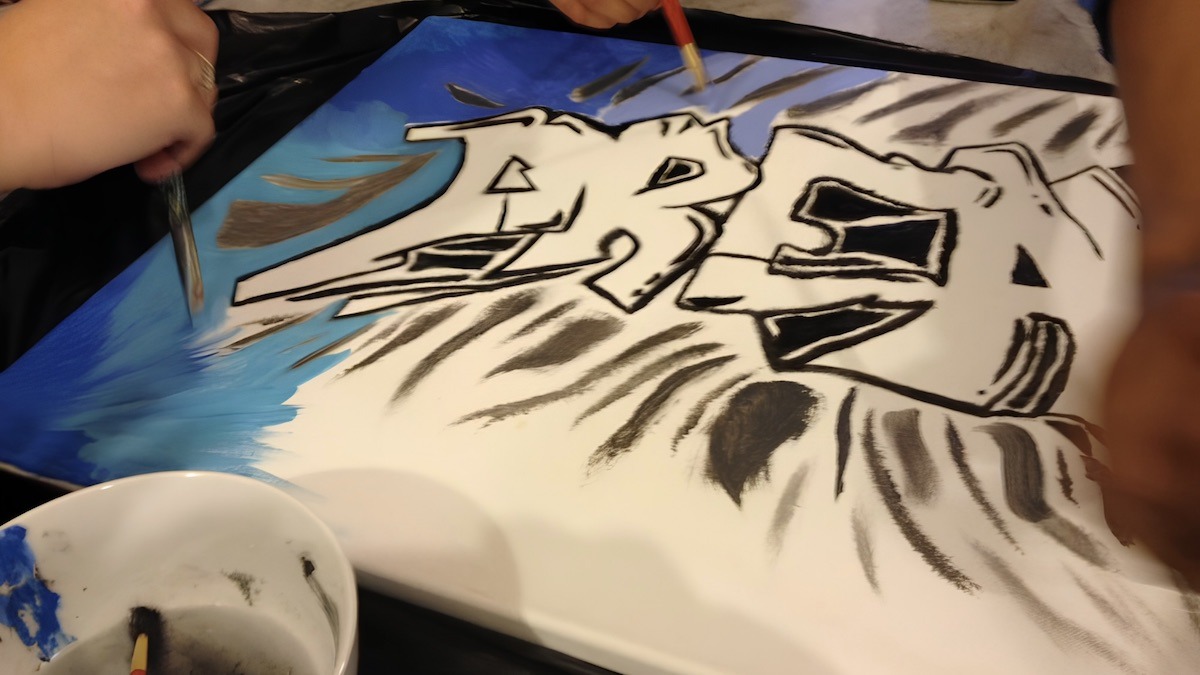
But things change entirely when you throw a massive, blank canvas onto a plastic tarp on the floor, crank up some music, throw in some food and tell a mixed room of local teenagers and older community members to go to town on a piece of graffiti art.
At first, the room is always stiff. You have local business owners or older residents who have probably complained about graffiti their whole lives standing next to sixteen-year-olds who spend their free time sketching tags in notebooks. The adults are terrified of looking stupid because they haven’t touched a paintbrush in thirty years. The youth are on the defensive, expecting to be lectured, judged, or told they’re doing it wrong.
The shift happens the second the first person messes up. Someone tries to fill in a sharp black outline, their hand shakes, and bright blue acrylic bleeds all over the place. In a regular classroom or a strict workshop, that’s a failure. But in a real, chaotic group session, the person running the room just laughs and tells them to turn that smudge into a 3D shadow or a background blast.
That single moment drops the stakes to zero. When an older neighbour looks over and sees a teenager shrug and say, “Don’t sweat it, we can fix that,” the imaginary hierarchy in the room dies. Suddenly, you have a 50-year-old asking a 16-year-old for advice on how to get a clean fade with a fat brush. The youth step into actual leadership roles, not because an adult handed them a badge, but because they actually know what they’re doing with the style, and the adults are willing to learn from them.
For a couple of hours, nobody is checking their notifications. You just have multiple generations crowded around the same canvas, elbows touching, trading markers and paint cups, arguing over which colors look best next to each other, and laughing at the disasters. The youth aren’t being policed, and the older residents aren’t being isolated. They’re just people getting messy.
By the time the paint dries, the canvas is usually a chaotic, loud explosion of different styles. Some parts are clean, some parts are totally wild, and none of it looks like traditional museum art. But that’s the whole point. The actual art isn’t the physical canvas you hang on a wall. It’s the fact that a room full of people who normally ignore each other on the street just spent two hours dropping their guards, working as equals, and realizing they actually like each other.
Try it.