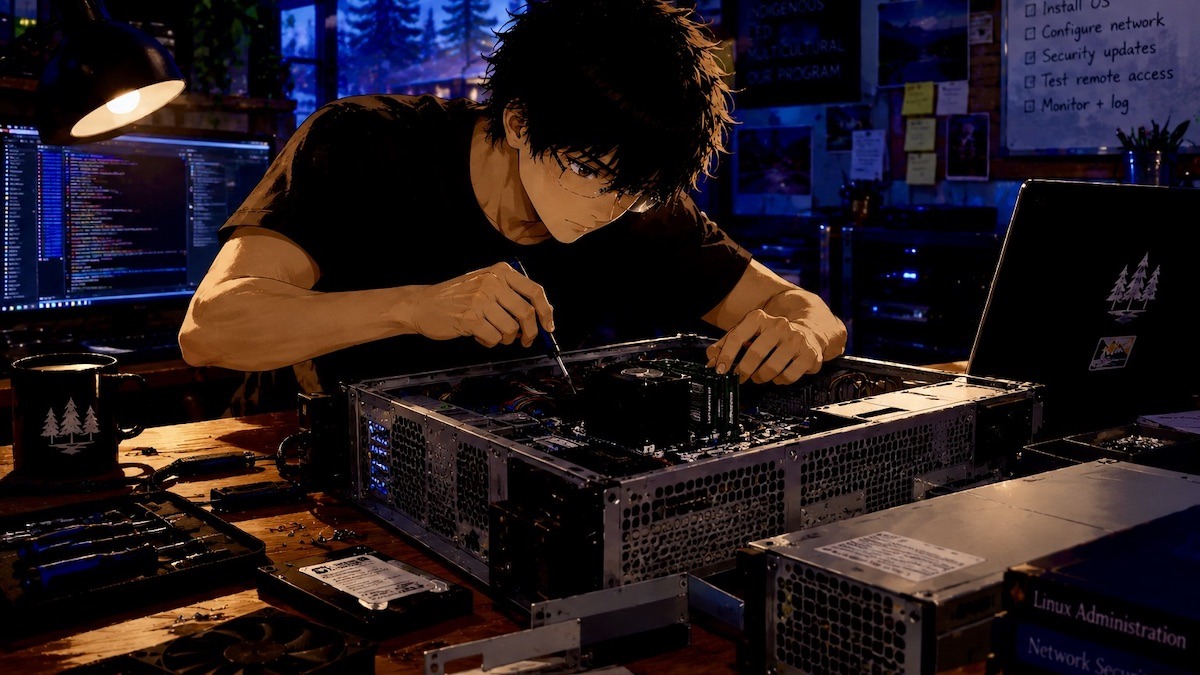
Growing Beyond Our Existing Technology Infrastructure
Our computing needs have changed considerably over the past few years. What started as a collection of small community arts, research and technology projects has grown into a substantial network of digital publishing, software development, data processing and regional collaboration. We have built much of this infrastructure ourselves, working with limited resources and making existing equipment go as far as possible. We are now reaching a point where our servers need to catch up with the work.
This is about more than upgrading computers. Our projects increasingly depend on systems that can handle large volumes of information, run multiple applications, support remote collaboration and provide a reliable environment for ongoing development. We are maintaining websites, developing custom WordPress plugins, managing databases, generating static websites, experimenting with locally hosted artificial intelligence models and even a bit of nuclear research. These are demanding workloads, particularly when several projects are underway at the same time.
Supporting Advanced Software Development and Digital Publishing
Across our wider development work, the volume of code and generated material has exceeded 35 million words. Much of this has been accomplished with modest equipment and very limited operating resources.
These projects require more than conventional website hosting. They involve database operations, software builds, data processing, interactive applications and ongoing development. Better server capacity would allow us to work more efficiently, run multiple services and reduce the time spent managing hardware limitations.
Investing in Reliable Digital Infrastructure
Planned server upgrades would give us more processing capacity, memory, storage and room to run multiple services reliably. It would allow us to host and test applications locally, work with larger datasets, support AI-assisted development and maintain the websites, databases and digital resources our projects already depend on.
We have always tried to make the most of what we have. Our approach has been to build with open-source technologies, develop our own tools, share resources and put available funding directly into practical work. That approach has produced a considerable amount of development for an organization operating at our scale. However, the time spent working around hardware limitations is becoming increasingly difficult to justify when that time could be spent developing applications, supporting participants and delivering programs.
Strengthening Rural Technology and Regional Innovation
There is also a broader regional benefit. We want to make advanced digital tools and computing resources available beyond major urban centres. Shared server capabilities would give us a practical foundation for supporting artists, researchers, students and community partners across our network. It would connect local activity with wider opportunities in digital media, creative technology, software development and applied research.
We see this as an opportunity to build useful technical capacity locally, rather than relying entirely on outside facilities and services. The infrastructure would support existing projects while giving us room to develop new tools, offer practical learning opportunities and take on more ambitious collaborative work.
Building for the Work Ahead
Upgrading our servers is a necessary next step. We have already demonstrated what can be accomplished with limited resources. The investment now is about giving that work the capacity, reliability and room to grow. We are not building infrastructure simply to keep up with technology. We are building it because the work is already here, the demand is growing and we need equipment that can support what we are doing.