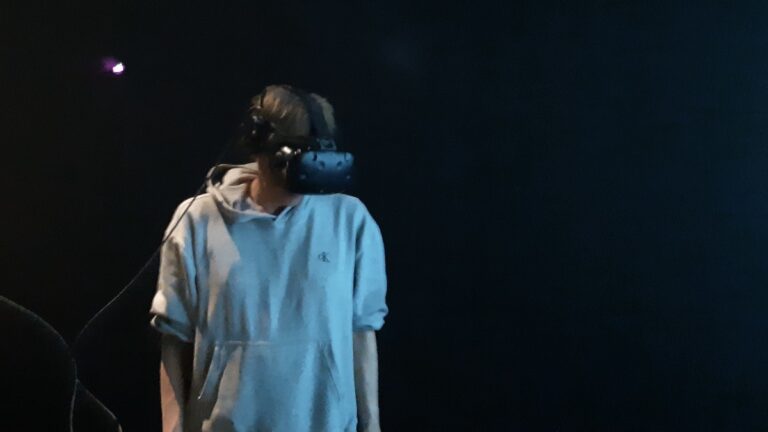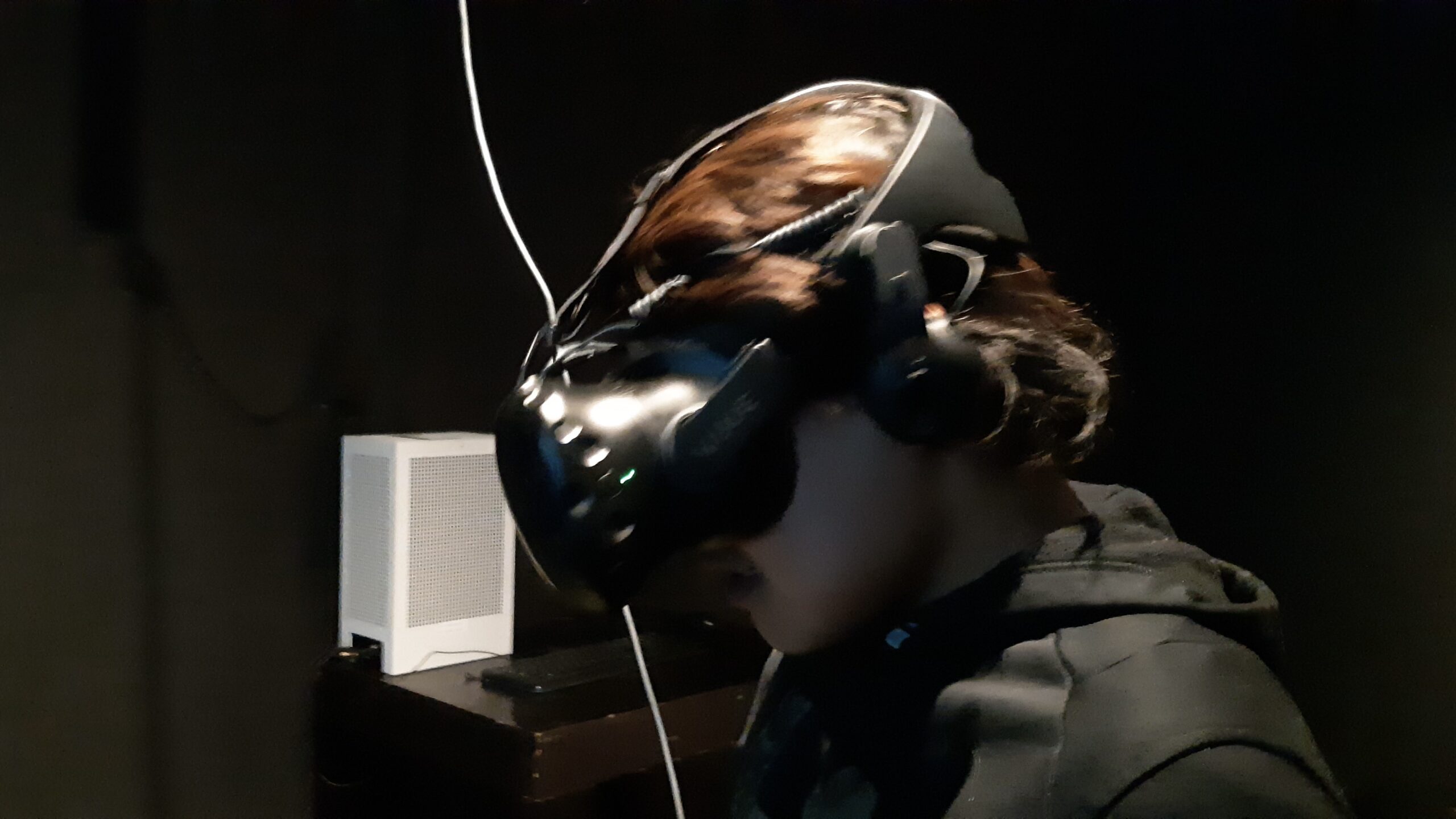
Emerging youth artist and musician Tony Eetak explores a VR installation at the Urban Shaman Contemporary Art Gallery in Winnipeg, Manitoba.
How XR and AI Are Making the Impossible Possible
As the global film and television industry confronts rapid technological change, few studies manage to bridge theory, production practice, and cultural impact as clearly as “AI and Emerging Filming Technologies Reshape the New Driving Force for the Development of Film and Television Art Creation” by Han Minjie and Lan Yi of the College of Arts at Lanzhou University of Commerce. Their research stands out not simply for describing new tools, but for articulating a systemic transformation in how film and television are conceived, produced, and experienced.
What makes this paper genuinely leading-edge is its framing of AI and Extended Reality (XR) not as auxiliary technologies, but as structural forces reshaping the “original ecological structure” of the film and television industry. Rather than treating AI as a post-production enhancement or a cost-saving measure, Han and Lan position it as an active participant in creation itself—introducing a new model of human-machine collaborative creation that spans the entire production pipeline.
Redefining Production Through Virtualization
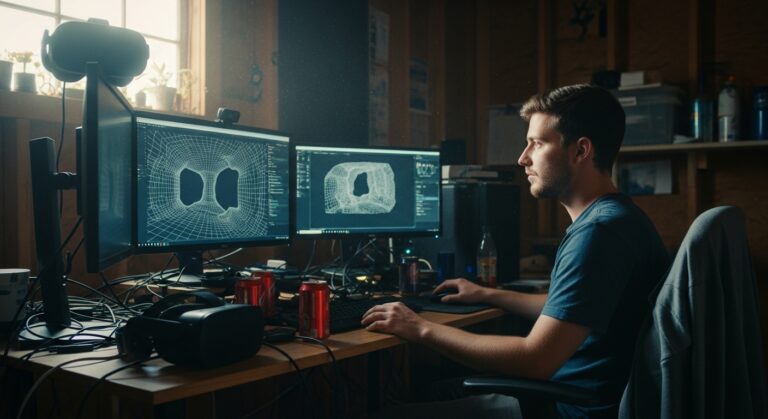
Central to the research is the rise of virtual studios powered by VR, AR, and MR technologies. Han and Lan document how these environments allow filmmakers to construct complete digital worlds, fundamentally altering mid-term shooting processes. This is not incremental change; it represents a shift away from location-dependent, high-risk, resource-intensive production toward flexible, data-driven, and environmentally sustainable workflows.
The paper’s emphasis on risk reduction is particularly important. Enabling dangerous action sequences or extreme environmental conditions to be simulated virtually, production safety is dramatically improved without sacrificing realism. At the same time, the authors highlight the sustainability benefits—less physical waste, fewer large-scale builds, and reduced logistical footprints—positioning virtual production as both a creative and ethical advancement.
The “Smart Set” and the Rise of the Virtual Director
One of the paper’s most forward-thinking contributions is its analysis of the “Smart Set,” anchored by AI-driven virtual director systems. Han and Lan describe how these systems provide real-time guidance on scene composition, character placement, and action choreography, introducing a level of precision previously unattainable in traditional filmmaking.
Intelligent camera systems further extend this capability by automatically recognizing and adjusting lighting, color, and shadow in real time. The researchers’ focus on “precise color reproduction” and pre-editing image optimization demonstrates a deep understanding of how AI is collapsing traditional production silos. Decisions once reserved for post-production are now embedded directly into the filming process itself.
Human-Machine Collaborative Creation as a New Paradigm
Perhaps the most significant theoretical contribution of the paper is its articulation of a new creative paradigm. Han and Lan argue that AI does not replace human creativity but redistributes creative labor. AI systems handle technical scaffolding—automated special effects, real-time rendering, and “one-click” scene generation—allowing human creators to focus on narrative meaning, emotional depth, and cultural expression.
This reframing is crucial. Rather than framing AI as a threat to artistic labor, the research positions it as a tool that amplifies humanistic care and artistic intention. Integrating game engines and real-time visualization, creators can shape emotional tone and aesthetic quality during filming, not after, strengthening the expressive power of digital environments.
Expanding the Audience Experience
The paper also extends its analysis beyond production into reception and participation. In Mixed Reality environments, audiences are no longer passive viewers. Han and Lan explore how interactive design allows viewers to manipulate virtual characters or objects, influencing narrative outcomes in real time. This “personalized viewing experience” dissolves traditional boundaries between creator, text, and audience, pointing toward new forms of storytelling that blend cinema, gaming, and immersive media.
Why This Research Matters Globally
China’s research in AI-driven film and media technologies is increasingly setting the pace for global innovation. Scholars such as Han Minjie and Lan Yi are not merely experimenting with new tools, but developing integrated theoretical frameworks that connect technology, creative labor, industrial structure, and cultural expression. Unlike much Western research, which often emphasizes isolated applications or market efficiency, this work approaches AI and XR as systemic forces capable of reshaping entire creative ecosystems.
The importance of this research extends far beyond China. For countries like Canada—where film and television are deeply tied to cultural identity, regional storytelling, and emerging technology ecosystems—Han and Lan’s work offers a valuable roadmap. It demonstrates how national industries can strategically integrate AI and XR not only to remain competitive, but to redefine creative leadership on a global scale. For researchers and institutions in Canada and the United States, this represents a meaningful opportunity to learn from a model that combines technical ambition with cultural and artistic depth, and to engage more seriously with international scholarship that is already shaping the future of screen-based storytelling.
Equally important is the paper’s emphasis on talent development. The authors identify a critical shortage of professionals who combine artistic literacy with AI fluency, calling for new training systems and stronger collaboration between creative institutions and technology enterprises. This insight is highly relevant internationally, particularly for countries seeking to future-proof their creative sectors in an era of rapid technological change.
A Blueprint for the Future of Film and Television
Ultimately, “AI and Emerging Filming Technologies Reshape the New Driving Force for the Development of Film and Television Art Creation” is a really valuable study on strategic frameworks. Han Minjie and Lan Yi provide a clear, research-driven vision of how human creativity and machine intelligence can co-evolve, reshaping not only how films are made, but how stories are told, shared, and experienced.
Thanks to the researchers for writing this amazing paper. We learned a lot, and it gave us a lot to talk about. As global industries grapple with rapid technological acceleration, this research stands as an example we should be looking at for how thoughtful, culturally grounded innovation can lead the way.
About the Author