How rethinking your psychological relationship with constraints unlocks radical grassroots innovation.
Innovation is often framed as a stroke of lightning or the result of a massive R&D budget. In the world of grassroots arts, we need a more sustainable definition.
Innovation is actually a psychological posture. It is the mental habit of looking at a closed door and wondering if it is actually a wall or just a different kind of canvas. For those of us running organizations on hope and recycled materials, innovation isn’t a luxury; it is our primary mode of operation. It is the ability to maintain a state of intellectual play even when the stakes feel incredibly high.
Why does the psychology of innovation matter for us? Because we often fall into the trap of the Scarcity Mindset. When we focus entirely on what we lack—money, space, equipment—our brains switch into survival mode. Survival mode is the enemy of creativity. It makes us rigid. It makes us stick to the safe way of doing things because we feel we cannot afford a mistake. But the paradox of the grassroots world is that our lack of resources is exactly what allows us to be truly radical. Big institutions are often too heavy to move quickly. We are light. We are agile. To lean into that, we have to psychologically reframe our constraints as design parameters rather than roadblocks.
The core of this mindset is the Permission to be Low-Fidelity. We live in a world of high-definition expectations, but true innovation usually starts in low-def. It starts with the Ugly Prototype. This is the psychological practice of intentionally making something unpolished so that you can test the core idea without getting attached to the aesthetics.
When we lower the bar for how a project looks in its early stages, we lower the psychological cost of failure. This creates a space where what if becomes more important than is it perfect. If you cannot afford to lose a thousand dollars on a failed event, can you afford to lose twenty dollars on a pilot workshop? By breaking big visions down into small, low-fidelity experiments, you protect your mental health and your organization’s longevity.
Another key aspect of the psychology of innovation is overcoming Functional Fixedness. This is a cognitive bias that limits a person to using an object only in the way it is traditionally used. Innovation in a small arts group requires us to break this bias every single day.
It’s about seeing a parking lot not as a place for cars, but as a temporary theater. It is about seeing a social media algorithm not as a master to serve, but as a medium to disrupt. When we challenge functional fixedness, we begin to see that our limited resources are actually a vast kit of parts waiting to be reassembled.
Finally, we must cultivate collective curiosity. Innovation thrives in environments where questions are valued more than certainties. As a leader, your job is not to have all the answers; it is to protect the space where the questions are asked. Encourage your team to look for the Adjacent Possible—the idea that the next big breakthrough is usually just one small step away from where you are standing right now. You do not have to reinvent the wheel; you just have to look at the wheel from a new angle.
Innovation is a practice of resilience. It is the optimistic belief that there is always another way to solve the puzzle. When you stop seeing constraints as enemies and start seeing them as partners in the creative process, everything changes.
You are not just making art with limited resources; you are inventing a new way of being a creator.
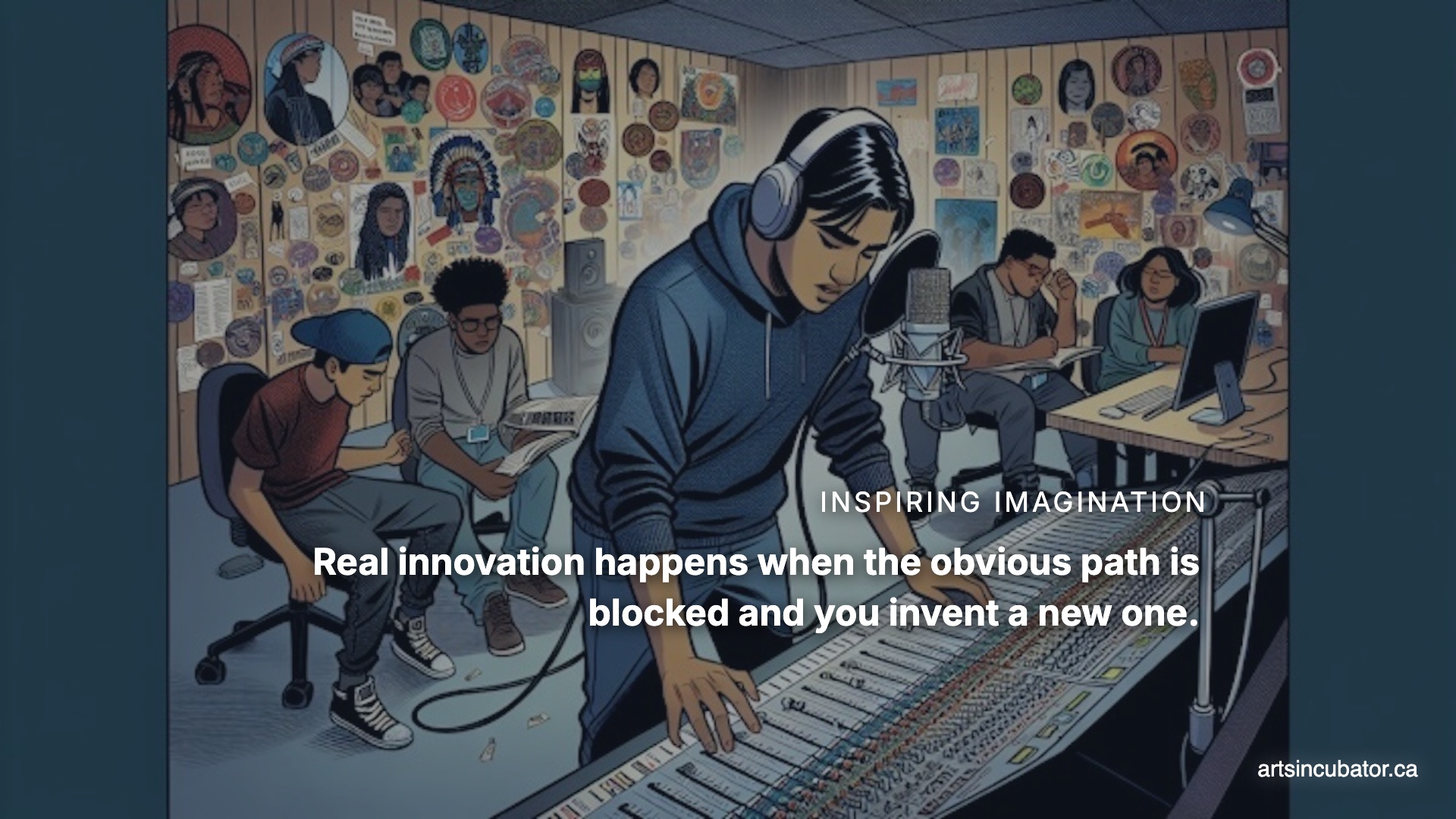
Northern Arts and Regional Innovation
This is a collaborative initiative by The Arts Incubator Winnipeg and the Art Borups Corners art collective, supporting artists and creative projects in Melgund Township, Northwestern Ontario. Our groups champion rural arts development, community programming, Indigenous arts partnerships, and cultural innovation—strengthening the local and regional arts sector through mentorship, exhibitions, digital media, and sustainable creative entrepreneurship. Our events and activities include artists from Melgund Township, Winnipeg, Ignace, Sioux Lookout, Dryden, and beyond. You read more innovation-focused posts here.
About the Author