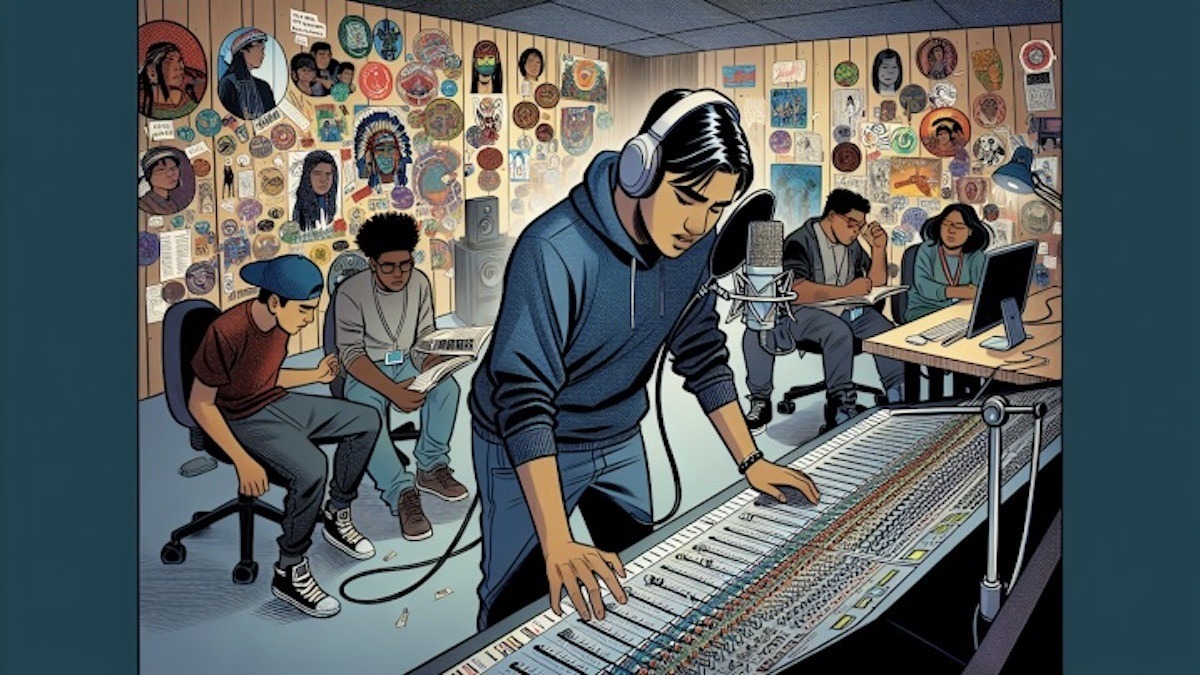
How shifting your perspective on limitations unlocks the most original creative breakthroughs.
Innovation is often sold as a high-tech luxury, something that only happens in silicon-valley labs or glass-walled institutions with seven-figure endowments. But for those of us operating in the grassroots arts world, innovation isn’t a line item in a budget; it is a psychological stance.
It’s the mental habit of looking at a limitation and seeing a doorway. Real innovation happens when the obvious path is blocked and you invent a new one. This is not just “making do”; it is the highest form of creative problem-solving. It is the architecture of the pivot.
For a small organization, your psychological advantage lies in your lack of legacy. Large institutions are often paralyzed by the “way things have always been done.” They have reputations to protect and massive overheads to justify. You, however, have the freedom to be intellectually nimble. When you have fewer resources, you are forced to engage with the world more deeply. You can’t simply buy a solution, so you have to understand the mechanics of the problem. This friction is exactly what generates original thought. Friction creates heat, and heat is what allows you to forge something new.
One of the most significant psychological hurdles in creative leadership is a concept known as functional fixedness. This is a cognitive bias that limits us to seeing an object or a situation only in its traditional use. To the average person, a vacant storefront is just a real estate problem. To an innovative grassroots leader, that same storefront is a pop-up gallery, a community classroom, or a site-specific theater.
Overcoming functional fixedness is the primary job of a scrappy creator. It requires you to decouple an object’s identity from its utility. Once you realize that everything is a raw material, your “budget” essentially expands to include the entire world around you.
To foster this mindset in your team, you have to cultivate a “safe-to-fail” psychology. In big corporations, they talk about being “fail-safe,” which means building expensive systems to ensure nothing ever goes wrong. In a grassroots setting, we should aim for the opposite. We want experiments that are so low-cost and high-learning that if they fail, the only thing we’ve lost is a bit of time. When the cost of a mistake is low, the psychological barrier to trying something radical disappears. This is where real breakthroughs live. You stop asking “Will this work?” and start asking “What will we learn if it doesn’t?”
This psychological shift also changes how you respond to the word “no.” In the early stages of a creative project, you will hear “no” more often than “yes.” You’ll hear no to funding, no to space, and no to partnerships. A traditional mindset sees “no” as a stop sign. An innovative mindset sees “no” as a design constraint. If you can’t use the park, maybe the street becomes the stage. If you can’t afford the printing costs, maybe the project becomes a digital whisper campaign. These are not compromises; they are the pivots that give your work its unique DNA.
Ultimately, the psychology of innovation is about trust—trust in your own resourcefulness and trust in the creative process. You don’t need a lab to be an innovator. You just need the willingness to look at what you have and ask what else it could be. Your brain is the most sophisticated piece of technology in your organization.
When you combine that with a community of people who aren’t afraid to try, you become unstoppable. Keep looking for the cracks in the wall; that’s where the light gets in, and that’s where you’ll build your most interesting work.
Northern Arts and Regional Innovation
This is a collaborative initiative by The Arts Incubator Winnipeg and the Art Borups Corners art collective, supporting artists and creative projects in Melgund Township, Northwestern Ontario. Our groups champion rural arts development, community programming, Indigenous arts partnerships, and cultural innovation—strengthening the local and regional arts sector through mentorship, exhibitions, digital media, and sustainable creative entrepreneurship. Our events and activities include artists from Melgund Township, Winnipeg, Ignace, Sioux Lookout, Dryden, and beyond. You read more innovation-focused posts here.
About the Author