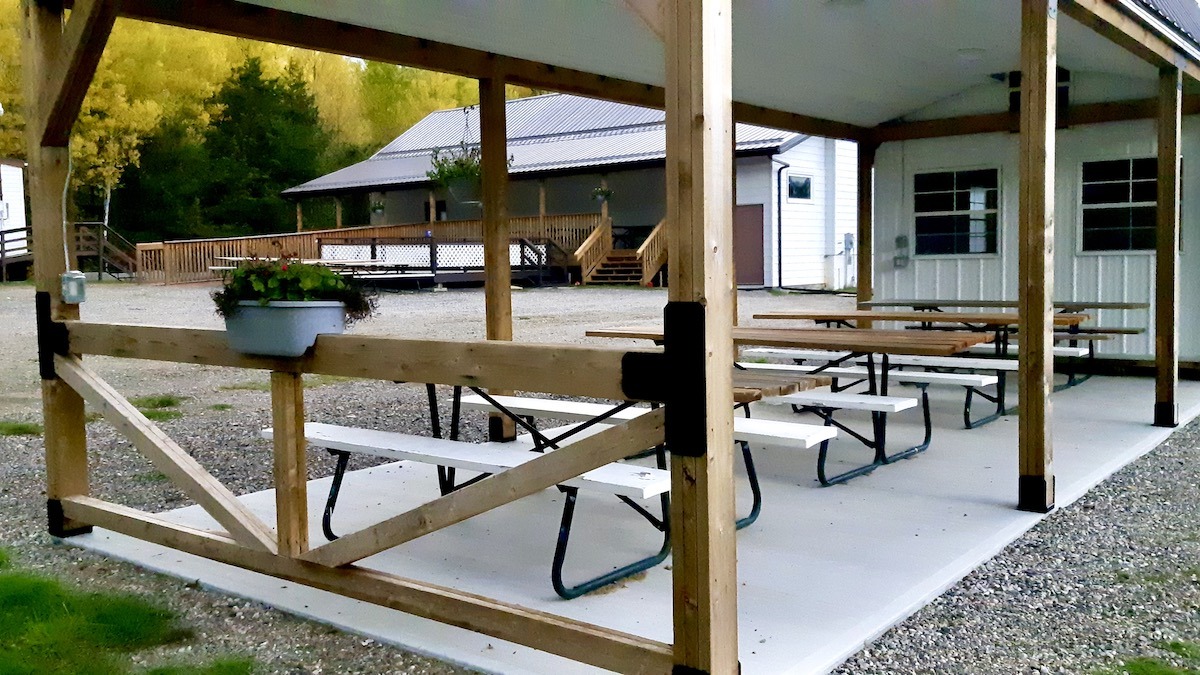
How the disappearance of informal gathering spots is making loneliness structural
I keep thinking about how hard it is just to exist somewhere that isn’t home or work/school. Like, where do you go when you don’t have a specific plan but you also don’t want to stare at your walls? The answer used to be “just go somewhere.” A café that didn’t rush you. A park bench where people actually sat and talked. A community center, a library that felt lived-in, a cheap diner, a church basement, a rec league that didn’t take itself too seriously. Those spots sociologist Ray Oldenburg called “third places” in his 1989 book The Great Good Place, the informal public living rooms between home (first place) and work (second place).
They’re disappearing, and it’s not subtle.
Only about 22% of Americans visit these kinds of spaces regularly now, down from 41% in 2000. One in five of us live in what researchers call “civic deserts,” places with basically zero access to parks, libraries, community centers, cafés, or anything else where you might casually run into people. Another 36% have only minimal access. And the loneliest neighbourhoods tend to have the fewest of these spots (Third Place Index research; Survey Center on American Life / Washington Monthly summary).
Look at the numbers on what people actually do. From 1995 to 2026, the share of Americans who entertained people at home at least once a year dropped 21 points. Club meetings down 19 points. Church or place of worship down 20. Picnics, card games, volunteering, all double-digit declines (Data for Progress 2026 analysis). We’re spending more time alone at home (young adults especially, roughly two extra hours a day compared to two decades ago) and way less time just being around other people in public. Time spent on in-person socializing has plunged by more than 20% since the early 2000s.
Hybrid work made it worse. People used to bump into people on the commute, at the coffee place near the office, after hours. Now a lot of us go from bedroom to Zoom to delivery app (especially the delivery apps!). Urban design doesn’t help either, so many places are built for cars and efficiency, not lingering. Rents are now so high that a lot of independent spots can’t afford to let people sit for two hours with one drink. Chains optimize for turnover. Parks get underfunded. Libraries cut hours. Independent coffee shops alone saw a net loss of thousands of locations in recent years. And for us in our early 20s? A lot of the remaining spots either cost money we don’t have or actively don’t want unsupervised young people hanging around.
This isn’t some soft “people should just try harder” problem. Third places are where weak ties form, the repeated low-stakes “hey, I see you” interactions that slowly turn into real friendships or just make a neighborhood feel less empty. When those vanish, you don’t just lose a café. You lose the accidental conversations, the sense that you’re part of something bigger than your group chat. Research from CU Boulder and others has documented widespread closures of these spaces (especially 2019–2021 and continuing), with the losses hitting socially vulnerable and rural communities hardest. Young people are feeling it hard because we’re the ones trying to build adult social lives without the infrastructure previous generations had. No wonder so many of us default to screens.
Some of those old third places had their own problems. But the vacuum is real, and it’s structural. High costs, zoning that separates everything, delivery culture, screens that make staying home too easy, declining participation in groups that used to create free gathering spots. We’re designing cities and lives for efficiency and privacy, then acting surprised when people feel isolated.
The good news is some places are pushing back, libraries adding more programming, communities fighting for better parks, people starting low-key clubs in whatever free space they can find. But it needs to be bigger than individual effort. We need actual investment in spaces that let people linger without buying something every five minutes. Because right now the message is clear: if you don’t have a private home to host in or money to spend, your options for just being around other humans are getting thinner every year.
That’s not a personal failure. That’s a design failure. And it’s making everything else, the loneliness, the friendship drought, the weird silence, harder to fix.