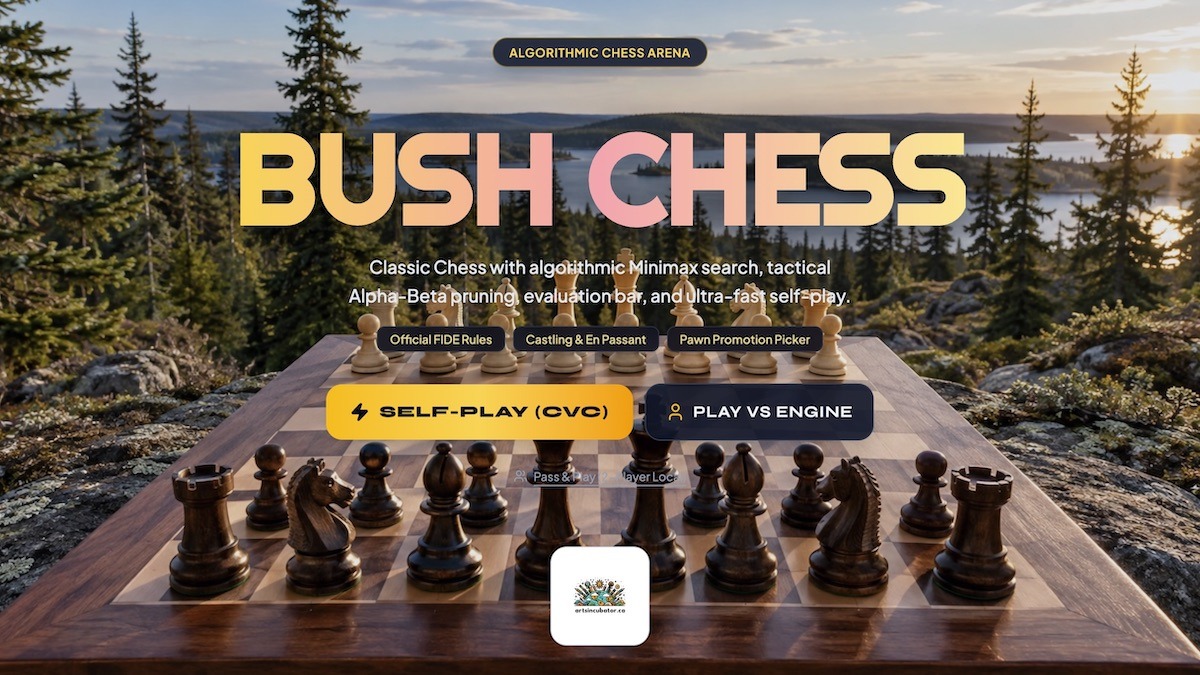
What happens when artists, coders, and educators spend two hours stress-testing classic game design.
Most weekend mornings begin with coffee and quiet routines. Around here, they usually kick off with a blank text editor, a wild whiteboard sketch, and a shared question: What can we bring to life before lunch? As part of our fall and winter creative programming, we set aside dedicated studio time every weekend to dig into digital literacy, game mechanics, and hands-on coding. We pick an idea dreamed up over the previous week and push ourselves to build a working, playable prototype in just an hour or two. This past weekend, the chessboard claimed our collective imagination—and the result is Bush Chess.
Chess has fascinated thinkers and makers for over a millennium, but peeling back the board to code its rules from scratch gives you an entirely new appreciation for its architecture. It is an extraordinary masterclass in system design. Behind every quiet pawn advance lies an intricate dance of state management, coordinate geometry, and decision trees. Instead of reaching for heavy engines or bloated backends, we wanted to build something lean, tactile, and completely self-contained—a snappy web-native arena that runs anywhere with zero friction and zero installs.
Bush Chess gives players three distinct ways to engage with the board. You can sit down for a match against the algorithmic engine across multiple difficulty tiers, pass the keyboard back and forth with a friend in local two-player mode, or kick back and watch the machine spar against itself in hyper-speed Self-Play mode. That autonomous simulation mode was an absolute blast to build; watching two automated strategies test tactics at fifty milliseconds a turn feels less like traditional gaming and more like peering into an active mechanical clockwork exhibit.
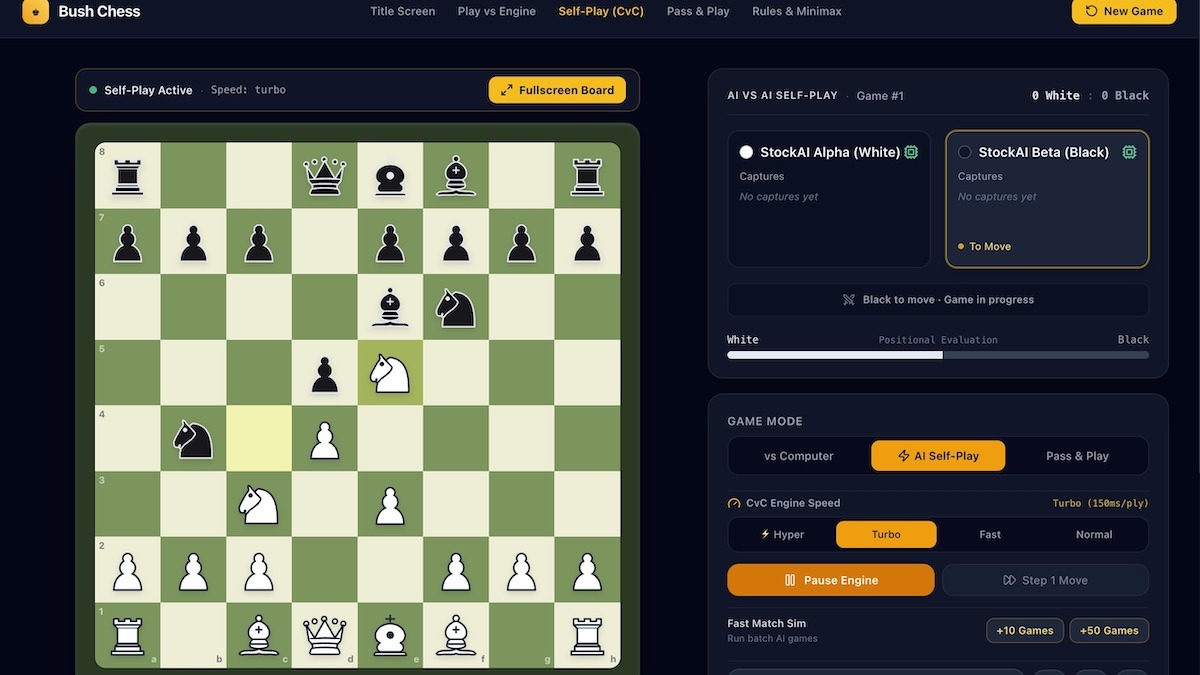
Along the way, we layered in all the small details that make digital games feel satisfying to touch. We tuned procedural web-audio clicks that give every slide, capture, and castle a clean tactile snap. We added an interactive piece-promotion picker, an active material tally that tallies captured pieces in real time, a live positional evaluation meter, and interchangeable board palettes ranging from classic Tournament Green to rich Heritage Walnut. We even made sure to hard-code standard tournament guardrails—like the threefold repetition draw rule—so our algorithmic bots would pursue real progressive plans instead of wandering back and forth in endless piece-shuffling loops.
At its core, projects like Bush Chess illustrate the true power of rapid prototyping and design thinking. You do not need months of planning or a massive engineering budget to demystify technology. By treating code as an artistic medium and games as living design puzzles, anyone can learn to deconstruct complex systems, iterate through stumbling blocks, and ship something functional in a single afternoon. It bridges the gap between passive digital consumers and active creators.
Now we want to hand the board over to you. Take Bush Chess for a spin right in your browser, see how our bots hold up against your favorite opening lines, and let us know your thoughts. What features should we add next? Should we expand this into a full series of creative coding workshops? Drop us a note at info@artsincubator.ca and tell us if we should keep building on it!
Image Captions
Caption 1 (Board Overview / Match in Progress):
A clean board state in mid-match showing custom vector Staunton pieces, last-move indicators, and the live material ledger. Every movement and capture is calculated purely on the client side without needing external servers.
Caption 2 (Scoreboard & Positional Evaluation):
The custom HUD tracks active turns, real-time material leads, and centipawn positional evaluations. Designing dedicated, fixed-height interface containers kept the layout rock-solid even during rapid-fire bot matches.
Caption 3 (Self-Play & Control Deck):
The control tray lets players dial between human play, head-to-head local matches, and accelerated engine-versus-engine simulation. Watching algorithmic decision trees unfold at sub-second speeds turned out to be one of the prototype’s most captivating features.
Caption 4 (Theme & Customization Switcher):
Swapping board finishes from Tournament Green to Modern Slate or Heritage Walnut highlights the visual design side of the sprint. Small aesthetic touches turn an abstract mathematical grid into an inviting digital sandbox.