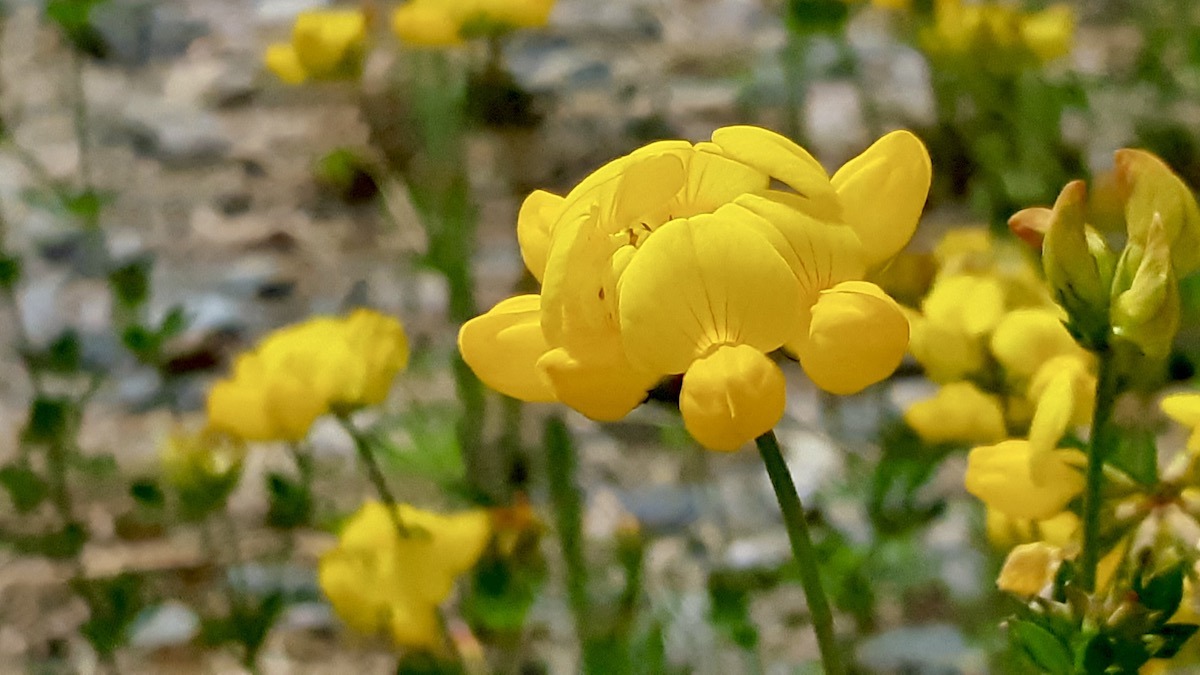
The Sunny Little Slippers of Our Summer Trails
Walking along the sunny roadsides or gravel paths of Northwestern Ontario in mid-summer brings you face-to-face with dense mats of bright, cheerful yellow blossoms. These small flowers cluster together in a unique crown shape that looks remarkably like miniature slippers or tiny pea blossoms. This is bird’s-foot trefoil, a remarkably durable perennial that loves to blanket open spaces with a vibrant splash of gold.
Documenting these species is a big part of our summer routine. Every year, our arts incubator program works to capture the local plants, berries, and flowers growing in and around Melgund Township and the wider region. We want to celebrate the local landscape and show how these native plants shape our ecosystem. Capturing the bright, intricate details of bird’s-foot trefoil helps us highlight the hardy groundcovers that bring life and color to our rugged northern trails.
The Clustered Pea-Flower Design
Take a closer look at a single cluster, and you will see the distinctive anatomy that places this plant in the pea family. The blossoms have a distinct shape featuring a large upper petal called a banner, two side wings, and a lower keel. They grow in small, circular groups at the top of slender stems, often blushing with tiny orange or red lines when they first open to attract bumblebees.
The plant gets its unusual common name from what happens after the flowers fade. The resulting seed pods grow straight out from a single point in long, thin cylinders. When they ripen, the cluster of pods looks exactly like the foot of a bird, making it incredibly easy to identify later in the season.
Built for Rugged Spaces
You will frequently find this plant thriving in places where other vegetation struggles to find a foothold. It loves full sun and easily adapts to poor, compacted soils, sandy banks, and the gravelly edges of highways cutting through the Canadian Shield. Deep, aggressive root systems allow the plant to dig far into the earth to find water during dry spells, while its dense, sprawling stems create a protective green mat that anchors loose soil against heavy summer rains.
A Benefit for Soil and Pollinators
Beyond its bright appearance, this perennial does some serious heavy lifting for the local ecosystem. Like other legumes, it partners with soil bacteria to draw nitrogen from the air and pump it back into the dirt, naturally fertilizing the poor ground where it grows. Its long-lasting summer blooming period also provides a highly reliable, protein-rich food source for local bees, butterflies, and other pollinators when early spring wildflowers have long since disappeared.