Federal Government unveils $200B national AI strategy to counter Canada’s lagging tech adoption
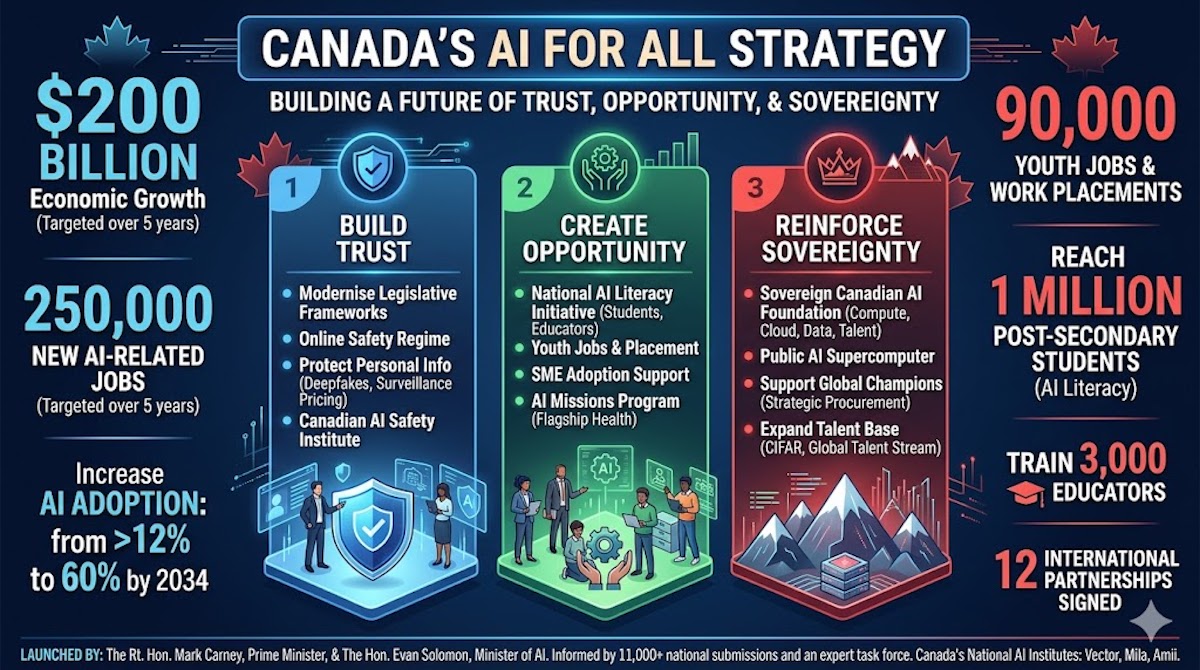
OTTAWA — Prime Minister Mark Carney launched a sweeping five-year national artificial intelligence strategy Thursday, pledging to inject $200 billion into the domestic economy and aggressively scale up technology adoption across critical sectors.
The initiative, dubbed “AI for All,” aims to reverse a significant economic vulnerability. While Canada possesses one of the fastest-growing digital sectors in the G7, federal data shows it remains among the slowest nations to adopt AI at scale, with just over 12 per cent of domestic businesses currently utilizing the technology.
The new federal framework targets a massive shift, aiming to push Canada’s AI adoption rate to 60 per cent by 2034. Government projections suggest the strategy will create 250,000 new AI-related jobs over the next five years, including 90,000 employment and placement opportunities targeted directly at younger Canadians.
“AI is here,” Carney said during an announcement in Toronto. “The question is whether it will improve the lives of all Canadians or benefit only a few. AI can shorten our emergency room wait times and make a small business more competitive, if it is governed by Canadian values with a clear goal of improving the lives of all Canadians.”
Federal Guardrails and Privacy Protections
To address mounting public concern over rapid automation and algorithmic risks, the strategy introduces a series of legislative overhauls.
Ottawa plans to modernize existing digital privacy laws to introduce a stricter online safety regime for social media and commercial chatbots. The new measures are designed to shield consumers from harmful tech practices, specifically targeting deepfakes and algorithmic surveillance pricing.
The legislative push builds on the Protecting Victims Act, introduced in December 2025, which proposes a federal ban on the distribution of non-consensual sexual deepfakes and increases criminal penalties for unauthorized intimate image distribution.
The plan will also expand the mandate of the Canadian AI Safety Institute, tasking the watchdog with conducting independent, transparent evaluations of advanced AI models before they hit the commercial market.
Subsidized Literacy and Industry Missions
The strategy places heavy emphasis on workforce transition and public education to prevent economic benefits from pooling solely within major tech hubs.
A new National AI Literacy Initiative will deliver basic AI training to one million post-secondary students and equip more than 3,000 educators with classroom learning kits. Under the plan, every post-secondary student in Canada will also be granted access to a government-verified, trusted AI assistant.
For industry, the government is launching an AI Missions Program. Its first flagship project will focus on the healthcare sector, deploying AI models to accelerate medical diagnostics, streamline patient care, and reduce emergency room wait times.
Evan Solomon, Minister of Artificial Intelligence and Digital Innovation, said the policy is designed to keep the economic value of home-grown innovation within Canadian borders.
“This is how we protect people, grow our economy, reflect our values, and deliver real benefits in everyday life,” Solomon said.
Sovereign Infrastructure and Clean Energy
A central pillar of the announcement involves heavy federal investment into sovereign technological infrastructure. The government intends to build a public AI supercomputer and expand domestic cloud capabilities, ensuring Canadian researchers and firms do not rely on foreign-controlled systems.
Officials stated the high-performance computing centers will be tied directly to Canada’s clean energy expansion to comply with federal environmental standards.
Industry Minister Mélanie Joly emphasized that domestic sovereignty is critical as the global AI market is projected to reach U.S.$4.8 trillion by 2033.
“Our government’s new AI Strategy will support responsible AI adoption and boost productivity and investment, while at the same time delivering real benefits for Canadians and protecting our digital sovereignty,” Joly said.
The strategy’s rollout will be supported by Canada’s three existing tech hubs: the Vector Institute in Toronto, Mila in Montréal, and the Alberta Machine Intelligence Institute in Edmonton. The international scope of the plan will leverage 12 existing bilateral partnerships, alongside the newly formed Sovereign Technology Alliance, to attract foreign capital and secure computing power from allied nations.
The framework follows a year of extensive federal preparation. In 2025, the government received more than 11,000 consultation submissions from workers, researchers, and business owners, alongside data from a 28-member expert task force, culminating in a final report released in February 2026.
Patty Hajdu, Minister of Jobs and Families, said employer-led training and upskilling programs will be widely deployed to protect mid-career and frontline workers from displacement.
“As AI is changing the future of work, we are supporting workers to adapt with it,” Hajdu said. “We’re equipping workers with the tools they need to strengthen their skills and helping them seize new opportunities in an AI-enabled economy.”