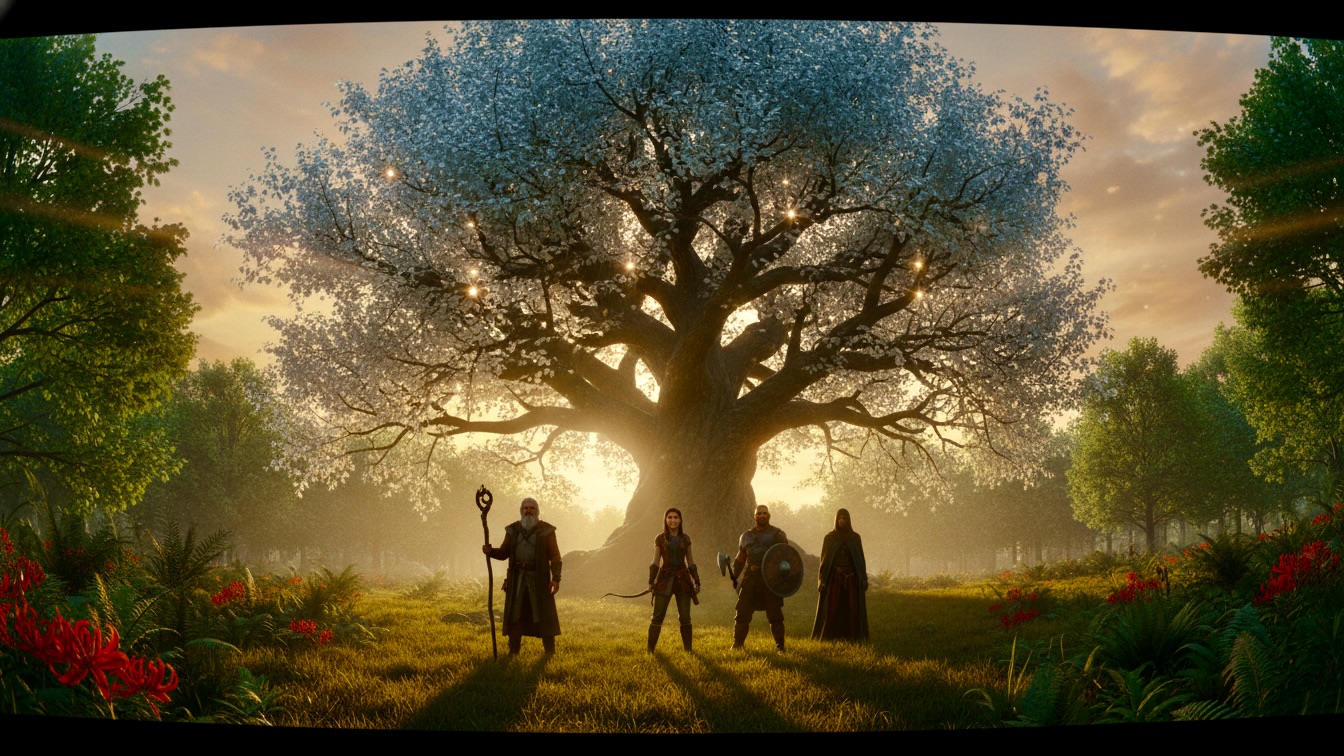
Format: Short Film / Anthology Episode | Est. Length: 10-12 minutes
Imagine The Copper Sap as a foundational chapter in a prestige anthology series titled The Verdant Reach, a "solarpunk-noir" that explores the intersection of environmental collapse and bureaucratic indifference. The series centers on the Wardens, a guild of botanical mages who maintain the world’s last atmospheric lungs within a sprawling, heat-choked metropolis. While the overarching narrative tracks the slow death of the planet’s "heartwood," individual episodes focus on the psychological resilience of the laborers who fight for every drop of water in a world that has prioritized urban expansion over survival.
Silas, an aging warden with joints like "unreliable hinges," kneels in the parched dust to touch the trunk of the Elder Oak, only to discover that the tree’s heartwood is radiating a feverish heat. This silent alarm signals that the forest has finally lost its ability to regulate its own temperature, marking the beginning of a terminal decline.
In a city that prioritizes summer festivals over ecological survival, an aging forest warden must pivot his demoralized guild from a state of despair to one of defiant craftsmanship. They must learn that in the face of total collapse, the only way to keep the forest breathing is to find and record the smallest of victories.
The episode explores the theme of "Resilience against Bureaucratic Neglect," highlighting the emotional toll of environmental stewardship when the governing bodies are physically and empathetically detached from the land. It examines the "grey sludge" of burnout—a state where the magnitude of a crisis paralyzes action—and proposes that the remedy is a radical shift in perspective toward micro-successes.
Furthermore, the story delves into the "Vocation of the Shaper," contrasting the meaningful, soul-crushing labor of growing a world with the empty, climate-controlled comfort of building "boxes" in the city. It posits that hope is not a passive feeling but a tactical tool that must be manufactured through the recognition of individual talent and the persistence of life in extreme conditions.
The stakes are both ecological and existential: if the Wardens of the Verdant Reach succumb to fatigue and close their gates, the city loses its only source of shade and breathable air, condemning the commoners to lethal heatwaves. For Silas, the failure of the guild represents the erasure of his life’s work and identity, while for the young Julian, it means the loss of a future where nature and humanity coexist.
The primary external antagonist is the High Council, an unseen but oppressive force that hoards mana-wells for aesthetic city fountains while the Grove starves. Internally, the characters battle a "heat-stroke of the spirit," manifested as Julian’s desire to abandon his vocation for steady pay and Silas’s own encroaching physical and mental exhaustion. The environment itself acts as a relentless, uncaring force, with the "copper sun" and "sun-baked brick" earth providing a constant physical pressure that threatens to break the team’s resolve.
Silas and his second-in-command, Mara, struggle to maintain the Verdant Reach during a record-breaking drought while the city's High Council denies them essential mana-wells to prioritize a summer festival. Faced with a demoralized team and a dying forest, Silas realizes that their traditional methods of labor are no longer sustainable under the weight of their collective despair. He halts all work to implement a "Win Board," a slate where the team must record tiny, successful moments—like a graft holding or a rare flower blooming—to counteract the "grey sludge" of their perceived failures.
The strategy proves transformative when Silas discovers a silver-leaf bud blooming prematurely on a graft Julian thought was dead, a miracle triggered by the very heat that threatened to destroy them. This small sign of defiance from the forest reinvigorates the team, shifting their mindset from desperate defense to proactive survival. The episode concludes with the guild preparing to launch a high-risk canopy-capture project, proving that while the drought remains, their internal drought of hope has been broken.
Silas: A thirty-year veteran of the Wardens whose body is failing as fast as the forest. At the start, he is drowning in the "grey sludge" of bureaucratic defeat, but by the end, he evolves into a visionary leader who understands that hope is a tactical necessity for survival. His psychological arc is a transition from an exhausted administrator to a defiant "shaper" who leads through inspiration rather than just labor.
Mara: The pragmatic, steel-spined ledger-keeper who tracks water drops like currency. She begins the story as a rigid realist, burdened by the math of their inevitable failure, but ends with a flicker of respect for Silas’s psychological pivot. Her arc represents the shift from cold, survivalist calculation to a cautious, shared optimism.
Julian: A talented young shaper whose hands are literally and figuratively blistered by the mission. He starts the episode on the verge of quitting for a comfortable city job, viewing every dead leaf as a personal failure. By the end, after seeing his silver-leaf graft bloom, he regains his sense of vocation and recognizes his unique worth as a creator of worlds.
The Fevered Oak: Silas discovers the Elder Oak is overheating, signaling a terminal threat to the Grove's heartwood, while Mara delivers the news that the Council has denied their water requisition. The scene establishes the oppressive, blanket-like heat and the crushing weight of bureaucratic indifference that makes the finish line feel "moved to another continent." Silas realizes that the team's exhaustion is a physical entity, a grey sludge that must be addressed before the forest can be saved.
The Win Board: Seeing Julian on the verge of a total breakdown in the workshop, Silas strikes the floor with his staff and halts all mulch-layering to demand a record of what went right today. He introduces the "Standing Vines" slate, forcing the skeptical team to acknowledge small victories like a successful silver-leaf graft or the return of fire-lilies. This shift in focus creates a psychological "spark" in the room, changing the silence from one of defeat to one of searching for success.
The Expensive Start: Mara and Silas gamble their last three units of emergency mana to clear a silt-blocked irrigation pipe, knowing the High Council would "have their heads on a pike" for the unauthorized use. As a thin stream of brown water begins to flow, Silas mentors Julian, reframing the young man's struggle as a vocation of "building a world" rather than just a job. The scene highlights the high stakes of their resource management and the deep, paternal bond Silas feels toward his struggling team.
The Celebration: On the hottest day of the year, the team gathers in the workshop to celebrate the completion of a trellis framework with fermented honey-water, choosing communal joy over the "treadmill" of endless labor. Silas validates each member's specific talents—Stefi’s eye for seeds and Julian’s touch for living grain—transforming them from a group of failures into a team of elite specialists. The mood shifts from survivalist dread to a shared sense of professional pride, proving that they are "winners of the small things."
The First Bloom: In the pre-dawn light, Silas discovers a silver-leaf bud blooming on Julian's graft—a biological defiance triggered by the extreme heat and Julian’s blood-sealed bond. He brings the team to witness the miracle, using it as the catalyst to launch a daring new atmospheric-capture project in the high canopy. The episode concludes with Silas writing "HOPE" on a stone, signaling that while the marathon is far from over, the guild has finally found its stride.
The episode begins with a suffocating sense of "Ecological Dread," characterized by physical heaviness and sensory details of heat and dust. As Silas introduces the Win Board, the mood shifts into "Manufactured Hope," a fragile and skeptical state where the characters are performing optimism to survive. The climax provides a "Cathartic Defiance," where a genuine miracle (the bloom) transforms the atmosphere from one of stagnant despair to one of focused, professional energy and communal pride.
In a full season, the Wardens would move from the Outer Circle into the "Deep Grove," discovering that the drought is not entirely natural but is being exacerbated by a secret Council project to siphon groundwater for a "Utopian" district. Silas would have to navigate increasing political pressure, eventually turning the "Win Board" into a ledger of evidence to expose the Council’s negligence to the city’s commoners.
The seasonal character arcs would see Julian rising as a leader of a new generation of shapers who use "survival-blooming" techniques to keep the forest alive. Mara would transition from a bookkeeper to a revolutionary strategist, while Silas’s health would decline, eventually forcing him to pass his staff to Julian in a series finale that sees the first rains finally breaking the "Copper Sun."
The visual style is "Tactile and Oppressive," utilizing high-contrast cinematography with a color palette dominated by burnt oranges, dusty greys, and the metallic "copper" of the sun. Close-up shots should emphasize the texture of the world: the gnarled bark of the oak, the stained bandages on Julian’s hands, and the shimmering heat-haze that distorts the horizon. Tonal influences include the environmental desperation of Children of Men mixed with the workplace intimacy and specialized jargon of a high-stakes medical drama like The Knick.
The tone is one of "Grounded Fantasy," where magic (mana) is treated as a scarce, industrial resource rather than a whimsical solution. The "mana-pumps" should look like rusted, rhythmic machinery, and the "shaping" of trees should feel like a grueling physical craft. This ensures that when the "First Bloom" occurs, it feels like a hard-won biological victory rather than a magical deus ex machina.
The target audience includes adults and young adults (18-45) who are drawn to "Eco-Fiction" and "Solarpunk" aesthetics. It appeals to viewers who appreciate character-driven dramas about labor, the psychological effects of climate change, and the power of small-scale activism. The sophisticated world-building and focus on "craft" will also attract fans of high-concept fantasy and prestige anthology series.
The pacing is a "Steady Burn," mirroring the long, grinding labor of the Wardens. The first half of the episode should feel slow and heavy to immerse the audience in the characters' fatigue, with the tempo increasing significantly after the "Win Board" scene. The final three minutes should move with a "Focused Momentum," as the team transitions from stagnant despair to the active, coordinated movement of the canopy project.
Practical effects are paramount to establishing the "Copper Sap" atmosphere; the use of real dust, sweat-matted costumes, and heat-haze filters will make the environment feel like a primary antagonist. The workshop should be a "lived-in" set filled with tactile botanical props—dried vines, jars of sand, and woven willow—to emphasize the manual nature of the Wardens' work.
The "mana" and "silver-leaf bloom" should be handled with subtle VFX, using bioluminescence and sound design (a low, rhythmic thrumming) rather than overt light shows. The soundscape is critical: the "sharp pop" of Silas’s knees, the "crunch" of parched grass, and the "gurgle" of the dry pipes provide a sensory anchor that makes the eventual "silence of hope" more impactful.


