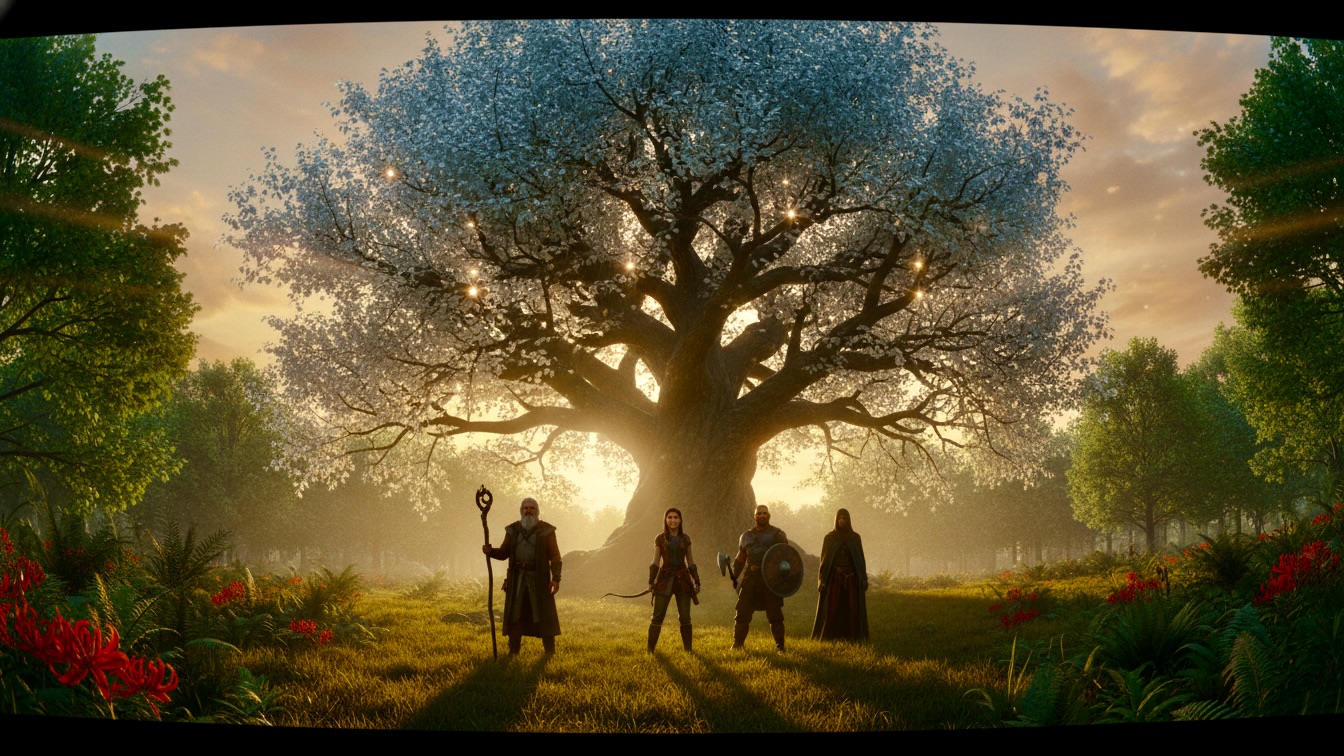
In the sweltering heat of a magical summer, a senior gardener struggles to maintain morale within a dying guild.
The heat did not just sit upon the land; it pressed down with the weight of a wet wool blanket. My knees, those old and unreliable hinges, gave a sharp pop as I knelt in the dust of the Outer Circle. It was mid-July, the height of the Great Bloom, but there was no blooming to be found. The ground was hard as sun-baked brick, and the air held a stillness that felt more like a threat than a reprieve. I reached out a hand, my fingers gnarled and stained with the green-black juices of a dozen different ferns, and touched the trunk of the Elder Oak. The bark was too warm. It should have been cool, a reservoir of deep-earth chill, but the fever of the season had finally reached the heartwood.
Running a guild like the Wardens of the Verdant Reach is not a task for the faint of heart, nor for those who expect quick gratification. It is a long, grinding labor. For thirty years, I have petitioned the High Council for more mana-wells. For thirty years, I have spent my winters hunting for venue-seeds and my summers begging for volunteers who do not mind the sting of the blood-gnats. We are a non-profit in the most literal sense; our only profit is the air the city breathes and the shade that keeps the commoners from boiling in their beds. But today, looking at the yellowed edges of the oak’s leaves, the finish line felt like it had been moved to another continent. The exhaustion was a physical thing, a grey sludge in my veins.
"The irrigation channels are bone dry, Silas," a voice called out. I didn't need to turn to know it was Mara. She was the one who kept our ledgers, a woman of sixty with a spine like a steel rod and a mind that could track a single drop of water through a thousand miles of root-systems. Her boots crunched on the parched grass as she approached. "The Council denied the emergency requisition. They say the city’s fountains are a priority for the upcoming festival. We are to wait until the autumn rains."
I stood up slowly, leaning my weight onto my staff. "Wait? They ask the forest to hold its breath for three months? That is not a request; it is a death sentence. Do they not see the irony? They want a festival to celebrate the summer, yet they starve the very trees that make the summer bearable." I wiped sweat from my forehead with the back of my hand. The salt stung my eyes. We were wading through deep water here, except the water was made of bureaucracy and heat-stroke. Every grant application we had sent out this spring had come back with the same polite, soul-crushing rejection. 'A worthy cause,' they said, 'but our focus has shifted to the urban expansion.'
"We are losing them, Silas," Mara said, her voice dropping its formal edge for a moment. She looked tired. Not just 'end of the day' tired, but 'end of a decade' tired. "The volunteers are quitting. Young Julian says his hands are too blistered to weave the sun-catchers anymore. He wants to go work for the stonemasons. They have shade and steady pay. We are asking people to give their lives to a cause that looks like it's turning to dust."
I looked at her, really looked at her. The lines around her eyes were deeper than they had been a month ago. We were the seniors of this guild, the ones who remembered when the Verdant Reach was a lush, vibrant lungs for the world. If we let the fatigue win, the whole mission would collapse. I had to find a way to pivot. We couldn't keep staring at the brown hills and the empty cisterns. We needed to see something else.
"Come to the workshop," I said, my voice sounding more certain than I felt. "Gather the others. Julian, Stefi, everyone. We are stopping for the day."
"Stopping? Silas, if we don't finish the mulch-layering by sundown, the northern saplings will be gone by morning," Mara countered, her brows knitting together in confusion.
"They will be gone anyway if we are too exhausted to stand," I replied. "The mulch can wait an hour. The people cannot. We are going to change the focus. We are going to look at what we actually have, rather than what the Council has stolen from us."
I led her back toward the central hub, a modest structure of woven willow and living stone. Inside, the air was slightly cooler, though it still felt thick and heavy. The workshop was a mess of half-finished projects. There were sun-catchers made of dried vines that refused to hold their shape, and jars of soil supplements that were more sand than magic. Julian was there, sitting on a bench, his head in his hands. He was barely thirty, but in this light, he looked like an old man. His palms were wrapped in stained bandages, the smell of bitter aloe and damp cloth clinging to him.
"Listen up," I said, striking the floor with my staff. The sound echoed in the quiet room. "I know the heat is a monster. I know the Council are fools. But we are still here. And I want to know one thing that went right today. Just one. I don't care how small it is."
Julian looked up, his expression skeptical. "Right? Silas, the well is dry. My hands are ruined. What could possibly have gone right?"
"Did you finish the grafting on the silver-leaf?" I asked, stepping closer to him.
He hesitated. "I mean, yes. It took four hours, and I had to use my own blood to seal the bond because the resin ran out, but it’s holding. For now."
"Then that is a win," I said firmly. "Mara, give me a piece of the white slate from the back room. We are starting a record. Not of our debts, and not of our failures. A record of the things that didn't break."
Mara stared at me for a long beat, her mind clearly weighing the practicalities against the psychological need. Finally, she nodded. She went to the back and returned with a large, flat piece of white stone and a charcoal stick. I took the charcoal and wrote in large, bold letters at the top: THE STANDING VINES. Below it, I wrote: 'Julian’s silver-leaf graft holds.'
"There," I said. "The first mark. Who else?"
Stefi, a quiet woman who spent most of her time in the seed-vaults, spoke up from the shadows. "I found a cache of fire-lilies that hadn't sprouted in five years. They broke the surface this morning. Just two of them, but they’re red. Bright red."
I added it to the board. 'Fire-lilies return.'
The atmosphere in the room didn't change instantly. The heat was still there, and the grey weight of our situation hadn't lifted. But the silence changed. It was no longer the silence of defeat; it was the silence of people looking for a memory of success. We spent thirty minutes just talking—not about the grants or the water or the Council, but about the specific way a certain leaf turned toward the light, or the fact that the local bakery had sent over a basket of day-old bread for the volunteers. These were tiny sparks, but in a world that was catching fire, a spark of the right kind was everything.
The following morning brought no relief from the sun. It rose like a copper coin, dull and hot, casting long, distorted shadows across the courtyard. My back was a roadmap of aches, and each step felt like I was dragging a heavy chain through the sand. I made my way to the irrigation hub, hoping against hope that some miraculous dew had collected in the basins overnight. There was nothing. Only a few dead beetles and a layer of fine, grey dust.
I found Mara there, her hands deep in the mud of the primary intake valve. She was trying to clear a blockage, her face streaked with dirt. "It's the silt," she muttered, not looking up. "Without the pressure from the upper springs, the whole system is just choking on itself. We need a high-pressure burst of mana to clear it, but we’ve used our monthly quota. If I tap into the emergency reserves, the Council will have my head on a pike by Tuesday."
"The Council is a hundred miles away in an air-conditioned palace," I said, kneeling beside her. My joints groaned in protest. "Let them come. We cannot let the heart of the Grove starve because of a ledger. What is the status of the reserve?"
"We have three units left," she said, finally pulling her hands back. They were shaking. "Three. That’s barely enough to keep the nursery alive for a week. If we use one now to clear the pipes, we’re gambling that the rain will come early. And look at that sky, Silas. That is not a rain sky. That is a sky that wants to see us burn."
I looked up. She was right. The blue was so intense it looked white at the horizon, devoid of any moisture. It was a cruel, beautiful thing. "We are not gambling on the rain," I said. "We are gambling on our own ability to keep this mission moving. Clear the pipes, Mara. I’ll take the heat for it. If they want to audit us, I’ll show them the dead wood and ask them to explain the math of their negligence."
She looked at me, a flicker of something—maybe respect, maybe just shared desperation—crossing her face. "Fine. But if we run out by Friday, you’re the one who has to tell the volunteers we’re closing the gates."
"I’ve told people worse things," I lied. I hadn't. Closing the gates would be the end of everything I’d built. It would mean the forest would revert to a wild, unmanaged state, or worse, it would simply wither away into a graveyard of grey timber.
As she worked the valve, I felt a sudden, sharp pang of guilt. I was pushing her, pushing everyone, because I didn't know how to do anything else. When you reach my age, the work isn't just what you do; it’s who you are. If the Guild failed, I wasn't just losing a job; I was losing my identity. I was becoming a relic in a world that didn't care about the old ways of shaping and growing.
"Done," Mara said, her voice tight. A low, rhythmic thrumming began to vibrate through the stone floor. It was the sound of mana being spent, a precious, shimmering energy that we were now burning just to stay at baseline. A few moments later, a gurgle echoed from the pipes, and a thin, brown stream of water began to trickle into the basin. It wasn't much, but it was movement.
"It’s a start," I said.
"It’s a very expensive start," she replied. She stood up, wiping her hands on her apron. "I’m going to go check on the nursery. Julian is there trying to keep the seedlings from wilting. He’s... he’s struggling, Silas. He doesn't have the callouses we do. Not on his hands, and certainly not on his spirit. He sees every dead leaf as a personal failure."
"I’ll talk to him," I said. "He has talent. His eye for the way the grain flows... it’s better than mine was at his age. He just hasn't learned that the forest is a slow conversation. You can't win the argument in a single day."
I walked toward the nursery, my shadow a dark, stunted thing on the ground. The heat was intensifying, the air shimmering over the parched beds. I found Julian hunched over a tray of glow-moss. He was trying to sing to it—a low, melodic hum that was supposed to stimulate growth—but his voice was cracked and dry. The moss was a sickly shade of grey, its natural luminescence gone.
"You’re pushing too hard, Julian," I said softly, coming up behind him.
He jumped, nearly knocking over the tray. "I have to save it, Silas. If the moss dies, we can't light the paths for the night-bloom tour. That’s our biggest fundraiser. If we lose that money, we’re done."
"The moss doesn't care about the fundraiser," I said, sitting down on a crate. "It cares about the vibration of your voice. And right now, you sound like a man who is terrified. The moss can feel that. It’s a parasite for your anxiety. Take a breath."
He slumped, his shoulders dropping. "How do you do it? How do you stay so calm when everything is literally dying around us?"
"I’m not calm," I said. "I’m just old. I’ve seen the forest die three times in my life. And I’ve seen it come back three times. It’s a cycle, Julian. A brutal, uncaring cycle. Our job isn't to stop the sun. Our job is to be the ones who are still standing when the sun finally goes down."
He looked at his bandaged hands. "I don't know if I have the bandwidth for this anymore. I see the guys I went to school with building stone towers in the city. They have air conditioning. They have weekends. I have blisters and a sense of impending doom."
"You also have the ability to make a silver-leaf graft hold in a hundred-degree heat," I reminded him. "That isn't a job. That’s a vocation. Those guys in the city? They’re building boxes. You’re building a world. There is a difference."
He didn't look convinced, but he didn't leave. He went back to his humming, a bit slower this time, a bit more deliberate. I watched him for a moment, feeling the grey weight of my own fatigue. I wanted to tell him it gets easier, but that would be another lie. It doesn't get easier. You just get better at carrying the weight.
By the end of the week, the 'Win Board' had become a fixture in the workshop. At first, it was just Mara and me making entries, but slowly, the others began to contribute. It was a strange, desperate collection of successes. 'The north-east drainage pipe is 10% clearer.' 'The local grocer donated three crates of slightly bruised peaches.' 'A family of blue-jays moved back into the hollow elm.'
On Friday afternoon, the heat peaked. The thermometer in the shade read 104 degrees. We had reached a point where physical labor was no longer possible. We sat in the workshop, the air heavy with the smell of dry dust and the faint, metallic tang of the mana-pumps. We were sharing the bruised peaches, the juice sticky and sweet on our chins. It was the first time in weeks I’d seen anyone smile.
"We reached the internal milestone for the southern trellis," Mara announced, looking at her clipboard. She looked slightly less like a drill sergeant today. "The structure is 100% stabilized. Even if the vines don't grow another inch this summer, the framework is there for next year. That’s a phase-one completion."
"That deserves more than a mark on the board," I said, standing up. "Julian, go get the small cask of fermented honey-water from the cellar. We’re taking thirty minutes. No work. No talk of the Council."
"Silas, we really should be checking the mulch..." Stefi started, but I cut her off with a wave of my hand.
"The mulch is not going anywhere, and neither are we. We are celebrating the trellis. It’s a victory. We set a goal, and we hit it, despite the sun trying to melt our skin off. That matters."
We sat in a circle on the floor, passing around the small cups of honey-water. It was cool and sharp, cutting through the thick heat of the room. For a few minutes, the 'treadmill' feeling—the sense that we were running as fast as we could just to stay in the same place—seemed to dissipate. We talked about the history of the trellis, about the time ten years ago when a storm had knocked the whole thing over and we’d had to rebuild it from scratch in a downpour.
"I remember that," Mara said, a rare laugh bubbling up. "Silas was covered in mud from head to toe, screaming at the wind like it was a personal enemy. You looked like a swamp monster."
"The wind was being particularly unreasonable that day," I defended myself, grinning.
Julian laughed too, a real, honest sound. "I can't imagine you screaming at anything, Silas. You’re always so... composed."
"That’s just the stiffness in my joints," I said. "It’s hard to be theatrical when your hips are locked in place."
The conversation shifted to individual talents. I took the opportunity to point out Stefi’s work in the seed-vault. "You have a way with the dormant spirits, Stefi. Most people would have given up on those fire-lilies. You knew exactly which frequency of light they needed. That wasn't luck. That was your eye for the subtle shifts in the soil."
She flushed, her face turning a deep shade of pink. "I just noticed the temperature was slightly higher near the ventilation shaft. It wasn't a big deal."
"It saved a species from local extinction," I countered. "It’s a very big deal. And Julian, your work with the silver-leaf? I’ve seen masters in the capital who couldn't have made that graft take in these conditions. You have a touch for the living grain that can't be taught. You need to know that your presence here is necessary. Not just as a set of hands, but as a shaper."
Julian looked down at his cups, but his jaw wasn't as tight as it had been. "Thanks, Silas. I... I appreciate that. It’s easy to feel like a failure when the results are so slow."
"Progress is usually slow," I said. "The forest doesn't grow in a day. Why should our success be any different? We are a group that is consistently winning small battles. If we keep that in mind, the big challenges—the Council, the drought, the funding—they don't look like mountains anymore. They just look like the next stretch of road."
The energy in the room had shifted. It wasn't that the problems were gone, but our perception of ourselves had changed. We weren't a group of struggling failures anymore. We were a team of specialists who were managing to keep a living ecosystem alive in the middle of a literal furnace. We were winners of the small things.
As the sun began to dip lower, casting long, orange bars of light across the workshop floor, I felt a sense of clarity I hadn't possessed in months. The heat was still oppressive, and my knees still hurt, but the grey weight had thinned. We were no longer wading through deep water; we were navigating a river. It was still dangerous, and it was still exhausting, but we knew how to swim.
"Alright," I said, setting my cup down. "The thirty minutes are up. Back to the mulch. But let’s keep that board in mind. I want three new entries by sundown tomorrow."
They stood up with a bit more spring in their steps. Even Mara seemed to move with less of a heavy tread. I stayed behind for a moment, looking at the white slate. It was covered in charcoal marks, a messy, beautiful ledger of survival. It was the most important thing we’d grown all summer.
The change didn't happen with a thunderclap. There was no sudden storm to break the heat, no miraculous decree from the Council granting us unlimited mana. The change happened in the quiet, in the way the air felt at four in the morning when the world was at its most fragile.
I was out in the North Grove, checking the moisture sensors I’d installed near the base of the weeping willows. The earth was still dry, but it wasn't dead. There was a resilience in the soil, a structural integrity that hadn't been there a week ago. The mulch-layering had worked. It had trapped what little moisture we’d managed to pump through the system, creating a micro-climate of survival around the most vulnerable roots.
I reached the silver-leaf tree that Julian had grafted. In the pre-dawn light, its leaves were a dull, metallic grey. But as I leaned in, I saw it. A single, tiny bud, no bigger than a fingernail, was forming at the junction of the graft. It wasn't supposed to bloom until spring. The stress of the heat, combined with the power of Julian’s seal, had triggered a survival response. It was beautiful. It was a defiance.
I didn't touch it. I didn't want to disturb the delicate balance of its growth. I just stood there, my breath hitching in my chest. This was the 'massive end goal' in miniature. This was why we did it. Not for the gala or the opening ceremony, but for the moment when the life we’d tended decided to fight back.
I made my way back to the workshop, my pace faster than it had been in years. I found the team already there, preparing for the day’s labor. They were talking quietly, the tension that had defined our interactions for months replaced by a focused, professional hum.
"Julian," I called out, my voice booming in the small space. "Come with me. Now."
He looked startled, dropping a coil of twine. "What happened? Is something dead?"
"Just come," I said.
I led the whole group back to the North Grove. We walked in silence, the air starting to warm as the sun climbed above the horizon. When we reached the silver-leaf, I pointed to the bud. "Look."
Julian knelt in the dust, his eyes widening. He reached out a trembling hand, stopping just short of the leaf. "It’s... it’s pushing through. I thought the graft would just barely survive. I didn't think it would thrive."
"It’s thriving because you gave it exactly what it needed when it was at its weakest," I said. "This is your win, Julian. This is what you brought to the table."
Mara stepped forward, her face softening. "It’s a sign. The forest is responding to us. We aren't just maintaining it anymore. We’re leading it."
"We are," I agreed. "And that brings me to our next phase. We’ve spent the summer playing defense. We’ve been huddled in our workshop, counting our drops of water and praying for rain. But look at this. If a silver-leaf can bloom in 104 degrees, then we can do more than just survive. We’re going to take the fight to the deeper woods. We’re going to implement the new atmospheric-capture technique we discussed last winter."
"Silas, that requires a massive amount of physical coordination," Stefi said, though she didn't sound dismissive. She sounded curious. "We’d have to be in the canopy for six hours a day."
"Then we’ll do it in shifts," I said. "We’ll use the win board to track our progress. We’ll celebrate every single capture-vane we install. We’ve proven we can win the small battles. Now, it’s time to start winning the war for the Grove’s future."
I looked around at them. They weren't the same people they had been at the start of the summer. They were leaner, certainly, and their skin was tanned and toughened by the sun. but their eyes were different. The 'grey weight' had been replaced by a sharp, clear light. They perceived themselves as winners now. And in this business, perception is the only reality that matters.
"We have a lot of work to do," Mara said, her hand going to her hip in that familiar, authoritative way. "If we’re going into the canopy, I need to recalibrate the safety harnesses. And we’ll need more of those peaches. A lot more."
"I’ll handle the harnesses," Julian said, standing up. He looked at the silver-leaf bud one last time, a small, proud smile on his face. "I know a way to weave the straps so they don't chafe. It’s a technique I saw in the city, but I think I can adapt it for living wood."
"Do it," I said. "We start at noon."
As they headed back to the workshop, I stayed behind for a moment. The sun was fully up now, a bright, unrelenting orb in the sky. It was going to be another brutal day. My knees were already starting to throb, and the air was beginning to shimmer with heat. But for the first time in a long time, I didn't feel like I was drowning. I felt like I was exactly where I was supposed to be.
I reached into my pocket and pulled out a small piece of charcoal I’d taken from the workshop. I walked over to a smooth, flat stone near the base of the silver-leaf and wrote a single word in bold, black strokes: HOPE.
It wasn't a policy, and it wasn't a grant, and it certainly wasn't a solution to the drought. But as I watched the team disappear into the trees, their voices carrying back to me on the hot wind, I knew it was the only thing that would keep us moving toward that finish line, however many miles away it might be.
I turned and followed them, my staff striking the hard earth with a steady, rhythmic beat. We had a canopy to climb, and a world to save, and I wasn't about to miss a single minute of it. The marathon was far from over, but we had found our stride.
“I looked up at the towering canopy we were about to claim, and for the first time, the height didn't terrify me.”


